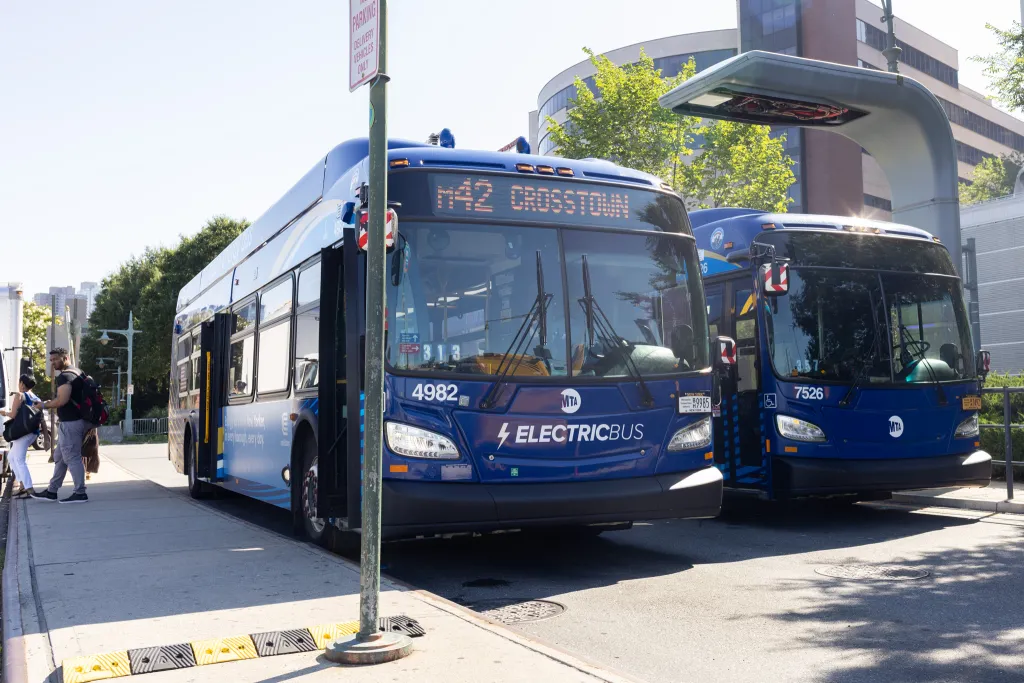
The MTA’s plan to convert to a zero-emissions bus fleet by 2040 has hit enough roadblocks that the target date is “in jeopardy” of not being met, a new report from New York state’s top fiscal watchdog warns.
The audit from state Comptroller Thomas DiNapoli comes after the MTA acknowledged in June that it had to pump the brakes on ordering hundreds of electric buses because of reliability shortfalls with the green technology.
“The electric buses that we have tested so far have not been up to standards. They break down too frequently,” Janno Lieber, MTA chairperson and chief executive, said Wednesday at an unrelated news conference. “We have put the manufacturer on notice and in order for us to continue purchasing electric buses, we need that reliability standard to be met.”
The 28-page report from DiNapoli’s office notes the MTA committed in 2018 to make its entire fleet of nearly 6,000 buses emissions-free in a little more than two decades, but flags several challenges that could put the 2040 goal out of reach.
The transportation authority has previously estimated the ambitious undertaking of replacing all of its buses could cost close to $12 billion — and require enough power to light up nearly 200,000 homes.
Electric buses first hit city streets in 2018, on the M42 and M50 routes in Manhattan and the B32 route between Williamsburg and Long Island City.
“The MTA has set an ambitious goal to transform the nation’s largest bus fleet to 100% zero-emission,” DiNapoli said in a statement Wednesday. “Unfortunately, this audit identified multiple challenges that have put its 2040 target in jeopardy.”

‘An Industrywide Problem’
The audit cites obstacles including surging costs for electric buses as well as the transportation authority’s reliance on a single manufacturer with limited capacity and a backlog of orders from the MTA and other transit providers. The comptroller’s office noted how the $1.8 million cost of a single articulated bus — the type that bends in the middle — is about 60% more than a diesel bus of comparable size.
The audit also flagged that 75 electric buses in the MTA’s fleet have been in service significantly less than had been projected.
“The [battery-electric buses] at five depots were only able to be put into service less than 60% of the time the MTA anticipated,” the audit said.
Jessie Lazarus, MTA chief of rolling stock, acknowledged as much in June at a board meeting where she outlined how the electric buses now in use have proven less reliable than clean-diesel buses in their first years in operation.
“It’s not unique to the MTA, this is an industrywide problem,” she said at the time. “And that also doesn’t mean that we’re shying away from trying to do something about it.”
Lieber said Wednesday that the transit agency is looking to make use of other low-emissions options, including compressed natural gas, hybrid and low-emissions diesel buses.
“We are on track to improve emissions and we are committed to maintaining the rapid progress on that,” he said. “But it does depend on, ultimately, the electric buses or hydrogen — which we’re also testing — panning out.”

‘NY Should Lead the Path Forward’
The challenges with shifting to a zero-emissions fleet extend beyond service reliability. A 2020 report from the nonprofit Tri-State Transportation Campaign cited how thousands of MTA buses are stored in neighborhoods with “very high,” “high” or “moderate” risk of flooding, according to 2050 flood projections.
Lieber said electrification efforts are ongoing at several locations, including the Jamaica and Grand Avenue bus depots in Queens and the East New York depot in Brooklyn.
“We’re going to continue to get ready, assuming that these electric buses are in fact eventually going to be proven and meet the reliability standards that we require,” he said.
Danny Pearlstein, policy director for the nonprofit Riders Alliance, said the MTA is far from the only transit agency having issues with electric buses. More than 1.1 million riders use MTA buses daily, according to transportation authority data.
“It’s not just a New York problem by any stretch of the imagination, but New York should lead the path forward because more riders here depend on buses,” Pearlstein told The City Reporter. “The U.S. has fallen far behind and the current federal government’s commitment to stranding riders and burning fossil fuels adds insult to injury.”
Our nonprofit newsroom relies on donations from readers to sustain our local reporting and keep it free for all New Yorkers. Donate to THE CITY today.
The post MTA’s 2040 Goal for Zero-Emissions Bus Fleet Is ‘In Jeopardy,’ NY Comptroller Says appeared first on The City Reporter.
