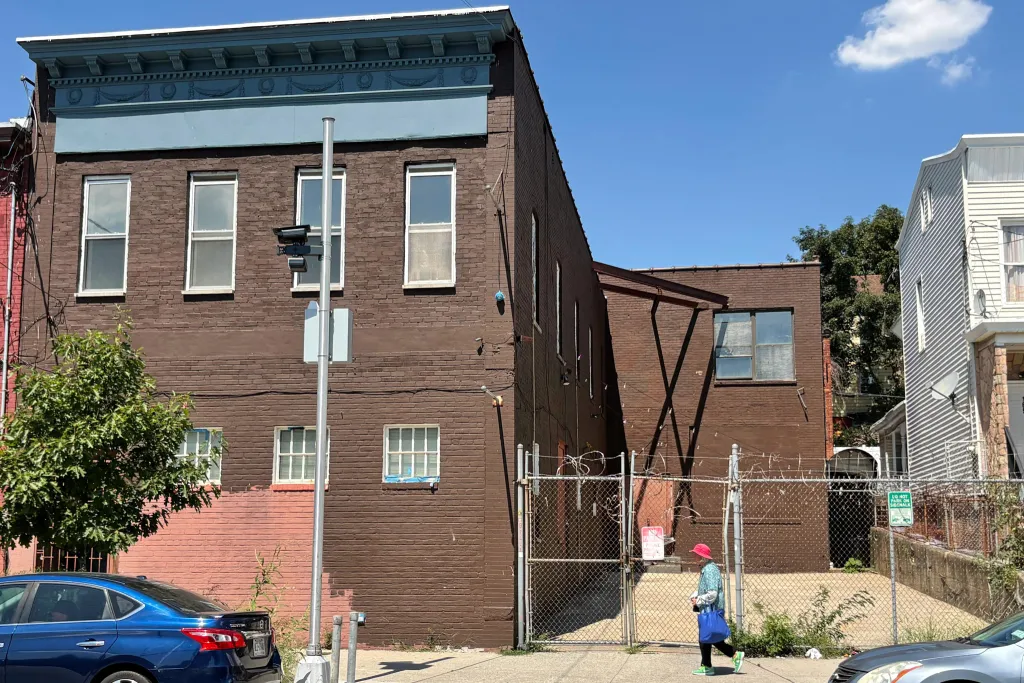
Debra Ack beamed with pride as she looked at the two-story brown brick warehouse on Jamaica Avenue in East New York.
To anyone passing by, the vacant 9,500-square-foot building looks like any other lot in a neighborhood known for its mix of industrial sites and residential homes. The building itself has been home to an event space for graduation parties and birthdays, and has had at least four different owners in its 95-year history, according to city records.
But pretty soon it is set to become the East Brooklyn Liberation Center, a new multipurpose community center that will serve as an anchor for local organizations like Preserving East New York and the East Brooklyn Archives, and a business hub for local businesses and worker co-ops.
“This space means everything, especially to me because I’m always telling people about ownership,” Ack, special projects coordinator at the East New York Community Land Trust, told The City Reporter.
In addition to the communal space, the center will double as the main office of the land trust, a membership-based grassroots group organizing for community ownership of housing and removing neighborhood land from the private market.

The nonprofit’s purchase of the $2.3 million building is historic, the first time that a New York City community land trust has acquired commercial property off the open market, rather than from the government or a non-profit.
Ack, who has lived in East New York for nearly 30 years, said the group’s recent purchase speaks to its larger mission of ensuring residents have a stake in their neighborhood.
“It helps us build our organization,” Ack added. “We want the community to be able to purchase land. Everywhere you look, it’s a high-rise and more high-rises. It’s liberating the land in East New York, returning it back into the hands of the community.”
MORE: Inside NYC’s K-Shaped Economy: A Few Do Well, Most Do Not
The majority of residents in East New York are Black or Hispanic, according to data from the NYU Furman Center, making up 81% of the neighborhood’s population. The neighborhood’s population has grown 33% over the last 25 years, to more than 196,000.
While the neighborhood is growing overall, more and more Black residents are leaving, with at least a 10% decline since 2010.
That drop echoes citywide declines in Black residents: 288,564 Black New Yorkers left the city from 2000 to 2024, according to census data.
What Is a Community Land Trust?
The first community land trust was founded in 1969 in Albany, Georgia, to support Black farmers who were being pushed off their land at the height of the Civil Rights Movement.
Now there are more than 200 community land trusts across the U.S., 20 of them in NYC. The city defines community land trusts as nonprofit organizations that own and steward land to provide affordable housing and other public benefits into perpetuity.
They also work with the city’s Department of Housing Preservation & Development to “enforce affordability requirements, ensure fairness, and empower residents.”
In short, the trusts work to bring land into community ownership, making sure it’s developed and used in a way to benefit the people who live there, according to Deyanira Del Rio, executive director of the New Economy Project.
“It’s a really flexible model, but the point is really about neighborhood self-determination,” Del Rio said. “It’s about permanent affordability and it’s about treating land and housing as things that should be for the common good and not for extractive profit.”
The East New York trust is five years old and has already made an impact. In 2024, the group was the first community land trust in NYC to buy a multi-family apartment building from a private landlord.

The rent-stabilized 21-unit building on Arlington Avenue in Cypress Hills is still being converted to a democratically shared co-op, according to East New York CLT president Boris Santos. “The nonprofit would have the title to the land, [and] lease it out to the tenants, who will also be shareholders of the property.”
Amid rising rents and declining affordability, Santos said the group’s commercial and residential buys are a sign of hope.
“When you think about the history of organizing and advocacy, especially in the U.S. and when it comes to a predominantly Black and brown community, and you have an affordability crisis that’s being highlighted now, so — more than ever — we are that hope,” Santos said.
East New York and Cypress Hills rank among the neighborhoods where residents have the greatest danger of dislocation, according to the city’s displacement risk map, which was last updated in July 2025.
MORE: Wait, How Much? Manhattan and Brooklyn Rents Hit Record Highs
As a resident and organizer, Santos said he recognized a shift in the community following passage of former Mayor Bill de Blasio’s 2016 East New York Rezoning Project, which spurred the building of 6,500 housing units and high-rise buildings along Atlantic Avenue.
But he said more needs to be done, which is why the East New York land trust is pushing to close the gap.
“All mayors have an ambitious ‘I want to create housing under a housing crisis,’ but I don’t believe in creating housing. I believe in creating homes,” Santos said.
“There’s a difference, because housing is just shelter,” he said. “A home is safety. There’s also a dearth of spaces for communal gatherings, and I think that’s where the city fails.”
Help From Their Friends
To purchase the plot, the East New York land trust initially put down $230,000 as a deposit, according to organizers.
The rest of the money was raised through multiple revenue streams, including donations, elected officials like state Sen. Julia Salazar, who committed $1 million, and working with groups like Resource Generation, a nonprofit group of young people with access to wealth that supports social causes. Organizers said Resource Generation helped them raise around $250,000.
Del Rio said The New Economy Project also co-underwrote a $650,000 acquisition loan with The Working World, a nonprofit that provides loans to worker co-ops.
“We were able to meet the fast timeline that the CLT needed with the seller,” Del Rio said.
“There’s growing interest in this work, and there’s a lot of support that the CLT movement has generated among individuals that want to support these kinds of purchases, like foundations which have program-related and mission-related investing,” he said.
MORE: Mamdani Administration Says NYC Needs 700,000 New Apartments
In search of an easier pathway for community land trusts to buy properties, organizers are pushing for the Community Opportunity to Purchase Act, which would give the trusts and nonprofits first dibs on distressed multifamily properties — buildings up for foreclosure due to unpaid fines or an excessive number of violations — when they are put up for sale.
East New York has at least 46 properties, holding 1,152 apartments, that would qualify, according to an analysis by The City Reporter, with most located in the New Lots section.
The bill is one of two pieces of legislation the Mamdani administration supports in its housing plan, and it is on track to be calendared in September, according to City Councilmember Sandy Nurse, who represents Bushwick, Brownsville, Cypress Hills, and East New York.
The bill passed in the City Council last year, but Mayor Eric Adams vetoed it in his last few weeks in office. Nurse, the bill’s author, moved to revive it earlier this year.
“We were only short a single vote” to override the veto, “so it’s not like it wasn’t good, but we’ve used the time to hone in on it even more just to make sure everything is crystal clear given the amount of opposition that will come to it, mainly because there are a lot of people who don’t want any intervention in the market,” Nurse told the City Reporter.
She also said her office is working with the city’s Housing and Preservation Department to make sure “all i’s are dotted, and t’s are crossed.”
Similar laws have been implemented in San Francisco, San Diego, Chicago, Philadelphia, and Washington, D.C., according to Policy Link.
Tough Economics
Kenny Burgos, CEO of New York Apartment Association, argues the bill won’t address the housing market’s largest issue, ever-increasing operational maintenance costs.
“We have no fundamental disagreement with tenants’ ability to purchase buildings,” Burgos said. “But it is not going to change the finances. These tenants will find themselves either raising the rent on their own property, on their own neighbors, or the city will step in with millions if not billions in public bailout dollars.”
Nurse said she’s seen across her district how fast investment firms and LLCs are buying property. “You have to go through layers and layers to figure out who owns these buildings and it’s just a commodity to these purchasers,” she said.

Under the proposed law, owners would notify the housing department about their intent to sell their property. Interested housing groups or nonprofits would have 20 days to submit a letter of interest giving them the first opportunity to purchase the property.
The groups would then have 70 days to submit an offer to buy the property with the owner barred from selling to other interested buyers.
“We want to create a small window of time where we can slow down a transaction and allow good faith organizations to bid on it and those organizations are then subject to affordability requirements and preservation requirements,” Nurse said.
“It keeps the rents low, it gives the same people in the building opportunities to get their units renovated, rehabilitated, and potentially on a pathway to ownership. It’s like the golden egg,” she said. “Who has that in New York?”
Our nonprofit newsroom relies on donations from readers to sustain our local reporting and keep it free for all New Yorkers. Donate to THE CITY today.
The post East New York Residents Try Buying Back Their Neighborhood, One Lot At a Time appeared first on The City Reporter.