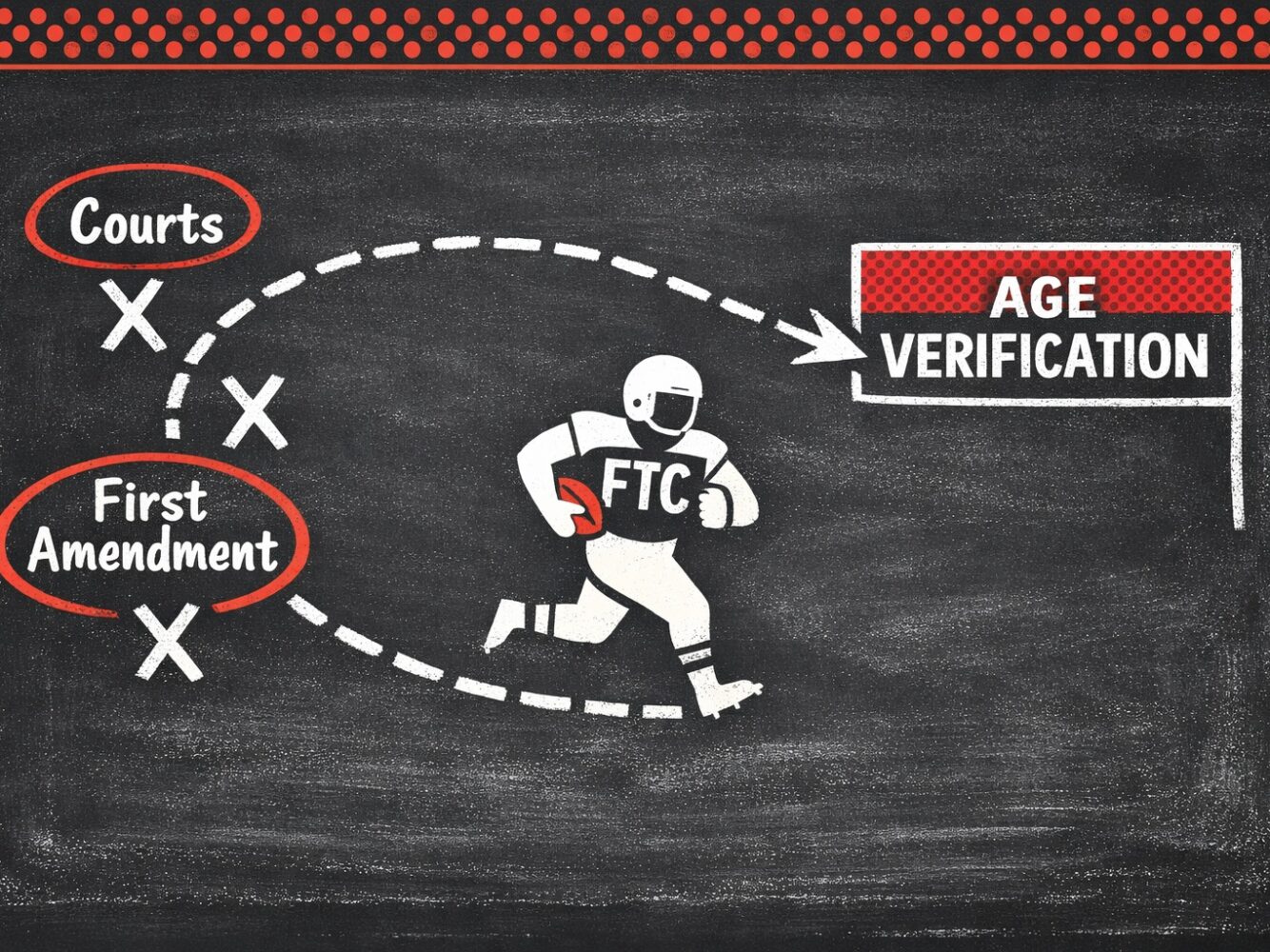
The Federal Commerce Fee (FTC) has a brand new plan to “defend youngsters on-line.” It begins by enjoyable enforcement of the very privateness legislation designed to guard them.
In a brand new enforcement coverage assertion on the Kids’s On-line Privateness Safety Act (COPPA), the FTC indicators that it’s going to decline to pursue enforcement actions in opposition to firms that gather private info for age-verification functions earlier than acquiring verifiable parental consent (VPC). In impact, the company is inviting firms to collect further information—together with from youngsters—in an effort to decide customers’ ages.
That transfer sits uneasily with COPPA’s statutory design. It additionally displays a broader coverage shift: reasonably than mandating age verification instantly, the FTC seems to be encouraging it not directly by way of selective non-enforcement.
When the Courts Say No, Strive Coverage Statements
Throughout the nation, federal courts have repeatedly struck down state age-verification mandates on First Modification grounds, whether or not geared toward social-media platforms or app shops. These legal guidelines could also be properly intentioned, however courts have concluded that they impose unconstitutional obstacles to accessing lawful info on-line.
As I’ve noticed beforehand, the shift in technique by age-verification advocates has been evident for a while:
The combat has shifted. Lawmakers have moved their focus from social-media platforms to app shops. However the fundamental drawback hasn’t modified: the First Modification nonetheless stands in the best way.
By now, the sample is obvious. Courts have held that age-verification and parental-consent mandates for social media limit minors’ entry to lawful speech and fail constitutional scrutiny as a result of they don’t make use of the least-restrictive means.
Courts have additionally pointed to these less-intrusive options. Mother and father and youths can depend on device-level controls, platform instruments, and different user-managed safeguards to handle on-line dangers with out requiring each consumer to confirm their age merely to entry lawful speech.
Justice Brett Kavanaugh made this level specific when reviewing the Supreme Court docket’s First Modification precedents, together with Free Speech Coalition. As he defined, “[g]iven these precedents, it’s no shock that the District Court docket in [NetChoice, LLC v. Fitch] enjoined enforcement of the Mississippi legislation and that seven different Federal District Courts have likewise enjoined enforcement of comparable state legal guidelines.”
The FTC now seems to be pursuing a distinct path to the identical goal. The fee’s COPPA Enforcement Coverage Assertion references the wave of state legal guidelines requiring age verification however doesn’t acknowledge that lots of these legal guidelines have been enjoined or stay below lively constitutional problem.
The timing is notable. Having struggled to enact age-verification mandates that survive First Modification scrutiny, policymakers now look like encouraging the identical end result by way of regulatory non-enforcement.
That technique is probably not unconstitutional. It nonetheless raises critical issues. The company seems to be utilizing regulatory discretion to realize what Congress has not enacted—and in a method that cuts in opposition to COPPA’s core privateness protections.
COPPA Has No Pre-Consent Clause
COPPA’s rule is easy: operators should get hold of verifiable parental consent earlier than gathering private info from a toddler below 13. The statute accommodates no exception that permits firms to gather information first in an effort to decide whether or not a consumer is a toddler.
That distinction issues. COPPA regulates the gathering of youngsters’s information; it doesn’t operate as a normal age-verification statute. Its companion laws, the Kids’s On-line Safety Act (COPA), did try to control entry to sure on-line materials by way of age verification. The U.S. Supreme Court docket in the end struck down COPA as a violation of the First Modification.
The FTC’s coverage assertion strikes COPPA nearer to that mannequin by way of enforcement discretion. The company declares it “is not going to convey an enforcement motion” in opposition to firms that gather private info for “Age Verification Functions” earlier than acquiring VPC.
That place sits uneasily with the statute’s textual content. COPPA requires parental consent earlier than gathering youngsters’s private info. By promising to not implement the rule when firms gather further information to confirm age, the FTC successfully invitations conduct the statute seems to ban.
The authorized footing for that invitation is skinny. The coverage assertion itself acknowledges its restricted authorized pressure, noting that “[t]his Enforcement Assertion doesn’t create any substantive rights or entitlements, and the Fee retains the correct to research and convey actions for violations of the COPPA Rule in particular person instances.”
The difficulty isn’t that the assertion itself is unconstitutional. The FTC isn’t mandating age verification, and enforcement discretion falls inside government authority. The priority is that the company seems to be utilizing non-enforcement to encourage the very coverage end result courts have repeatedly blocked when legislatures tried to impose it instantly.
The Gather-It-All Answer
The FTC argues that the coverage will “promote innovation” in age-verification expertise. In follow, it encourages a “collect-it-all” mannequin.
Dependable age verification usually requires biometric identifiers, government-issued IDs, or behavioral “age inference” indicators. To find out who is likely to be below 13, firms would seemingly gather such info from anybody who lands on a website.
That method reverses COPPA’s logic. The statute was designed to forestall the gathering of youngsters’s private info with out parental consent. Age-verification programs, against this, function by gathering info first and figuring out age afterward. In lots of instances, a toddler’s information could possibly be collected earlier than a mother or father even is aware of the kid visited the location.
The implications prolong past youngsters. As a result of age-verification programs should display each consumer to establish minors, they essentially gather details about adults as properly. What begins as a rule geared toward defending youngsters turns into broad-based information assortment affecting everybody on-line.
Massive-scale age-verification databases additionally create safety dangers. Even with “affordable safety safeguards,” repositories containing biometric identifiers, authorities IDs, or related indicators would current enticing targets for hackers.
The Lengthy Method Across the First Modification
The FTC’s method resembles a well-known regulatory maneuver. When courts reject direct mandates, companies typically pursue related objectives not directly—right here, by signaling that sure conduct is not going to set off enforcement.
Encouraging age verification by way of regulatory forbearance dangers reaching by way of coverage indicators what legislatures have repeatedly did not impose by way of legislation. On the identical time, the method undermines COPPA’s central safeguard: limiting the gathering of youngsters’s private info with out parental consent.
Congress ought to as an alternative revisit the difficulty instantly. Defending youngsters on-line is a vital goal, however insurance policies that increase critical First Modification issues whereas increasing information assortment are unlikely to outlive judicial scrutiny—or enhance privateness outcomes.
A extra sturdy method would empower mother and father, reasonably than develop surveillance. Instruments that permit households to regulate how and when minors share age-related info can deal with security issues with out requiring common age verification or testing constitutional limits.
