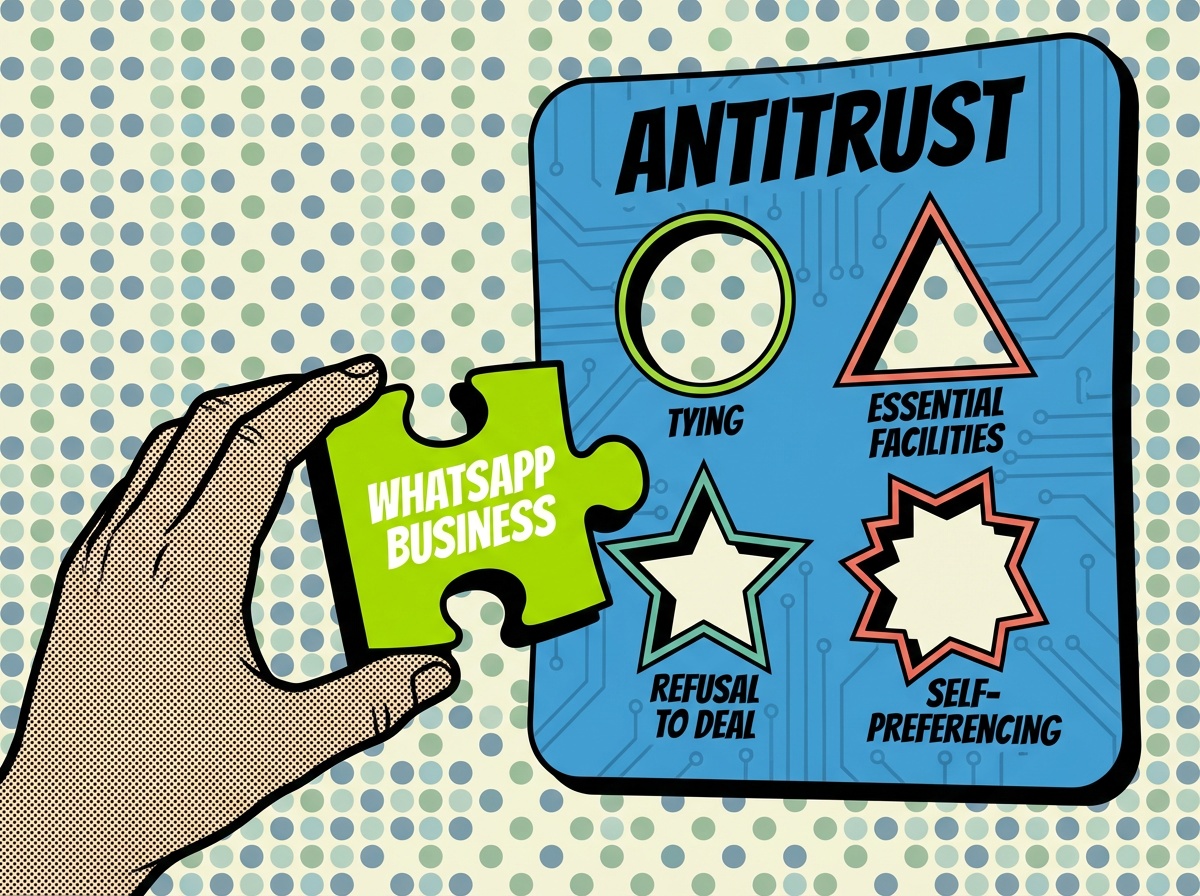
Meta’s resolution to restrict third-party AI entry to WhatsApp Enterprise has shortly drawn antitrust scrutiny throughout a number of jurisdictions. The Frequent Marketplace for Japanese and Southern Africa (COMESA) Competitors and Client Fee (CCCC) is the most recent authority to open an investigation. However earlier than the case can reply whether or not Meta’s conduct harms competitors, a extra primary query arises: what concept of hurt really matches the details?
The CCCC on Feb. 17 introduced an investigation into Meta Platforms Eire Ltd. for alleged abuse of dominance. The probe stems from Meta’s October 2025 modification to its WhatsApp Enterprise Resolution Phrases. These adjustments prohibit suppliers of general-purpose artificial-intelligence (AI) companies from accessing WhatsApp’s Enterprise Utility Programming Interface (API), whereas—in accordance with the fee—“preserving and preferentially integrating Meta’s personal AI service.”
The European Fee and Italy’s Autorità Garante della Concorrenza e del Mercato (AGCM) had already opened proceedings on the identical challenge. COMESA’s discover adopted, echoing these issues.
Competitors investigations of enormous expertise platforms have turn into routine. Routine scrutiny doesn’t, nonetheless, assure sound evaluation or procompetitive outcomes. The COMESA discover seems to use the flawed doctrinal normal—a mistake that would undermine the investigation’s intention of defending competitors and shoppers.
Even setting that error apart, the obtainable theories of hurt face critical obstacles on the present details. This submit examines these difficulties and asks whether or not any coherent concept in the end survives.
A Merger Take a look at in a Dominance Case
Probably the most fast downside with the COMESA discover is its normal of hurt. The investigation proceeds beneath Regulation 36 of the COMESA Competitors and Client Safety Laws 2025—the supply governing abuse of dominance. But the discover claims the conduct is “prone to considerably reduce competitors within the Frequent Market.” That could be a merger-control normal, not an abuse-of-dominance normal.
Some jurisdictions apply the substantial-lessening-of-competition (SLC) take a look at outdoors merger management. Australia and New Zealand achieve this for sure restrictive agreements, and the USA applies it beneath Part 3 of the Clayton Act. The COMESA rules themselves, although, present that policymakers selected to not apply the SLC normal in dominance circumstances.
Regulation 33, which governs restrictive agreements, explicitly adopts the SLC language. Regulation 36—addressing abuse of dominance—doesn’t. The SLC take a look at additionally seems nowhere in COMESA’s 2019 Abuse of Dominance Tips. The related query, subsequently, shouldn’t be whether or not conduct considerably lessens competitors, however whether or not it’s exclusionary or exploitative.
If the fee goals to develop a coherent and analytically sound physique of competitors legislation for digital markets, it should start with the right normal. Making use of the flawed take a look at from the outset dangers distorting the evaluation and undermining the investigation’s function.
Chasing the Antitrust Unicorn
The dominant concept of hurt recommended by COMESA’s discover is refusal to deal. The fee describes WhatsApp as “an important gateway [for artificial intelligence service providers] to entry their clients within the Frequent Market.” That framing factors towards an essential-facilities concept.
Labeling WhatsApp an important facility is notable as a result of the doctrine itself stays controversial. As Robert Bork and Gregory Sidak famously noticed:
The important services doctrine is the unicorn of antitrust legislation. Everybody is aware of what an important facility appears like, however treasured few have seen one within the flesh.
Courts have handled the doctrine cautiously. Some have averted endorsing it outright—most prominently, the U.S. Supreme Courtroom in Verizon Communications Inc. v. Legislation Workplaces of Curtis V. Trinko, LLP. Others acknowledge it solely beneath exceptionally slender circumstances, such because the Courtroom of Justice of the European Union in Oscar Bronner GmbH & Co. KG v. Mediaprint Zeitungs- und Zeitschriftenverlag GmbH & Co. KG, and the seventh U.S. Circuit Courtroom of Appeals in MCI Communications Corp. v. AT&T Co.
The place the doctrine applies, courts impose demanding standards. A claimant should present:
- The power is managed by the dominant agency;
- The power is exclusive or exceptionally troublesome—if not unattainable—to copy;
- Entry to the power is indispensable for rivals looking for to compete within the related market; and
- Denial of entry forecloses competitors in that market.
COMESA’s discover doesn’t but outline the related market—a prerequisite for any coherent abuse-of-dominance evaluation. Even when it did, establishing WhatsApp as an important facility within the COMESA area can be troublesome. Management and potential foreclosures is perhaps controversial. Demonstrating uniqueness and indispensability can be far tougher, given the vary of different communication platforms and distribution channels obtainable throughout COMESA member states.
Aspen’s Shadow
One other path for COMESA can be to comply with the method taken by the AGCM. In a November 2025 announcement increasing its investigation into Meta’s integration of Meta AI into WhatsApp, the AGCM relied on language drawn from the European Courtroom of Justice’s (ECJ) Google Android Auto resolution:
Denying entry to a digital infrastructure initially developed by a dominant firm not solely for the wants of its personal actions, however with a view to permitting third-party firms to make use of that infrastructure, as is the case with the WhatsApp platform, is abusive when it has the precise or potential impact of excluding, hindering, or delaying the market growth of a services or products that’s, no less than doubtlessly, in competitors with a services or products offered or that may be offered by the dominant firm, and constitutes conduct that limits competitors on the deserves, doubtlessly inflicting hurt to shoppers. [Translated in part using Google Translate.]
The Google Android Auto case arose from a criticism by Enel X Italia, the developer of the electric-vehicle (EV) charging app JuicePass. The app permits EV drivers to find and handle charging stations. Enel X sought to make JuicePass obtainable by way of Android Auto, Google’s in-car interface that mirrors smartphone apps on a car’s dashboard show.
On the time, Google permitted solely sure classes of apps—equivalent to navigation and messaging—by way of standardized templates. It declined to supply a template that might permit EV-charging apps to run on Android Auto. JuicePass subsequently couldn’t function on the platform, regardless that Google’s personal companies, equivalent to Google Maps, remained accessible.
In paragraph 49 of its resolution, adopting the opinion of Advocate Common Laila Medina, the ECJ held:
Article 102 TFEU should be interpreted as which means that the refusal, by an enterprise in a dominant place which has developed a digital platform, to make sure, on the request of a third-party enterprise, that that platform is interoperable with an app developed by that third-party enterprise is able to constituting an abuse of a dominant place regardless that that platform shouldn’t be indispensable for the business operation of that app on a downstream market, however is equivalent to to make that app extra enticing to shoppers, the place that platform has not been developed by the enterprise in a dominant place solely for the wants of its personal enterprise.
Below this reasoning, a platform that originally permits third-party entry could abuse its dominance by later proscribing that entry. Utilized to the current case, the argument can be that as a result of WhatsApp as soon as allowed third-party integration, a subsequent resolution to bar sure makes use of could possibly be exclusionary.
Whether or not WhatsApp was designed with such openness in thoughts is uncertain. Extra importantly, COMESA ought to method the Google Android Auto logic with warning. The choice rests on shaky doctrinal floor. In essence, it borrows the construction of the U.S. Supreme Courtroom’s resolution in Aspen Snowboarding Co. v. Aspen Highlands Snowboarding Corp., whereas stripping away the weather that justified legal responsibility in that case.
The 1985 Aspen Snowboarding resolution carved out a slender exception to the overall rule that corporations don’t have any obligation to take care of rivals. Legal responsibility rested on a particular set of details: a previous, voluntary, and worthwhile course of dealing; termination of that relationship with no authentic effectivity justification; and conduct in step with sacrificing short-term revenue to hurt a rival.
That willingness to forgo income with no authentic enterprise motive was the lynchpin. It distinguished exclusionary conduct from the odd train of unilateral enterprise judgment—selections courts are rightly reluctant to second-guess.
The Supreme Courtroom itself handled Aspen Snowboarding as distinctive. In Verizon Communications Inc. v. Legislation Workplaces of Curtis V. Trinko, LLP, the Courtroom confirmed that view, describing Aspen as sitting “at or close to the outer boundary of Part 2 legal responsibility.” Extending it additional, the Courtroom warned, dangers forcing corporations to subsidize rivals and chilling funding. Because the Courtroom emphasised, the Sherman Act typically “doesn’t prohibit the lengthy acknowledged proper of [a] dealer or producer engaged in a completely non-public enterprise, freely to train his personal impartial discretion as to events with whom he’ll deal.”
The Google Android Auto resolution adopts Aspen’s construction—substituting prior platform openness for a previous course of dealing—whereas eradicating its limiting precept. The result’s a concept beneath which a dominant agency that after opened its platform can not later withdraw entry or decline new integrations with out risking abuse allegations. Proof of bare exclusionary intent—the centerpiece of Aspen—drops out of the evaluation.
The implications are vital. Treating an preliminary resolution to open a platform as making a quasi-permanent obligation of openness discourages experimentation with open architectures. A agency advised that openness at the moment constrains product selections indefinitely has a rational incentive by no means to open in any respect. The doctrine successfully taxes openness and rewards closed, walled-garden designs from the outset.
To make certain, open and closed ecosystems generate completely different aggressive dynamics. Open platforms typically create broader ecosystem worth by enabling third-party innovation and complementary companies. Closed methods prohibit participation and require the platform proprietor to shoulder extra of the innovation burden. The tradeoff lies between ecosystem-wide innovation by way of openness and tighter worth seize by way of closure, which can carry weaker long-term innovation incentives.
The Google Android Auto method additionally raises a deeper concern. It deprives corporations of the autonomy to revamp or handle their very own merchandise with out regulatory oversight. A platform that can’t shut what it as soon as opened—absent an “goal justification” judged by an exterior authority—now not competes freely. It operates beneath ongoing administrative supervision.
Supervising the design of complicated technical platforms in fast-moving markets is a demanding job for any competitors authority or court docket. Such intervention dangers substantial error prices, typically exceeding institutional experience. COMESA needs to be cautious of importing a doctrine with these traits into a contest regime that’s nonetheless growing its institutional foundations.
A Self-Preferencing Concept in Search of a Platform
The COMESA discover’s declare that Meta is “preserving and preferentially integrating Meta’s personal AI service” whereas excluding rivals suggests a self-preferencing concept of hurt. That concept sometimes arises the place a dominant platform serves as a crucial gateway between customers and downstream companies after which makes use of management of that intermediation layer to favor its personal choices.
The European Fee’s resolution in Google Procuring illustrates the purpose. There, the Fee argued that Google introduced its common search engine as a impartial index of net content material, however then departed from that neutrality by favoring its personal comparison-shopping service over rival companies that relied on Google for site visitors. The alleged abuse thus lay within the discriminatory use of a supposedly impartial gateway—not within the mere indisputable fact that Google promoted its personal product.
WhatsApp Enterprise doesn’t seem to share that baseline. Meta has not introduced the WhatsApp Enterprise API as a impartial platform by way of which competing AI suppliers attain customers. Rival AI companies haven’t traditionally relied on the API as a distribution channel.
As Todd Davies and Marina Iskander noticed, a stronger case may exist if companies equivalent to ChatGPT or Claude had launched on Meta’s platform after which confronted exclusion. That isn’t the scenario right here. For that motive, characterizing Meta’s conduct as self-preferencing could also be misplaced.
Tying: The Least Dangerous Concept
Of the obtainable theories of hurt, tying stands out as the most believable—although its viability is determined by defining the related market and demonstrating foreclosures, neither of which COMESA has but finished. As famous in a earlier article, tying requires three parts: separate merchandise, coercion, and foreclosures.
The separate-products factor would seemingly be happy. There may be plausibly distinct client demand for the WhatsApp messaging platform (the tying product) with out built-in Meta AI, in addition to for Meta AI as a standalone service (the tied product). One counterargument is that Meta AI’s integration differs from a typical chatbot. It assists instantly with drafting, summarizing, and responding to messages inside the app—capabilities intently tied to WhatsApp’s core messaging options. Whether or not that distinction alters the evaluation stays unclear.
The coercion factor may be met, although not by way of traditional bilateral conditioning (“purchase A to get B”). As an alternative, coercion may come up from the construction of the mixing itself. In its Fb Market resolution, the European Fee—citing the Courtroom of First Occasion in Microsoft Corp. v. Fee—noticed that:
…compulsion or coercion can nonetheless exist the place the social gathering accepting the tied product shouldn’t be required to make use of it or is entitled to make use of the identical product equipped by a competitor of the dominant enterprise.
Below that reasoning, excluding rival AI companies whereas integrating Meta AI right into a dominant messaging platform may structurally favor Meta’s product. The comfort and seamless integration may steer customers towards Meta AI, doubtlessly satisfying the coercion factor.
The foreclosures factor presents essentially the most critical issue. Tying requires greater than coercion; it requires foreclosures of rivals within the tied-product market on account of the tie. That declare is troublesome to maintain in opposition to world AI suppliers equivalent to OpenAI, Google Gemini, and Anthropic. These corporations possess substantial assets and quite a few distribution channels—together with standalone apps, net entry, and enterprise gross sales—and don’t depend upon the WhatsApp Enterprise API for viability.
The extra related query for COMESA’s mandate could contain native dynamics. The foreclosures evaluation may look completely different if the related rivals are usually not world incumbents however smaller, regionally targeted AI suppliers constructing merchandise for the COMESA widespread market. For such nascent corporations, WhatsApp may symbolize a couple of distribution channel amongst many.
Even so, the argument carries dangers. Defending potential entrants who could by no means turn into environment friendly rivals dangers sliding from competitors coverage into financial protectionism. The related authorized query can’t be merely whether or not WhatsApp entry would assist native AI suppliers. It should be whether or not these suppliers can not obtain financial viability with out it.
If supported by concrete market proof, that argument—targeted on nascent regional competitors—could supply COMESA essentially the most defensible path towards a viable tying concept.
Borrowing Doctrine Means Borrowing Hassle
COMESA has a chance to develop competitors doctrine for its digital economic system that’s each analytically disciplined and attentive to the market realities of the area it serves. That chance can be poorly served by importing contested European frameworks whose doctrinal foundations stay unsettled even of their dwelling jurisdiction.
A extra cautious method would floor enforcement theories in coherent financial logic and acknowledge the appropriate of impartial merchants to determine the way to deploy their assets. Administrative restraint, in that sense, shouldn’t be mistaken for passivity. It’s typically an indicator of sound administration.