Paris, 1905. The Salon d’Automne 1905 hums with restrained anticipation—velvet coats, low murmurs, a public accustomed to beauty behaving. Then the paintings appear, and the atmosphere shifts almost immediately. Color, unbound and unapologetic, asserts itself with startling clarity. Skin turns green, skies ignite in red, shadows vibrate in cobalt and violet. A visual rupture takes hold. The critics, unsettled and perhaps quietly provoked, reach for language that mirrors their unease. Les fauves. Wild beasts. The term, intended as reproach, lingers instead as a declaration.
What disturbed them was not subject, but color itself.
For centuries, color had been tethered to description, bound to the logic of the visible world. Pigment—once precious, arduously sourced from mineral, earth, and organic matter—was revered, though always in service of representation. It followed. It translated. It complied. The Fauves dismantled that hierarchy with remarkable conviction. Henri Matisse and André Derain abandoned naturalistic palettes in favor of chromatic autonomy, allowing hue to operate independently of form. The world no longer required replication. It invited interpretation through sensation and psychological resonance.
Color, in that moment, became both structure and theory.
Blue suggests stillness, perhaps a restrained melancholy. Pink leans toward levity and optical play. Black introduces a field of absorption, a spatial depth that evokes both void and totality. Color functions not only as an emotional register, though as a conceptual framework, constructing meaning without reliance on descriptive narrative. The canvas becomes a site of chromatic orchestration, where relationships between hue, saturation, and value generate visual tension and resolution.
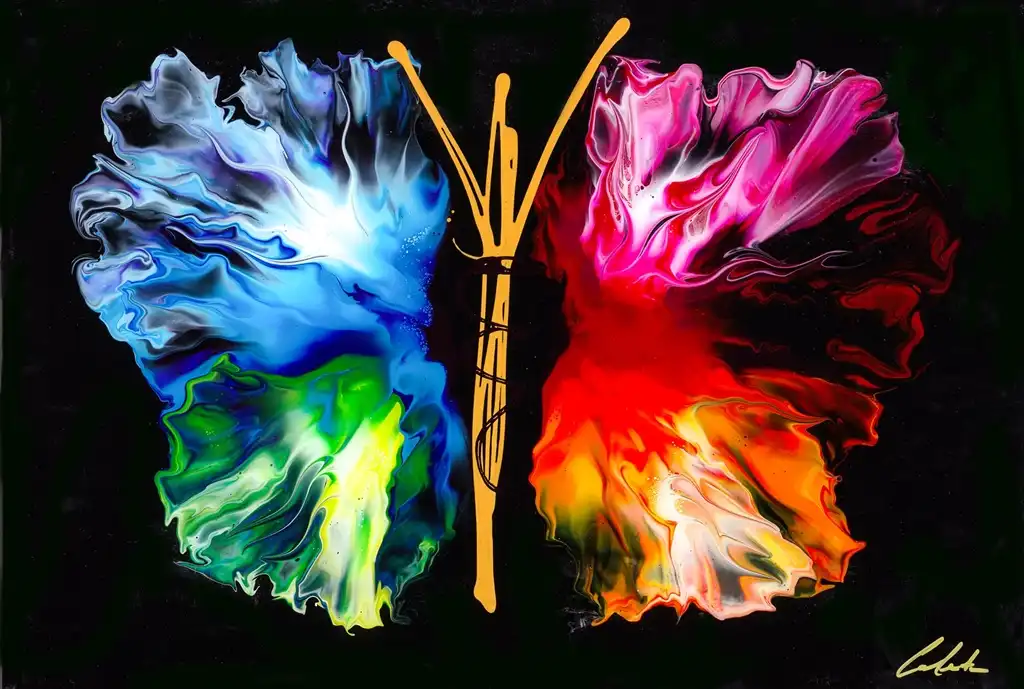
That rupture extends forward, finding a contemporary articulation in the work of Celeste Reiter, now presented through Park West Gallery, a gallery increasingly recognized for advancing female artists whose practices engage both formal rigor and market presence. Reiter’s paintings operate within the expanded field of abstraction, drawing on the material behavior of polymers, metallic suspensions, and pearlescent pigments to construct compositions that are both process-driven and visually resolved.
Her methodology is grounded in fluid dynamics and material interaction.
Pigment is poured, manipulated, and set into motion across the surface, often through centrifugal force or controlled directional flow. Viscosity, surface tension, and evaporation become compositional tools. Metallic particles refract light, creating shifting optical effects that alter perception depending on the viewer’s position. Pearlescent layers introduce a secondary register of luminosity, producing depth that is not strictly spatial, though perceptual.
The resulting compositions resist fixed orientation.
They operate through movement, both actual and implied, with layered strata of color interacting across the picture plane. Edges dissolve, re-form, and destabilize the notion of a singular focal point. Chromatic fields expand and contract, creating a visual rhythm that recalls both geological formations and liquid dispersion. The work engages with traditions of Color Field painting and post-painterly abstraction, while introducing a distinctly contemporary emphasis on material reactivity and optical flux.

Within this context, Reiter’s distinction as the first woman in the gallery’s history to sell out her first and second exhibitions signals a broader recalibration. It reflects a growing recognition of practices that merge technical experimentation with formal sophistication. Her presence within Park West Gallery aligns with the gallery’s evolving commitment to amplifying female voices within contemporary abstraction, positioning her work within a larger discourse around materiality, authorship, and visibility.
Reiter’s work extends beyond the gallery into design contexts, appearing in major platforms such as the Las Vegas and High Point Furniture Markets. Recognition as a top-selling artist by Touch of Modern underscores the resonance of her practice within a contemporary audience attuned to both visual intensity and conceptual clarity.
What remains most compelling is the structural intelligence of the work itself.
Color is not applied. It is orchestrated. Material is not incidental. It is generative. The canvas becomes a site where chemical process and compositional intent converge, producing a visual language that is both immediate and sustained.
The legacy of Fauvism persists here, though translated through a contemporary understanding of material and perception, resulting in a body of work that is at once sensorial, analytical, and distinctly present.
Kjasven@parkwestgallery.com
