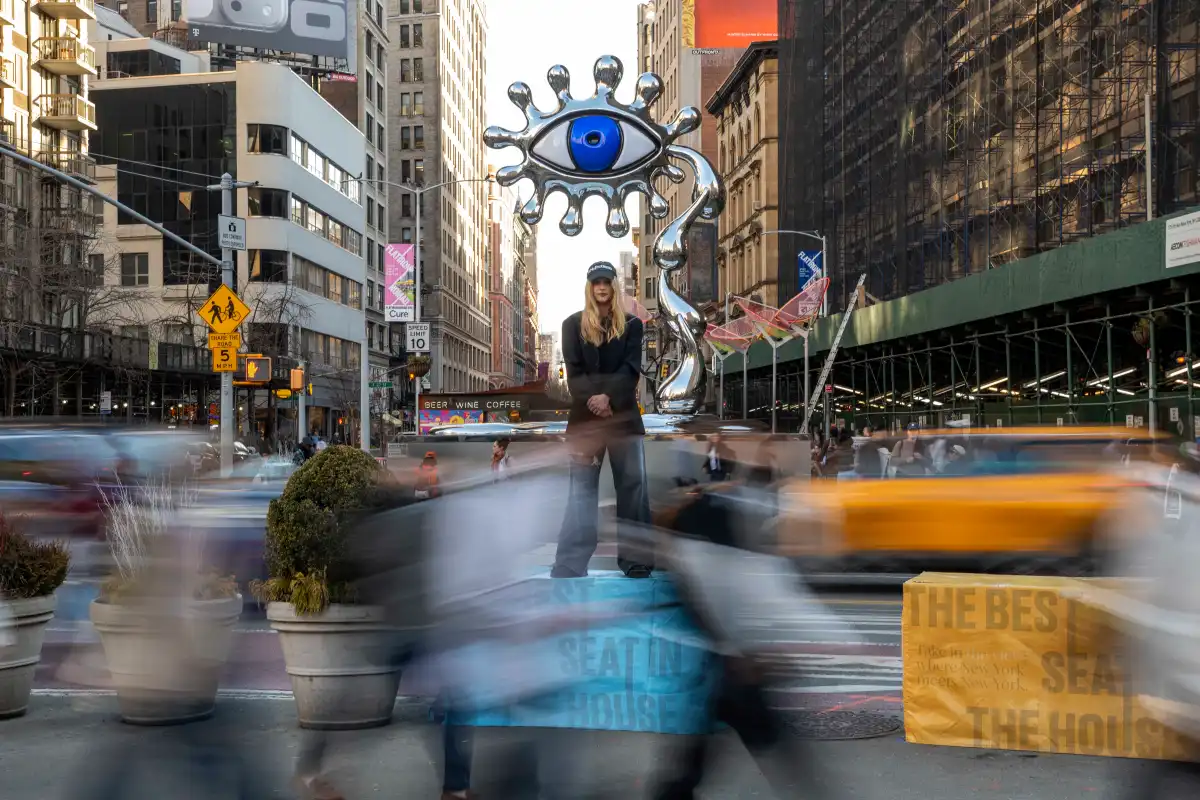
Chasing Rainbows, 2026, by Charlotte Colbert. Paintings©️Charlotte Colbert, 2025
Picture ©️Timothy Schenck.
Public artwork, at its most consequential, will not be merely an aesthetic gesture—it’s an ideological providing. It collapses the gap between mind and atmosphere, putting probably the most cerebral dimensions of inventive inquiry instantly into the civic bloodstream. No velvet rope. No institutional mediation. Quite, a radical proposition emerges: that philosophy, symbolism, and the structure of the unconscious belong as a lot to the passerby as they do to the collector or the curator. To function at monumental scale inside this enviornment requires an artist of unusual precision—one able to translating inside vastness into exterior kind, of holding psychological depth in opposition to the visible noise of a metropolis that hardly ever yields. This spring, that uncommon alchemy takes maintain as Charlotte Colbert installs two towering meditations into Manhattan—works that don’t merely occupy house, however interrogate it.
The Metropolis Desires Again
New York has at all times functioned as a monument to will; its skyline reads as assertion, its tempo as doctrine. “Chasing Rainbows,” Colbert’s two-site public set up, gently but decisively intervenes in that doctrine with one thing way more subversive: interiority. Not as retreat, however as confrontation. Arguably, the work asks what it means to really feel inside a system engineered for acceleration, to recollect inside a panorama constructed to overlook.
Curated by New Public in collaboration with the NYC Division of Transportation Artwork Program, and additional elevated by the enduring cultural power of Simon de Pury, the set up transforms metal into one thing nearly metaphysical. In flip, its reflective surfaces don’t merely mirror the town; they destabilize it, folding its picture again onto itself till the boundary between observer and object begins to dissolve.
The place Angels Nonetheless Linger
Inside the Meatpacking District, The place Angels Reside rises not as sculpture alone, however as a type of site-specific philosophy—a vertical axis between reminiscence and matter. A towering metal tree, adorned with talismanic kinds, turns into a repository for perception itself.
Traditionally, this neighborhood has been outlined by reinvention, the place histories layer moderately than disappear. Colbert engages that lineage with a reverence that resists nostalgia. Every suspended attraction reads as each relic and proposition, suggesting that which means will not be fastened, however frequently negotiated via collective reminiscence. Consequently, the work capabilities as a up to date shrine, but it avoids sanctimony. As a substitute, it provides a quieter, extra enduring inquiry: what constitutes the sacred in a metropolis that so typically commodifies the whole lot?

The Eye That Watches Us Dream
Throughout Manhattan, in charged proximity to the Flatiron Constructing, Dreamland Sirens emerges as a psychological counterweight—a monumental eye elevated above a column of tears, without delay sentinel and mirror.
At first look, the gesture seems deceptively easy; nevertheless, its philosophical density shortly reveals itself. To be seen in New York is continuously synonymous with visibility, standing, and projection. Colbert complicates that equation. This eye doesn’t merely observe; it absorbs, displays, and implicates. Town folds into it, and in return, the work redirects that picture inward, prompting the viewer to think about not how they’re seen, however how they see.
Inside a district outlined by stream—of capital, of our bodies, of time—the sculpture introduces a rupture. A second by which dreaming turns into collective, nearly infrastructural. On this method, the unconscious briefly enters the general public grid.
A Female Reinscription of Monumentality
The importance of this set up extends past kind into authorship. Monumentality has lengthy functioned because the language of dominance—traditionally male, declarative, and glued. Colbert’s intervention doesn’t reject that scale; moderately, it reconfigures its intention.
By way of a visible language rooted in surrealism, fantasy, and symbolic elasticity, she renders monumentality permeable, emotional, and intuitive. The works don’t dictate which means; as a substitute, they invite it, permitting for multiplicity moderately than management. Consequently, they quietly dismantle the rigidity that has so typically outlined public house.
There may be, with out query, a definite power in witnessing this recalibration—monumental kinds conceived by a feminine artist, realized via a women-led curatorial framework, and put in inside probably the most seen arteries of Manhattan. Not as opposition, however as evolution.

The Luxurious of Creativeness, Made Public
To come across “Chasing Rainbows” is to confront a profound reordering of worth. Creativeness, on this context, will not be indulgence. It turns into infrastructure—a shared useful resource embedded into the town’s each day choreography.
Colbert understands, with placing readability, that beneath New York’s relentless exterior lies an unarticulated starvation—for which means, for pause, for one thing that resists transaction. Her work meets that starvation with out spectacle or insistence, but with plain presence.
In the end, the sculptures don’t ask for consideration in any standard sense. As a substitute, they recalibrate notion itself. One finds oneself slowing, trying, reconsidering. Town, if solely momentarily, turns into much less a machine and extra a thoughts.
Such a shift, nevertheless fleeting, isn’t any small feat. It’s, maybe, the quiet triumph of public artwork at its strongest: to change not solely what we see, however how we exist inside what’s seen.
@colbertcharlotte
