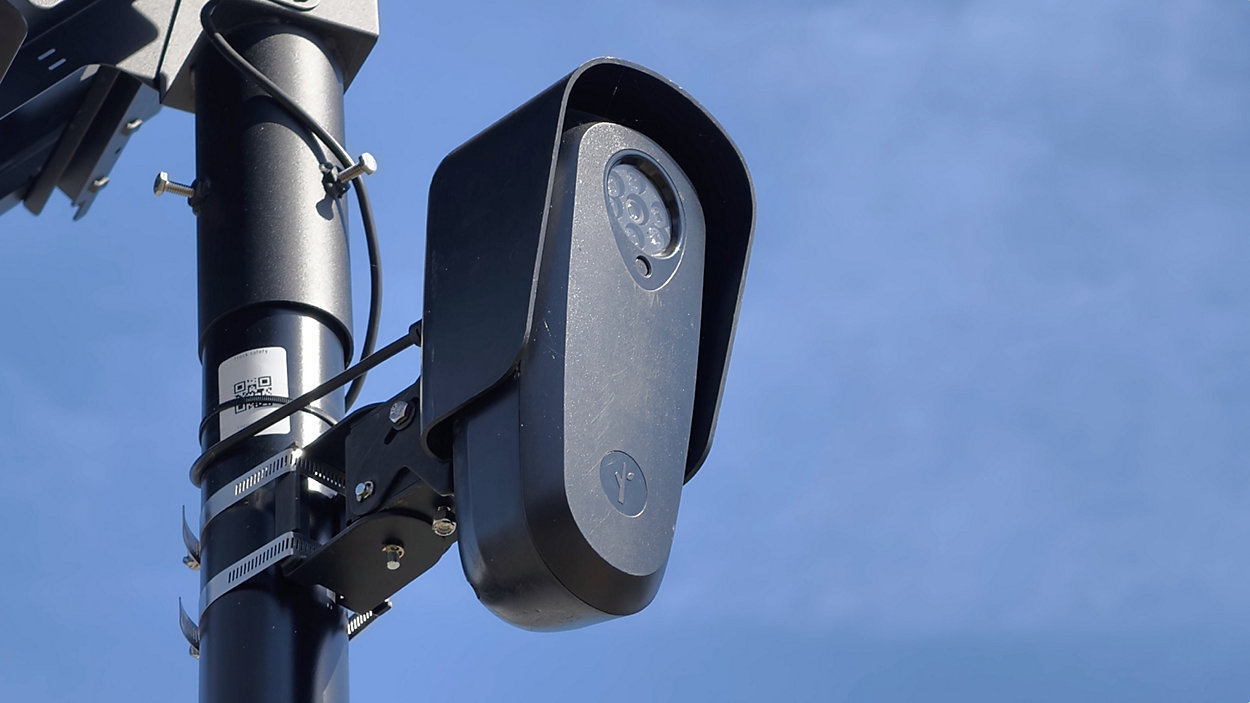
Gubernatorial candidate Byron Donalds is alarmed by the ongoing adoption of Flock Cameras around the state, and says policy makers must “re-look at this whole system” amid concerns about mass surveillance and 4th Amendment rights prohibiting unreasonable searches and seizures.
“I actually think we need to take a full pause on this and re-look at this whole system, because you’ve got to protect the constitutional rights of people in their persons, in their possessions. You’ve got to protect that, and you cannot have a situation where the government now has active abilities to watch your every movement,” Donalds said during a Cartier Family interview Saturday.
Other Republicans have expressed concerns about the technology, and as the likely nominee and favorite to be the next Governor, Donalds is uniquely positioned to do something about it if elected.
As reported last year by Gov Tech, at least 100 law enforcement agencies in the state use Flock license plate reader (LPR) cameras, of which there are 114,000 in the country according to Deflock, which opposes the technology.
Nearly 7,500 LPRs are in Florida, according to WUFT.
Other brands exist, but Flock has the most robust presence.
They are ubiquitous in cities like Jacksonville, Gainesville, Orlando, Sanford, Ocala, Miami, Hialeah, Venice, Sarasota, Boynton Beach, Port St. Lucie, Vero Beach, Sebastian, Sanibel Island, the Florida Keys, and Titusville. The Lake County and Seminole County Sheriff’s Offices use them as well. Law enforcement uses them to track everything from stolen tags and narcotics to immigration status.
“What I want to do is make sure that we don’t start setting up ‘surveillance states’ in Florida,” Donalds said.
The Congressman, who has been endorsed by 35 sheriffs and the Florida Police Chiefs Association, takes issue with information being put into a database.
“We have real time crime centers that passively have cameras that are operating in intersections. That has been happening in Florida for years. I want to be clear. But when you now move to where you’re actually scanning plates, just to log them, that’s where I get off the ship.”

He proposes harsh criminal penalties for misuse, floating five years in prison and a $500,000 fine per occurrence for those mishandling the data.
Flock defends its use of data and protections of privacy, acknowledging “isolated incidents” of “misuse” and saying “role-based access controls, audit logs, retention limits, geofencing, and case-based search requirements are designed to constrain use, support lawful investigations, and balance public safety benefits with civil liberties protections.”
Flock also bills itself as “purpose-built for local agencies with strict data ownership, 30-day default retention, and full auditability,” saying it is not involved in “predictive policing” and that it does not work with the controversial Palantir Technologies, known for its robust use of data for defense and law enforcement functions among others.
Flock also maintains that local agencies have a default setting of “sharing off” with the federal government, including Immigration and Customs Enforcement, where prohibited by law.
However, Florida’s cooperation with illegal immigration crackdowns is notably robust, and the use of the technology to facilitate deportations has been reported in recent years, including with the Florida Highway Patrol.
Yet despite Donalds’ concerns about Flock and its competitors, the U.S. Supreme Court ruled this year that kindred technology is constitutional in Chatrie v. United States.
The ruling affirmed the use of cellphone location data from Google as SCOTUS rejected an argument that the 4th Amendment was violated.
This arguably established a precedent Flock could invoke if a plaintiff had standing to challenge its use or a contract giving it market position.
Some contracts are up to five years long.
Red light cameras created a similar controversy in the state in recent decades.
According to the Florida Department of Highway Safety and Motor Vehicles, 37 jurisdictions used them as of June 30, 2025, the last date for which data is provided. They are at 302 intersections and more than 923,000 notices of violation were issued in FY 24-25.
