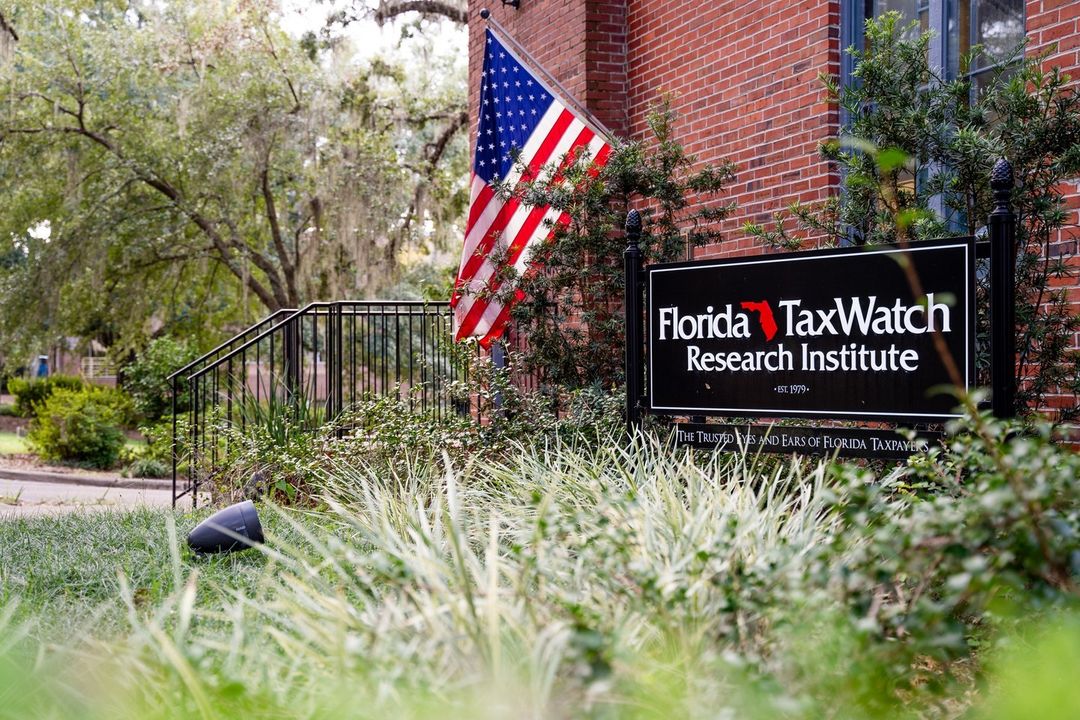
For the past 47 years, Florida TaxWatch has been one of the state’s most influential government watchdogs.
The organization provides information to residents and public officials about local government taxation, expenditures, policies and programs, and creates a regular list of “budget turkeys” cautioning against government bloat.
Billed as an independent and nonpartisan research institute, Florida TaxWatch is often considered a conservative think tank, because it takes a hard-line approach to taxation. Most of the time, Florida TaxWatch prefers trimming fat, not bloating revenue.
So it’s understandable that its word of caution this week about Gov. Ron DeSantis’ priority property tax cut drew a bit of confusion from some. The group warned that the government can’t solve affordability by “simply discussing the increase in property tax.”
“Rather than force this issue to be decided in a hastily called Special Session it would be far better to have this issue taken up by the constitutionally mandated group Florida TaxWatch helped establish — the Taxation and Budget Reform Commission,” reads a TaxWatch analysis of the Governor’s proposal released ahead of this week’s now-concluded Special Session.
Enter former lawmaker Bob Rommel, Florida State Chair of the America First Policy Institute.
Rommel took to X after the TaxWatch analysis came out with a gif of an ostrich with its head stuck in the sand, asking the question, “where was TaxWatch the last seven years when local government was spending 300% above inflation?”
The better question might be, where was he?
The TaxWatch analysis, published Monday in alignment with the start of the Special Session to address property cuts, laid out the basics of DeSantis’ proposal: increasing the state’s homestead exemption from $50,000 now to $150,000 in 2027, then to $250,000 in 2028.
It specifically praised “the conversation about lowering property tax” and noted that guardrails were needed to curb local government spending it said has “far exceeded the growth in population and inflation over the last 10 years.”

The TaxWatch analysis was every bit as sharp as Floridians have come to expect from the government watchdog. It lamented governments living outside their means and agreed that “significant relief is warranted.”
The report did not call for no property tax relief, it called for a more pragmatic approach.
Perhaps Rommel didn’t read the full analysis. If he did, he’d know that Florida TaxWatch has done everything but put its head in the sand.
The analysis itself pointed directly to TaxWatch’s important work on ensuring the state and local governments are good stewards of taxpayer dollars. Its report, “Save Our Taxpayers — Property Tax Relief Must be Accomplished Equitably,” pointed directly to increased local government property tax collections and found taxpayers were due relief.
It also pointed to its “How Counties Compare” report showing how most Florida counties have increased property taxes far in excess of population and inflation over the past 10 years.
Reining in unnecessary spending is at the core of TaxWatch’s work. The group has spent decades building research practices and educational programming to not just be fiscal hawks on one-off policy discussions, but to create a policy environment throughout the state that balances public amenities with taxpayer cost.
While it often calls out “budget turkeys” in legislative and local budgets, it also exercises caution when proposed cuts are too deep and threaten the greater public good.
Rommel’s flippant post ignores that balance.
Florida taxpayers should be thrilled that the state’s preeminent fiscal hawks are working to ensure property tax relief, without simply shifting the fiscal burden to other fees and taxes, as numerous analyses have suggested will happen under the now-approved joint resolution creating a ballot question for November.
Suggesting that TaxWatch has had its head in the sand for the past seven years is pure political theater. As a recent TaxWatch government efficiency report notes, identifying taxpayer savings should “not be something we do every four years.”
It calls on the Legislature to enact a Florida Government Efficiency Act requiring the Governor’s annual budget to include efficiency and cost-saving features informed by the state’s Auditor General, the Office of Program Policy Analysis and Government Accountability, the constitutional Government Efficiency Task Force, agency inspectors general, state agencies and credible outside institutions, including itself.
That’s not nothing. In fact, it’s a lot.
Florida TaxWatch is not deterring property tax savings, it’s asking for such savings to be realized intentionally, carefully and prudently, in a way that saves taxpayers money without risking services that make Florida the economic powerhouse that it is.