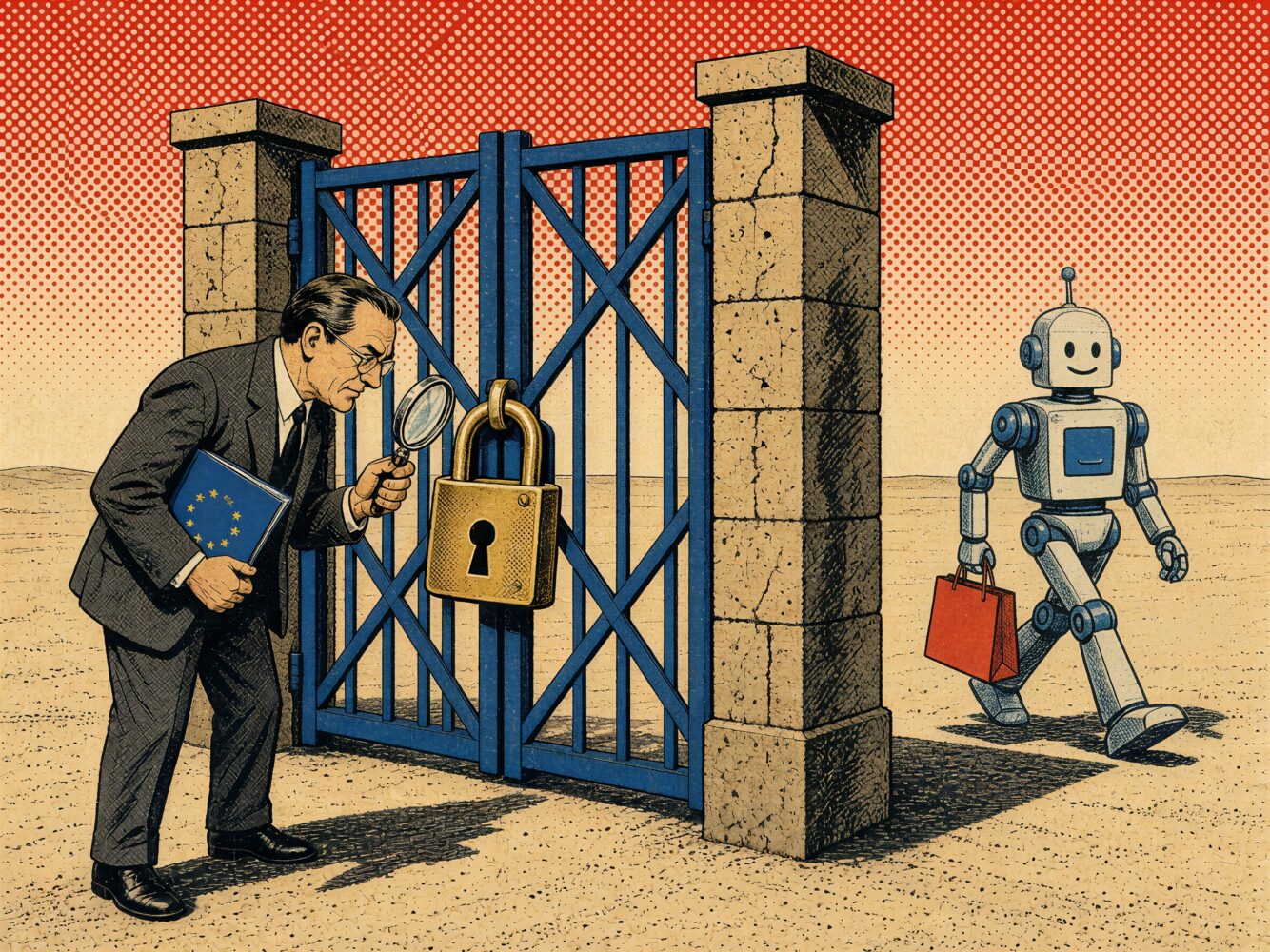
Big Tech is spending a fortune to secure a future that competition regulators seem to think it already owns. Investors aren’t so sure. They’re losing patience with the industry’s artificial intelligence (AI) bill—and questioning what all that spending will buy.
Alphabet shares sank more than 12% last Thursday—the company’s worst trading day on record—after both revenue and profit missed expectations for the first time in nearly four years. Google’s core advertising business fell short of expectations, and free cash flow—the cash left after operating expenses and investments in assets such as data centers—turned negative by $9.1 billion. The company’s chief financial officer also warned that capital expenditures would increase significantly in 2027.
Amazon fared little better. Its shares closed down more than 4% ahead of its earnings release, then slid another 6% after hours when the company revealed that it had spent $75.9 billion on capital expenditures in a single quarter, while generating just $42.4 billion in cash from operations. Meta had already shed 6.98% the previous week over its own spending plans.
As The Economist, CNN, and CNBC all reported, investors increasingly question whether Big Tech’s massive AI spending will ever pay off. Alphabet’s results also stoked fears that consumers’ shift to AI chatbots threatens Google’s core search-advertising business.
It would be unwise to read too much into a few days of trading. Stock prices are noisy, and markets have swung between AI euphoria and anxiety more than once this year. But the sell-off sharpens a question for competition policymakers—one that sits uneasily with the regulatory frameworks they’ve spent the past five years building: What if the dominant platforms those frameworks label “gatekeepers” aren’t nearly as entrenched as policymakers assumed?
So Much for Entrenchment
The deeper concern isn’t that Big Tech is spending too much on AI. It’s that it may have no choice. For two decades, Google, Amazon, and Meta have made money from their position as the places users go to find information, products, and one another.
AI chatbots and agents—systems that carry out tasks on users’ behalf—threaten to insert a new layer between those users and the services they rely on. When a consumer asks an AI agent to find the best pair of running shoes and buy them, the agent—not the consumer—runs the search, compares offers, and completes the transaction. Nobody sees the ads. Nobody browses the marketplace.
This raises two related questions. First, will yesterday’s business models remain viable as AI increasingly handles transactions and access to services? Second, if they won’t, can established firms overcome Clayton Christensen’s innovator’s dilemma—the tendency of successful firms to underinvest in technologies that could undercut their core business—and compete head-on in AI markets? Neither question has an obvious answer. Both go to the heart of modern competition policy in digital markets.
Consider the European Union’s Digital Markets Act (DMA). To qualify as a gatekeeper, a firm must, among other things, enjoy “an entrenched and durable position” in its operations, or be expected to enjoy one in the near future. The regulation’s entire structure—from its per se obligations, which apply without a case-by-case assessment of competitive harm, to its abbreviated enforcement procedures—rests on the notion that the core platform services it targets will remain essential gateways for years to come. That assumption looked plausible when the European Commission proposed the regulation in December 2020. It looks considerably shakier today.
Even staunch proponents of intervention against Big Tech appear to recognize this. In a recent post on X, Tim Wu called AI agents’ challenge to “the attention-driven business models favored by the platforms” probably “the most important but slightly under the radar thing going on right now.” He added, tellingly, that those very advertising platforms own some of the major AI agents.
Wu made a similar point in a late-2025 interview, wondering what purpose Google would serve if users turned to chatbots that display few ads, and calling AI “the wildcard.”
That’s quite a concession from one of the intellectual architects of the neo-Brandeisian movement, which favors stronger antitrust intervention—and a far cry from the view of Andreas Mundt, president of Germany’s Federal Cartel Office (Bundeskartellamt). In 2024, Mundt described AI as a “first-class fire accelerator” of anticompetitive abuse, warning that it would only make Big Tech more powerful.
Disruption Doesn’t Use the Front Door
If AI agents erode Big Tech’s profits, it likely won’t be because a rival search engine or marketplace beat Google or Amazon on their own turf. It will be because consumers changed how they reach those services. Today’s ex ante regimes—rules imposed in advance to prevent competitive harm—are ill-equipped to recognize this threat.
Regulations like the DMA and the United Kingdom’s Digital Markets, Competition and Consumers Act (DMCC) take a static view of competition that also overlooks how users reach a service. The implicit assumption is that only similar rivals entering the same core platform service can erode a gatekeeper’s market power: another search engine, another app store, another marketplace. Hence their focus on lowering barriers to entry within those services through requirements to share data, make services work with rivals’ offerings, and refrain from favoring their own products.
But market power doesn’t erode only from within. It can also evaporate when the services through which users reach a platform change.
Take Google. Assume, for the sake of argument, that it enjoys a monopoly in general search (I’ve argued elsewhere that this is unlikely). Its ability to make money from that position depends on users seeing—and clicking—its ads. If users increasingly access search through AI agents, that revenue could shrink dramatically, even if no rival search engine ever gains meaningful share. There are signs this is already happening: Apple’s Eddy Cue testified last year that searches on its Safari browser had declined for the first time in 22 years, which he attributed to users turning to AI.
Ironically, the DMA may accelerate this trend. Under a decision specifying its obligations adopted in July, Google must share anonymized data on search rankings, queries, clicks, and views with eligible rivals—a group that, the Commission confirms, includes AI chatbots offering search functions. In other words, the DMA may end up subsidizing the very services that come between Google and its users, without ever producing a viable competitor in “search” as the Commission defines it.
Amazon faces a similar predicament. Whatever marketplace power it holds depends on consumers coming to Amazon to look for products. Now imagine consumers asking an AI agent to find a product and buy it from whichever merchant offers the best deal, including thousands of small retailers using Shopify to run their stores and Stripe to process payments.
This isn’t science fiction. OpenAI and Stripe launched Instant Checkout in ChatGPT, built on an open set of technical rules that lets agents complete purchases directly with merchants. Although it doesn’t appear to have gained traction with users, it’s surely a sign of things to come.
None of these small merchants could conceivably challenge Amazon as a competing marketplace. Yet collectively, through AI agents, they could erode whatever pricing power Amazon enjoys. Amazon clearly understands the threat: It has sued Perplexity to keep its Comet shopping agent off Amazon’s store, while Perplexity counters that Amazon chiefly wants to protect its advertising revenue.
Competitive conditions in one market can change dramatically even when no rival enters that market. Analyzing competition only within narrowly defined core platform services systematically overestimates how long incumbents can hold their positions.
Spending Like There’s No Tomorrow
This dynamic helps explain why incumbents are pouring unprecedented sums into AI. Big Tech is expected to spend more than $700 billion this year on data centers, chips, and energy. Alphabet anticipates capital expenditures above $300 billion in 2027, while Amazon is borrowing heavily to fund its own expansion. Meta has gone so far as to propose a new class of nonvoting shares.
The threat of losing direct access to customers makes this spending less puzzling. Incumbents rightly recognize that letting someone else control the AI layer could reduce their core services to interchangeable suppliers—data pipes and fulfillment networks serving another firm’s agent. That firm would control the customer relationship and capture the profits that come with it.
Overspending on AI seems like a rational insurance policy against that outcome. Hence Google’s push with Gemini, which now has more than a billion users, and Amazon’s development of its own shopping agents, Rufus and Buy for Me, even as it fights third-party agents in court.
Whether these bets pay off is anyone’s guess. But the incumbents themselves clearly don’t believe their positions are “entrenched and durable.” They’re behaving like firms that fear for their survival.
Please Hold While We Amend the Future
All of this has at least four implications for competition policy.
First, the “entrenched” gatekeepers policymakers describe may not be so entrenched after all. Positions that seemed unassailable a few years ago now depend on technological shifts no regulator foresaw.
Second, well-intended rules may both hobble incumbents in AI markets and hasten their loss of direct access to customers. Restrictions on combining data, tying products (making access to one conditional on taking another), and favoring their own services make it harder for incumbents to use existing assets to develop new AI services. The commission’s recent Android decision, for instance, requires Google to give rival AI assistants access to 11 Android features on equal terms with Gemini. Meanwhile, access and data-sharing mandates hand AI rivals the keys to incumbents’ platforms.
In the worst case, this combination could help tomorrow’s AI leaders consolidate their power—precisely the outcome these policies ostensibly aim to prevent. Some would welcome that tradeoff: Wu has said that, if he could redo the Google case, he would keep Google out of AI entirely. But removing one of the industry’s most formidable competitors from the race is a curious way to encourage competition.
Third, the assumptions about competitive harm behind ex ante regimes already look outdated. The DMA was adopted in September 2022, less than three months before ChatGPT launched. Its list of core platform services and its obligations reflect a world of search boxes, app stores, and marketplaces, not AI agents.
The question isn’t just whether those obligations need updating, but whether regulators can update them fast enough to keep pace with AI markets. The commission’s first DMA review concluded that the regulation needs no revision. Even if the commission changed course, amending the DMA would take years. By then, AI markets would likely have moved on again.
Fourth, and most fundamentally, policymakers simply don’t know what tomorrow will look like. That uncertainty undermines inherently backward-looking tools like ex ante regulation, which rest on the assumption that a service that’s valuable, unique, and lacking rivals today will remain so tomorrow. Case-by-case enforcement under traditional competition law is far from perfect. But at least it requires authorities to establish harm in markets as they actually stand, rather than freezing yesterday’s market structure into law.
Obsolescence Comes for the Rulebook
This week’s sell-off may or may not mark a turning point. Alphabet, Amazon, and Meta could emerge from the AI transition stronger than ever—or follow earlier tech giants that once seemed unassailable. We simply don’t know.
What we do know is that yesterday’s ex ante competition regulations—if they were ever needed—were built for a world that no longer exists. Applying them mechanically to fast-moving AI markets risks creating the very competition problems they’re meant to solve.
The market has moved on. The rulebook hasn’t.