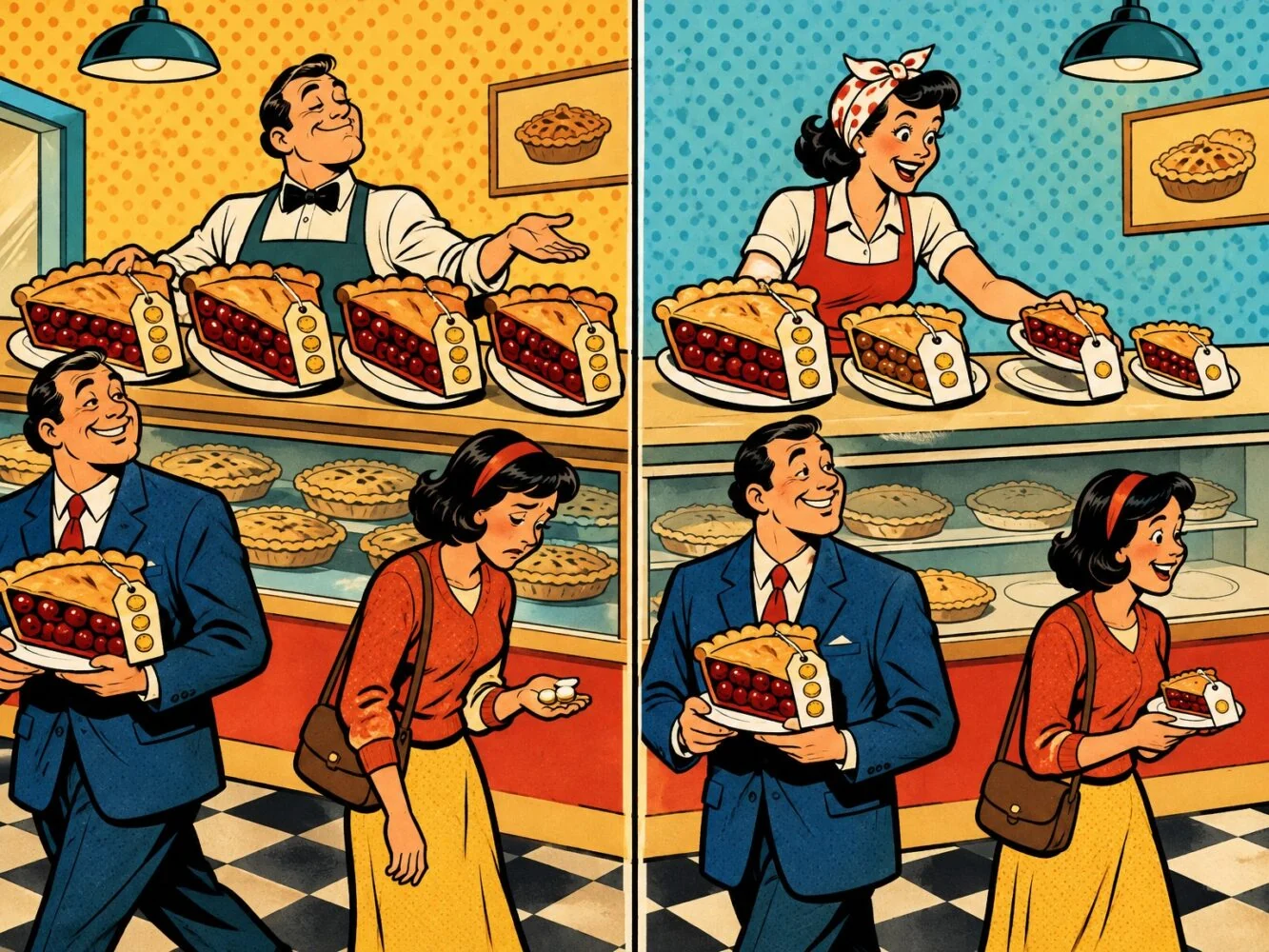
Imagine you have a business that earns zero economic profit. It exactly covers its costs, including the return needed to attract investors, but nothing more. Is this the end state of competition? Is there anything left for competition to do?
Sure. If another company comes along with lower costs, it can drive prices down. That’s always a possibility, and an important one in real markets. But is there anything else competition can do in the more traditional sense, where new rivals take time to enter a market but eventually erode profits?
There’s one more way to compete. Suppose a company comes along that has no technological edge or lower costs. It can still compete on pricing—by changing the pricing structure, rather than simply setting a lower price.
The rival could charge an upfront fee, offer a bundled deal, or charge different customers different amounts. That last possibility takes us to price discrimination, which is usually described as simply a way for sellers to charge customers more.
The Federal Trade Commission (FTC) appears to share that view. It just ordered nine companies to report whether they charge different people different prices. The FTC worries that companies use data “to estimate the highest price they can charge each consumer.”
But price discrimination can also be how a competitor offers customers a better deal and wins their business. To see how, we need to start with the problem of paying for fixed costs—the expenses a business incurs regardless of how much it sells.
Zero Profit Isn’t Mission Accomplished
Consider a customer buying electricity. The first unit is worth $120 to her, the second $30, the third $20, and the fourth $5. Producing each unit costs $10. If two suppliers have exactly the same costs, competition will drive the price down to $10—the marginal cost, or the cost of producing one more unit.
If you charge more than $10, your competitor can offer a lower price to win the business. Charging less than $10 loses money. We arrive at the usual competitive result: price equals marginal cost. This is the basis for much of how economists think about pricing.
Let’s add one small complication. Someone has to install the generator. Suppose installation costs $100, but nothing else changes. Production still costs $10 per unit, and our customer still values the units at $120, $30, $20, and $5.
Suppliers compete by making binding pricing offers before installation. The winning supplier installs the equipment and supplies the customer for the agreed-upon period.
Marginal-cost pricing no longer works because it doesn’t cover installation costs. At $10 per unit, the customer buys three units and pays $30—just enough to cover production, with nothing left for installation.
Notice I’ve rigged the numbers so that installing a generator is still worthwhile. Those three units produce $170 in benefits at a total cost of $130. But we need something besides marginal-cost pricing to generate those benefits.
So perhaps competition settles on a higher electricity price. A supplier charging $120 sells one unit, pays $110 in costs, and earns $10. A rival can offer $115 and earn $5. Suppliers can keep undercutting each other until the price reaches $110, where the winner just covers its costs.
Zero profit! Competition has worked!
Except the customer buys only one unit. The additional units, which are still worth more than they cost to produce, go unsold. That’s not great.
A new rival can’t fix this problem by cutting the per-unit price further. The supplier already earns zero economic profit. Dropping the price to $30 to sell the second unit would lose money, so no one does it.
The problem should be pretty obvious. You need to cover the fixed cost, so charge separately for it.
But now we’re beyond simple marginal-cost pricing. The basic Econ 101 model doesn’t allow that. You draw a line across the graph at “the price,” which means the per-unit price: $10 per unit of electricity, with every unit priced the same. The standard Marshallian and Walrasian models—the textbook frameworks behind our “price equals marginal cost, so we have competition” result—restrict suppliers to a single per-unit price, known as linear pricing.
Maybe we need to be more creative. You’re actually selling two products: installation and electricity. Charge separately for each.
That can solve our numerical problem, but it raises a question about the theory. What exactly is the product whose price competition drives down? Is it a unit of electricity, a connection, or an entire package delivered through that connection? Once we allow suppliers to compete over these arrangements, the familiar instruction to “take the price as given” needs a little more explanation. The arrangement itself is something firms can compete over.
The competitor in the model is just as smart as we are. It sees the problem and offers a different pricing strategy: $105 for installation, then $10 for each unit consumed.
Now we’re at the efficient outcome: the customer buys all three units worth more than they cost to produce. She pays $135 for electricity worth $170, leaving her with $35 in consumer surplus—the value she receives beyond what she pays—compared with just $10 under the original per-unit price.
Just by changing the pricing—without any technological improvements—the entrant earns a $5 profit and leaves the customer better off. A rival can profitably improve the customer’s deal even when the existing supplier already earns zero profit.
Pricing is an avenue for competition.
The opportunity arose for the usual reason: there was still deadweight loss, or potential gains from trade that went unrealized. The second and third units were worth $50 to the customer but cost only $20 to produce. Changing the pricing captures that $30 in forgone gains. The entrant gives $25 to the customer and keeps $5. Its total bill is actually higher than the old supplier’s, but the customer gladly switches because she gets more valuable service.
Other suppliers, seeing the crafty pricing strategy, can offer better terms. If the installation charge exceeds $100, a rival can lower it and still earn something. Competition pushes the installation charge down to $100, plus $10 per unit, leaving the customer with all $40 of the surplus.
We could also change the invoice. A package of three units for $130 would achieve the same result, without separate installation and electricity charges. Either way, competition is for the full contract.
We need a broader conception of how competition plays out. Louis Makowski showed how nonlinear pricing—arrangements where the total bill isn’t simply one per-unit price multiplied by quantity—can fit within a theory of perfect competition. Competition can discipline a whole pricing schedule, even when there’s no single per-unit price to take as given.
The Generator Won’t Pay for Itself
Nothing above should be controversial or surprising once it’s laid out this way. But we can carry the logic further.
Suppose one generator can serve two customers. A workshop wants one unit worth $120, while a household wants one unit worth $40. Installation still costs $100, and each unit of electricity still costs $10 to produce.
Start with the contract we just settled on: a $100 connection charge plus $10 per unit. The workshop signs up and pays $110, but the household declines. The supplier covers its costs.
Could a rival offer a lower connection charge to attract the household? The charge would have to fall to $30 or less. But collecting $30 from each customer would bring in only $60 toward the $100 installation. Offering the same contract to everyone leaves us stuck again.
Imagine instead that a rival offers the workshop an $80 connection charge and the household a $25 connection charge. Both still pay $10 per unit. The workshop’s total bill falls from $110 to $90. The household’s bill is $35. Their connection payments total $105, covering installation and leaving the entrant $5.
The rival has found another customer to help pay for the generator. The household contributes $25 toward installation, allowing the entrant to reduce the workshop’s bill by $20 and keep $5. Again, creative pricing gives both customers a better deal, even though the supplier it displaced was earning zero profit.
These customers receive identical electricity, and the supplier faces the same cost to serve each. There’s no cost-based reason for the price difference. This is pure price discrimination. Still, everyone prefers the discriminatory pricing system to the uniform price.
Further competition can squeeze out the remaining profit, but it won’t equalize the prices. Suppose a competitor offers total bills of $33 for the household and $87 for the workshop. That covers the $120 total cost. A rival can’t profitably win both customers by offering lower bills, because it wouldn’t cover its costs. Nor can it profitably serve either customer alone at a lower price: installing the generator and supplying one unit would cost $110.
Several ways of dividing the bill could survive these tests, but equal prices won’t. At $60 each, the household would decline.
Someone has to cover the fixed cost. There’s no way around it. Generally, those who value the service more will have to contribute more. When prices depend on value rather than cost, that’s price discrimination.
As a prediction about how markets work, we should expect price discrimination where fixed costs are high. Airlines have long used it because the fixed cost of a flight is high, while the marginal cost of carrying another passenger is low. Charging different fares helps support more flights.
Software is another example. High development costs and low marginal costs give sellers a reason to charge some customers, such as business users, much more to finance development while keeping software available to students and other price-sensitive users. For drugs, this happens across countries.
When assessing whether price discrimination is beneficial, fixed costs add another consideration: it can make investment worthwhile. That’s why I always stress fixed costs when discussing price discrimination. The standard Econ 101 model, even when it shows that price discrimination helps capture more gains from trade, assumes the product will be available either way. It leaves out whether the seller can cover the investment needed to offer it at all.
It’s also why I’ve proposed “more prices” in electricity to address concerns about data centers.
There’s More to Competition Than Undercutting
Okay, let’s move from simple examples to why this matters. I was listening to an episode of Odd Lots in which Lindsay Owens spends a long time worrying about pricing tools. For example, she doesn’t buy that charging some customers more would provide “a cross-subsidy for everyone else.” But one purpose of price discrimination is to offer a lower price to someone who wouldn’t buy at the uniform price. That possibility exists even in the simple case without fixed costs.
She also argued that targeted discounts for budget shoppers mean higher prices for everyone else. They could, yes, but they need not. In our example, attracting another customer lets a rival spread the fixed cost and lower the existing customer’s bill to win its business.
I’ve obviously chosen numbers that make the benefits clear and simple. Does that mean every pricing scheme helps consumers and increases the total gains from trade? No. A seller can use price discrimination to charge more on average, leaving consumers with less surplus. It may have an incentive to grab a bigger slice of a smaller pie.
But that incentive exists on both sides of every market. Sellers want higher prices; buyers want lower prices. It’s also not the only force at play. Instead of just fighting for a bigger share of a fixed pie, there’s also an incentive to find a bigger pie. Pricing schemes, including price discrimination, can be one way of finding that bigger pie.
The entrant wants a profit. It finds one by changing the pricing arrangement, creating more gains from trade, and offering customers enough of those gains to win their business. Then rivals copy the arrangement and compete over its terms. That is competition at work. Even when profits under the old pricing system have disappeared, the search for a better deal continues.
Owens represents a broader view. As I said, the FTC is making a big deal about personalized pricing. Many people share her perspective, which is why I spend so much time on it. They treat price discrimination as anticompetitive by definition, whether they use that language or not, because it departs from pricing at marginal cost. That misunderstands the competitive process.
This view was once even more prevalent. Courts and economists treated exclusive dealing, tying, resale price maintenance, and vertical mergers much the same way. These practices—agreements to deal exclusively, sell products together, set resale prices, or combine businesses at different stages of production—were presumed to reduce competition.
Since then, economists have built large bodies of research showing how firms use each practice to win customers. In response, courts have dropped per se condemnation—treating a practice as unlawful without examining its effects—for several of them.
That work begins with the same problem: a single price can leave units unsold that are worth more to the buyer than they cost to produce. Discounts, exclusive contracts, and two-part prices can help buyers and sellers trade those units. Public discussion of price discrimination hasn’t caught up.
Across those bodies of research, expanding the gains from trade has proved the more powerful force. Finding more of those gains is the big deal.