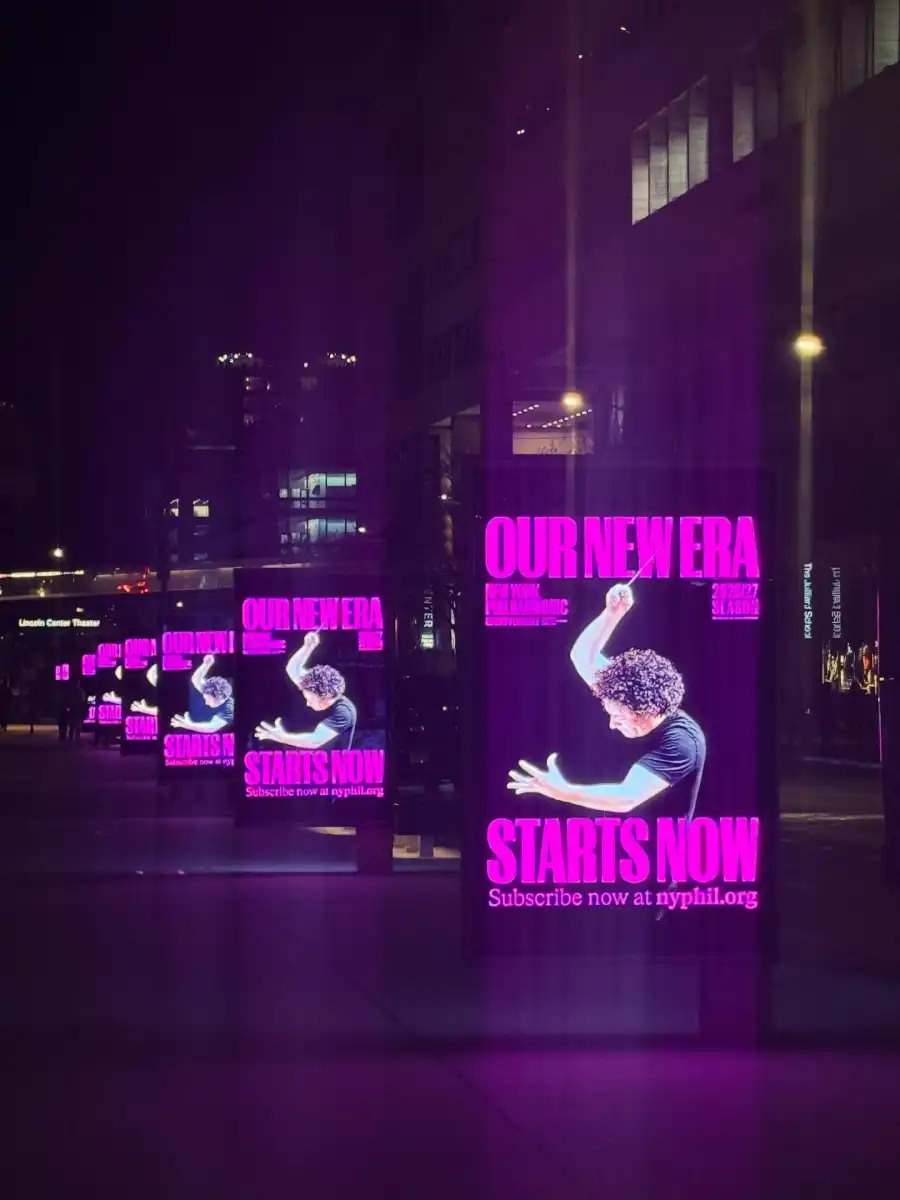
The New York Philharmonic is in a brand new period.
Picture: Erich McMillan McCall
A brand new period on the New York Philharmonic begins, fairly fittingly, with a return to one thing historic: the understanding that music, at its highest type, just isn’t leisure however transcendence. It’s the structure of feeling, the unseen power that strikes by means of the physique earlier than the thoughts has time to call it. Underneath the route of Gustavo Dudamel, that power feels newly woke up—expanded, reoriented, and undeniably alive.
Inside David Geffen Corridor, the ambiance carried that unmistakable cost of transition. Not a break from historical past, however a deep inhalation earlier than the following motion. Dudamel’s arrival because the Oscar L. Tang and H.M. Agnes Hsu-Tang Music and Creative Director indicators greater than a change in management; it suggests a recalibration of intention. Music, in his arms, turns into a dwelling language—elastic sufficient to carry grief, grandeur, experimentation, and collective reminiscence all of sudden.
There may be, notably, a gentleness to Dudamel that disarms. His presence doesn’t depend on severity or distance. As an alternative, it attracts you in with heat, with an nearly luminous sincerity, with a ardour that feels each disciplined and wildly human. One senses that he’s not merely conducting sound, however shaping expertise—guiding each musicians and viewers towards one thing shared, one thing felt in unison.
The 2026–27 season displays that expansive imaginative and prescient with hanging readability. It opens not throughout the anticipated partitions of Lincoln Heart, however at Radio Metropolis Music Corridor, a gesture that instantly widens the Philharmonic’s footprint and invitations a broader public into its orbit. The next night, a memorial on the Perelman Performing Arts Heart marks the twenty fifth anniversary of September 11, anchoring the season in remembrance and collective reflection.
From there, the programming unfolds with each mental rigor and emotional sweep. The world premiere of Zosha Di Castri’s new orchestral work enters into dialogue with John Adams’s On the Transmigration of Souls, a chunk that continues to resonate as one of the vital profound musical meditations on loss in up to date historical past. Sergei Prokofiev’s Symphony No. 5 follows, grounding this system in a sort of enduring structural brilliance.

Quickly after, one other premiere emerges—Tania León’s Imágenes mestizas—paired with the emotional vastness of Gustav Mahler’s Symphony No. 5. This interaction between the brand new and the canonical feels intentional, even philosophical. Custom just isn’t being changed; it’s being positioned in dialog with the current.
The presence of artists similar to Lang Lang and Yo-Yo Ma additional underscores the season’s breadth, bringing each virtuosity and world resonance into the fold. On the identical time, Dudamel’s determination to collaborate with figures past the standard orchestral sphere—Marina Abramović and Gustavo Santaolalla—indicators a Philharmonic that’s more and more porous, keen to have interaction with efficiency, movie, and multimedia as a part of its evolving language.
That is maybe the place the thrill turns into most palpable. The Philharmonic is now not positioning itself solely as a guardian of repertoire, however as a platform for interdisciplinary creativeness. Abramović’s staging of Stravinsky and Falla, Santaolalla’s multimedia premiere—these usually are not peripheral gestures. They’re central to a imaginative and prescient that understands tradition as interconnected, fluid, and alive.
There may be additionally, undeniably, a worldwide ambition at play. The orchestra’s return to Europe—its first tour in practically a decade—reasserts its presence on a world stage, carrying with it not solely legacy works however new commissions that talk to this evolving id.
But for all its масштаб and ambition, essentially the most hanging facet of this new period is its emotional accessibility. In the course of the night, a fleeting, nearly cinematic second unfolded as Timothée Chalamet appeared, prompting a ripple of laughter by means of the viewers. The response was unforced, heat, and revealing. It advised that even inside one of the vital storied establishments on this planet, there stays house for lightness, for immediacy, for the unpredictable humanity that defines New York itself.
That stability—between reverence and relatability, self-discipline and openness—might in the end outline Dudamel’s Philharmonic.
Because the season builds towards a sweeping Beethoven focus marking the composer’s bicentennial, and culminates in a full staging of Leonard Bernstein’s Mass, one begins to see the bigger structure taking form. This isn’t a sequence of live shows. It’s a fastidiously composed narrative about what music may be now.
In Dudamel’s arms, the Philharmonic feels much less like an establishment sure by custom and extra like a dwelling organism—respiration, increasing, reaching outward whereas remaining rooted in one thing deeply human.
The thrill within the air just isn’t misplaced. It’s, in reality, fully earned.
nyphil.org
