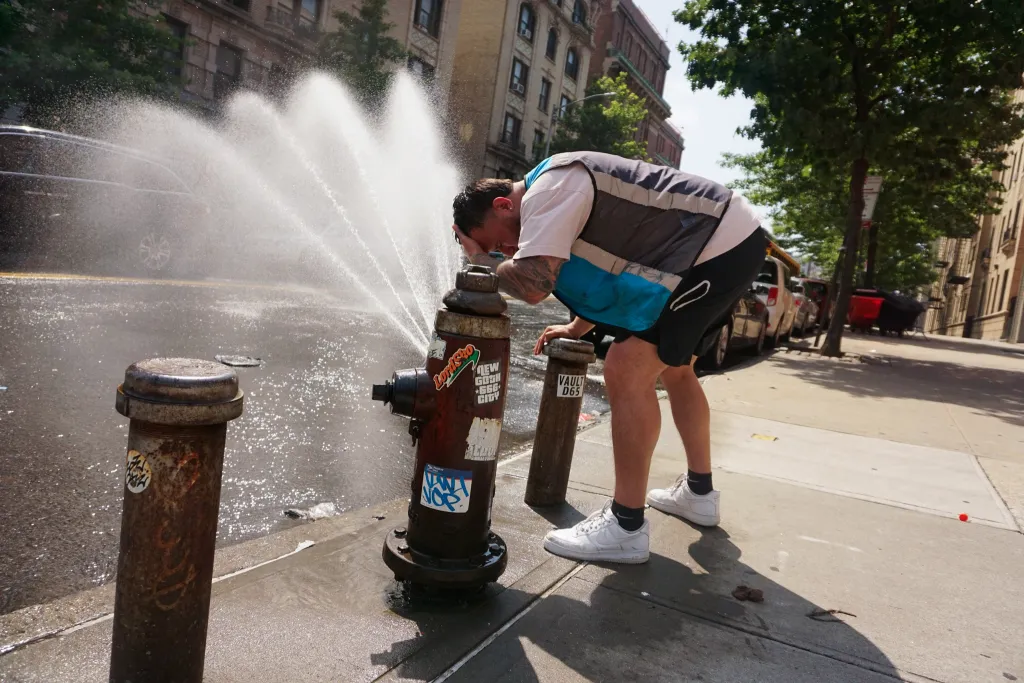
Summer in the city is for Coney Island, Central Park and coco-mango-cherry carts. But when the heat becomes dangerous — as it will this holiday weekend — the focus switches to cooling centers, Con Ed and air conditioning.
Beginning Wednesday through at least Saturday, a heat wave is hitting New York City, and hard. Feels-like temperatures could soar as high as 109 degrees on Friday. Mayor Zohran Mamdani activated a Heat Emergency Plan on Monday, broadening New Yorkers’ access to cool-down centers, and reminding local agencies of existing rights regarding the heat.
The heat is no joke; last year, 21 New Yorkers died from heat, the highest tally in a decade. Nineteen of those deaths happened as a result of just a four-day heat wave in June.
When it comes to staying cool — whether in your home or at your workplace — you have some rights in the city. Here’s what to know about those, how to protect yourself, and what you can do if those rules aren’t being honored:
Getting away from heat: Cooling centers (for your pet, too)
Because of Mamdani’s Heat Emergency Plan, a number of services will be available to any New Yorker who needs them, free of charge. The Department for the Aging will operate 280 cooling centers during the week, and 210 during the weekend, the commissioner said on Tuesday.
Cooling centers can be found in libraries, community centers, senior centers and NYCHA facilities, and you can find one near you here. Cool It! NYC also has a map of spray showers and drinking fountains available here.

In addition, 15 mobile Cooling Outreach On-Location stations, or COOL vans, from NYC Health & Hospitals will distribute water, electrolytes and sunscreen, as well as providing wellness checks, medical care, and transportation to cooling centers or health care facilities. Vans will have a registered nurse or nurse practitioner on board, meals and snacks, and will be dispatched for at-home wellness checks for seniors.
The Dept. of Health and Mental Hygiene will also operate pop-up cooling stations, complete with water, misting fans and cooling towels. Outdoor workers including street vendors, delivery drivers and laborers are encouraged to use these services. The department will also use Health Action Centers and Overdose Prevention Centers as cooling centers.
Anyone is welcome to go to cooling centers, and so are service animals. Some cooling centers allow pets — call each location to find out whether yours does, too — but all Petco locations in New York City serve as cooling centers for you and your pets.
Right to cooling? Not quite on the books
There is also no right to cooling in New York City — yet.
In January, City Hall passed a bill creating a “cooling season” — similar to the winter’s heating season — between June 15 and Sept. 15. Starting in 2030, landlords must provide tenants with air conditioning capable of maintaining 78 degrees or less in bedrooms, upon request.
So for now, if your apartment is too hot, definitely head to a cooling center.
And it’s crucial to check in on your neighbors to make sure they’re OK. See our guide for specific questions to ask.
Is there something we missed that should have been included in this article? Have a question? Get in touch with our newsroom at ask@thecityreporter.nyc.
Con Edison
Con Ed, the utility behemoth behind your air conditioner (and lights, and possibly your stove) is committed to keeping the power running, it says. Con Ed’s policy — as governed by the state Department of Public Service — is to not disconnect your power the day of, or day before, the heat index is projected to reach 90 degrees or higher at Central Park. And if the heat index exceeds 90, the company will suspend disconnections for the next two days.
If you are wrongfully or mistakenly disconnected despite that rule, contact Con Ed right away.

Still, during heat waves, power grids can be overrun to the point of blackouts, with air conditioners eating up lots of energy. And it wouldn’t be the first time: around the same time last year, more than 10,000 homes were left without power due to a heat wave, primarily in Brooklyn and Queens. If you experience an outage, report it to Con Ed here.
If you get an alert from Con Ed asking you to limit energy use, it’s important to do so. Energy-intensive electric use can strain the aging electric grid, which puts you and your neighbors at risk of power outages.
Pause on evictions
The Department of Investigation paused evictions on July 1 and 2. Evictions must take place on business days, which excludes weekends and holidays, so no one should be evicted during the span of this heat wave.
“No city marshal should show up at anyone’s house to evict them,” said Carolyn Norton, interim chief of litigation and advocacy at Legal Services NYC. “That would be a direct violation of their city directive.”
In the event a marshal attempts an eviction, the tenant should contact 311 to make a complaint with the city, and reach out to a legal services organization, Norton said.
There’s no official policy that pauses evictions in the case of extreme heat or other dangerous weather. It’s up to the DOI and the courts to make the call.
The city previously suspended evictions on May 19 and 20, when temperatures soared past 95. But when it was 100 degrees outside on June 12, 55 households got evicted, according to data from the New York City Marshals. Evictions were not suspended that day.
On the job: Worker rights
Through the city’s protected time off law, most employees are entitled to up to 40 or 56 hours of paid protected time off, for reasons including heat-related illness.
The Department of Consumer and Worker Protection will remind local workplaces of your rights, too: tens of thousands of businesses will be informed of extreme heat guidance and urged to comply with labor laws, the city said.
June 22, Mayor Mamdani signed into effect an executive order establishing guidance to prevent heat-related illness in the workplace. For construction workers, the Department of Buildings must review construction safety requirements to ensure they protect against heat-related illness, and for municipal workers, mayoral agencies must develop heat-illness plans for indoor and outdoor workers.
Per Department of Labor and federal OSHA laws, employers have a legal responsibility to protect employees from heat-related illness. According to guidance from the labor department, employers should provide each outdoor employee with 32 ounces of cool drinking water per hour at no cost. Employees should be given sufficient time to drink water throughout the work day, and water needs to be available at all times. Federally, all workers — not just outdoor workers — must be provided with potable water throughout the work day.
Employers should also provide shade and paid rest as needed when the heat index exceeds 80 degrees, 15 minutes every two hours when the heat index exceeds 90, and 15 minutes an hour when it exceeds 100. If the heat index exceeds 110, employers should consider rescheduling work, and if that’s not possible, 15 minutes of work with 45 minutes of rest every hour is encouraged.
For more information on outdoor workers’ protections, read the Department of Labor’s full guidance here.
Is there something we missed that should have been included in this article? Have a question? Get in touch with our newsroom at ask@thecityreporter.nyc.
Our nonprofit newsroom relies on donations from readers to sustain our local reporting and keep it free for all New Yorkers. Donate to THE CITY today.
The post A Heat Wave is Hitting New York. Know Your Rights Ahead of Soaring Temps. appeared first on The City Reporter.
