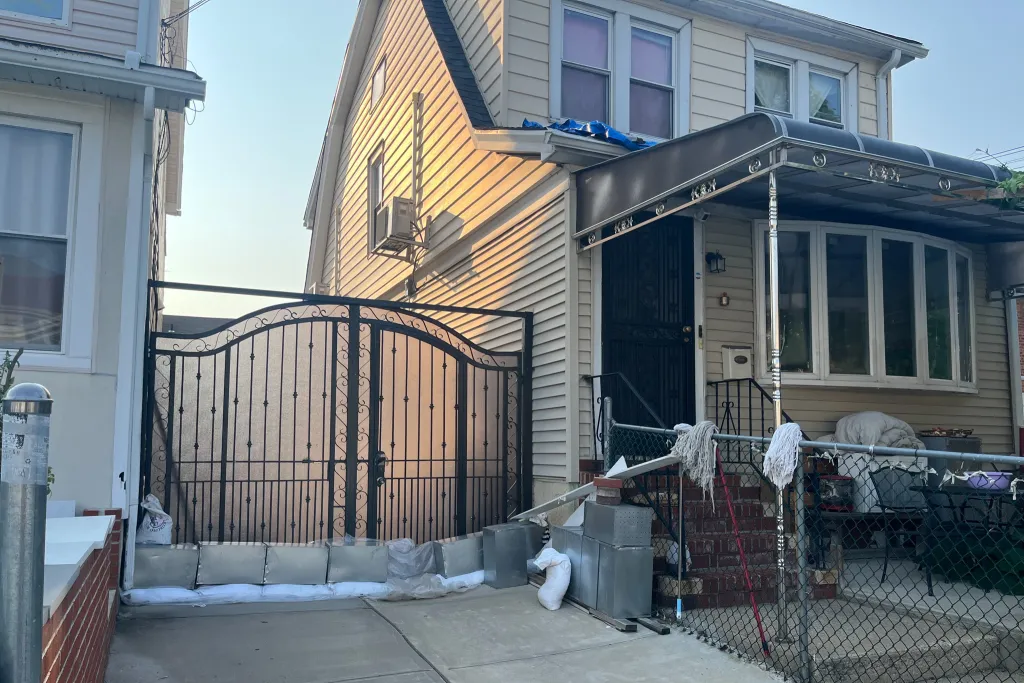
New York City is expanding outreach to homeowners in flood-prone areas of Queens to see whether they would consider selling their homes to the government as part of a climate adaptation program.
The program, called Resilient Acquisitions, targets neighborhoods where flood mitigation measures are limited. The increased outreach started this summer in Hollis, which sits atop a former pond, and the Kissena Park area of Flushing, where a swamp and creek once stood. Heavy rainstorms in May and July flooded homes on low-lying streets in these neighborhoods.
There is not yet funding for buyouts in Kissena Park or Hollis. For now, the Mayor’s Office of Climate and Environmental Justice is gathering information to gauge interest and assess feasibility.
“We are listening to homeowners and community members about their interest in voluntary buyouts and evaluating potential pathways forward,” said Pia Fouilloux, a spokesperson for the office.
As The City Reporter previously detailed, MOCEJ is also exploring buying out homeowners in the Jewel Streets area on the Queens-Brooklyn border. That neighborhood is known as the Hole because it sits in a basin below sea level and is not hooked up to the city’s sewer system.

Early Signs of Interest in Buyouts
Some Queens officials and residents have welcomed the possibility of buyouts, made more real by an expression-of-interest form disseminated by MOCEJ.
“I don’t think the current situation is going to get better,” said Councilmember Sandra Ung, who has advocated for the city to buy out homeowners in flood-vulnerable areas. “So I think it’s important to start having these conversations, recognizing that it could take, realistically, a very long time for this to happen.”
Both Hollis and Flushing recorded multiple drowning deaths in basement apartments as a result of Hurricane Ida in September 2021, including a family of three and a mother and her son.
Leona Chin, a Flushing resident and founder of the park stewardship group Kissena Synergy, said she and other volunteers have been helping spread the word about the buyout program to residents.
“Initially, people were suspicious,” Chin said. “People said, ‘That’s not for real, that’s not really going to happen.’”
But people in both neighborhoods who have put up with flooding for years are interested, according to multiple interviews with neighbors and elected officials. MOCEJ did not disclose how many people have filled out the form.
One of them is Hollis resident and local community board member Amit Shivprasad, whose family owned the house where the mother and son died in Ida’s remnants. He has been calling for the government to buy out him and his neighbors, who he said have spent thousands of dollars fixing up their homes after repeated floods. Many suffer from anxiety every time it rains, and some have already put their homes on the market.
“I’m happy people have decided it’s time to leave, but I don’t want someone to come and buy the property and then they have to deal with what they’ve been dealing with,” he said. “I want to get these buyouts done so we can take care of this as a long-term solution.”
Floodwaters reached 46 inches high at a Hollis intersection on May 20 this year, according to local flood sensor data. Surveillance camera footage reviewed by The City Reporter showed a person swimming across the street, where a car was almost fully submerged.

Managed Retreat
Research shows most urban areas built on historic waterways tend to flood and will continue to do so into the future. The idea behind buyouts is for the city to take flood-prone properties and use them for something else, such as parks, natural areas or stormwater storage systems.
The city and state used buyouts and property acquisitions in coastal Queens and on Staten Island in the aftermath of Superstorm Sandy in 2012. Recent efforts mark the first time New York City has tried the approach with an eye toward inland areas that experience stormwater flooding.
Buying up homes in areas vulnerable to flooding is a climate adaptation strategy known as managed retreat, where authorities move people, buildings and infrastructure out of harm’s way. But taking homes offline in a housing crisis and breaking apart communities present a complex, expensive endeavor.
Buyouts are often used in areas only where flood mitigation is particularly challenging. Both Hollis and the Kissena Park area fit the bill.
The city park surrounds a three-block enclave of mostly detached small houses on leafy and quiet streets near playing fields and canopied walking paths. On a recent evening, The City Reporter observed a handful of homes in the area with for-sale signs outside. Two were listed for more than $1 million. While the day had been sunny, some makeshift flood barriers of tarps, bricks and sandbags still sat in front of garage doors and fences.

Sam Wu, who has lived in Kissena Park for two decades, said he submitted the buyout interest form to the city but is unsure about what the process will entail. He lives with his family on the top floor of his home, while his brother lives on the ground floor with his family.
Wu said he’d like to move to Long Island eventually, but a buyout offer could influence his decision.
“Should we move out east first, or should we hold off and hope the city pays us out?” he said. “What if I wait five, six years and there’s still nothing happening?”
In Kissena, city officials have a plan to build a cloudburst hub, or series of interventions that can handle an onslaught of rainwater. They are also exploring creating a bluebelt, an engineered enhancement of a natural watershed to store and channel stormwater. But those projects are years away.
Wu’s family moves their cars when rain is forecast and seals up the inside of their home’s lower floor to prevent too much water from entering.
“I’m kind of used to it,” he said. “It sucks that I have to say that I’m kind of used to it, because it’s not normal for someone to have to worry about their home being flooded.”
Our nonprofit newsroom relies on donations from readers to sustain our local reporting and keep it free for all New Yorkers. Donate to THE CITY today.
The post NYC Targets Homeowners in Flood-Prone Areas of Queens for Potential Buyouts appeared first on The City Reporter.