Last October, 10 days out from his historic victory in the 2025 mayoral election, Zohran Mamdani made his final pitch to members and delegates of the city’s largest municipal union.
District Council 37 had supported the democratic socialist upstart in the dramatic Democratic primary that summer, and Mamdani would return the favor, he said, by working with allies in Albany to reverse pension rollbacks and providing raises commensurate with life in the most expensive city in the country.
“Every day you sacrifice that little bit of yourself for the place that we all call home. It’s time for us to see the value of your labor, the importance of your labor, and to recognize that in the policies, in the contracts, and the delivery of what we do,” Mamdani said.
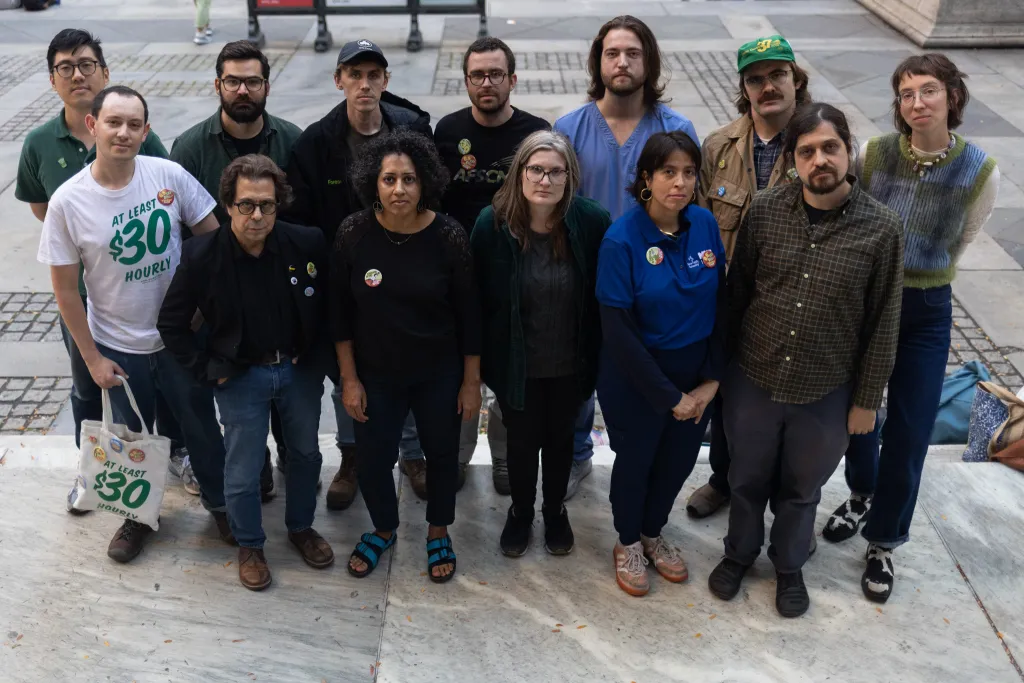
Now, with contract negotiations for the union’s roughly 100,000 members set to ramp up this fall, a crop of insurgent rank-and-file members, led by young, left-leaning workers, is pushing union leadership to ensure Mamdani lives up to his campaign promises. Many of them take credit for pushing top union brass to include Mamdani — seen at the time as a long shot — in the union’s candidate rankings during last year’s primary.

“Like many large unions, DC 37 does not engage deeply with its membership, which is not the way it should be,” said Adrian Singleton, a member of Local 375 and a field coordinator for the rank-and-file contract campaign. “Our goal is to meet members all around the city, and involve them in the decision-making processes of our campaign.”
For more than a year, these insurgents have been organizing DC 37 from the inside, sweeping local leadership elections and infiltrating the union’s delegates assembly, which rules on issues governing the entire membership.
“My eyes were really opened when I went to my first delegates assembly meeting,” said Cristina Rodriguez-Hart, a delegate from Local 3005. She said newcomers like herself were sidelined during discussions.
“We certainly can’t do our jobs like that and expect to get a paycheck and continue with our jobs,” she said. “So why should our union function like that?”
MORE: Follow The City Reporter’s Award-Winning Labor Coverage
The reformers are channeling long-simmering frustrations that pay raises from previous contracts have not kept up with inflation or helped members on low-paying jobs, such as school crossing guards. The union’s executive director, Henry Garrido, is also a key architect of a cost-saving plan to switch the city’s retirees to a privatized Medicare plan, which imploded after intense backlash from retirees and younger members.
In a key issue for the insurgents, Garrido secured a remote work pilot for some civil servants in the most recent city contract, a highly sought-after victory. While the pilot has been extended several times, many workers complain of inconsistent implementation.
Among the demands of the rank-and-file contract campaign: 6.5% yearly salary increases, permanent telework, and a $30 hourly wage floor.
The latter, the reformers are quick to point out, is modeled on Mamdani’s campaign promise to raise the citywide minimum wage by 2030.

“We’re trying to hold him to account on that,” said Thomas Hummel, a member of Queens Library Guild Local 1321. “If you want this for the general working class of New York City then start with where you have immediate power — and that’s your city workers.”
The group has gathered more than 4,000 petition signatures and counting in support of their bargaining agenda — a long way from its goal to collect 30,000.
“We gotta get member support. If the members don’t support the demands of this campaign, then we’re not going anywhere,” Hummel said. “We’re not trying to be a niche little group with our own agenda. We have to get widespread member support, and that is our big focus.”
Their demands face a tough fiscal outlook. The insolvency of a key fund that pays for prescription drugs, chemotherapy and other supplemental health benefits has left city and union negotiators scrambling to come up with a solution. The two sides are unlikely to begin talks on a new collective bargaining agreement until they first hammer out a deal to fund that program, known as PICA.
Garrido, through a union spokesperson, declined to speak with The City Reporter.
Bernie’s Kids
The rank-and-file contract campaign began to take shape early this year, when a handful of organizers crafted a membership survey to help develop their contract demands. They canvassed outside city agencies, Housing Authority facilities, libraries and hospitals during morning and evening shift changes and on the weekend, and DIY’d their own buttons to hand out to supporters, said Singleton. (DC 37 surveyed its members in the summer.)
The primary organizers of the reform effort are early in their careers. Like many other union activists who’ve emerged in the last decade, they cut their teeth knocking on doors for Bernie Sanders and entered the labor movement through the Democratic Socialists of America or Labor Notes, a magazine and non-profit that offers organizing workshops.
Their takeover efforts have led to friction. This summer, top DC 37 leadership moved to oust the president of a small insurgent local who led a protest outside the union’s Barclay Street headquarters in July. Colleagues from two other locals accused Meghan Peterson, who leads Local 3005, of improperly influencing and intimidating their members, which Peterson denies.
Another reformer leading the contract push is a member whose complaint led to the ouster of an embattled leader who misappropriated union funds from one of the union’s largest locals. That reformer, Honda Wang, is now a member of a different DC 37 local representing NYCHA clerical employees and an organizer of the rank-and-file contract campaign.

Union reform movements are not new, and the reformers have plenty of inspiration to draw from. In 2024, a group of advocates took over the leadership of a prominent United Federation of Teachers local in a shock victory that pushed president Michael Mulgrew to renege on his support for a controversial Medicare Advantage switchover for city retirees.
And in the private sector, reform efforts at the United Auto Workers and the International Brotherhood of Teamsters have turned the leaders that they elevated — the UAW’s Shawn Fain and the Teamsters’ Sean O’Brien — into national firebrands.
Under Peterson’s tenure, Local 3005 has been a thorn in the side of the Garrido flank of DC 37. Her slate swept the local’s leadership elections last year following a controversy over the union’s investments in Israeli stocks and bonds. In July, she led a demonstration accusing Garrido and other top union leaders of shutting her faction out of contract talks. That rally was nearly broken up by Port Authority police over an apparent permit issue before the protesters marched to the union’s headquarters.
That demonstration is the center of the push to oust her. Peterson is challenging the charges and a trial with DC 37’s parent union, the American Federation of State, County and Municipal Employees, is scheduled for Oct. 15; The Chief Leader first reported on the dispute.
“We were really just doing what most unions would do in a contract fight to advocate for better working conditions and respect on the job,” Peterson told The City Reporter. “This case is really important because at the end of the day it’s about free speech which is something that is constitutionally guaranteed by AFSCME, our international union.”
Breaking the Pattern?
For more than a century, New York City labor negotiators have relied on a system known as pattern bargaining. That system, which is not required by law, uses one union to strike a deal on wages, health care, and other benefits that then becomes the baseline the other municipal unions use to negotiate their contracts. Which union sets that pattern is a matter of intense attention and maneuvering across the city’s labor landscape.

Traditionally, City Hall has pushed for DC 37 or the United Federation of Teachers — the two largest civilian unions — to establish the pattern. The custom has been a source of immense controversy within the labor movement for decades, with detractors arguing the practice encourages top-down deal-making rather than taking members’ interests to heart.
At a WNYC town hall in April, longtime union activist Marc Kagan — who was Mamdani’s high school history teacher — pressed the new mayor on whether he would move away from the practice. Mamdani responded that the concept “is something [that] is worthy of consideration” and that he would take it back to his team.
So far, Mamdani’s moves suggest he won’t stray from his predecessors’ approach to collective bargaining. He retained Renee Campion, the city’s top labor negotiator under mayors Bill de Blasio and Eric Adams. Campion’s surprise announcement that she would retire before the end of the year has also scrambled the timeline for contract talks, according to several sources.
‘Getting Noticed’
Dean Fuleihan, Mamdani’s first deputy mayor, was de Blasio’s budget director in 2014, when the city brokered deals with the city’s unions that required dipping into a health fund to help pay for raises. That fund is now insolvent, and contract talks are stalled as union and city negotiators figure out a way to close the funding gap.
The Mamdani administration has made some strides to improve the city’s civil service. On Monday, he announced a task force to study the dysfunctional civil service system and make recommendations to state lawmakers to overhaul hiring.
Rodriguez-Hart, a Mamdani supporter, said the effort is long overdue but noted she is “concerned” that the mayor’s brain trust includes union leaders, including Garrido, but no rank-and-file members.
“Zohran needs to engage the rank and file more consistently and thoroughly,” she said. “But it’s definitely getting noticed.”
Our nonprofit newsroom relies on donations from readers to sustain our local reporting and keep it free for all New Yorkers. Donate to THE CITY today.
The post Left Flank Riles Union Old Guard as City Contract Talks Loom appeared first on The City Reporter.
