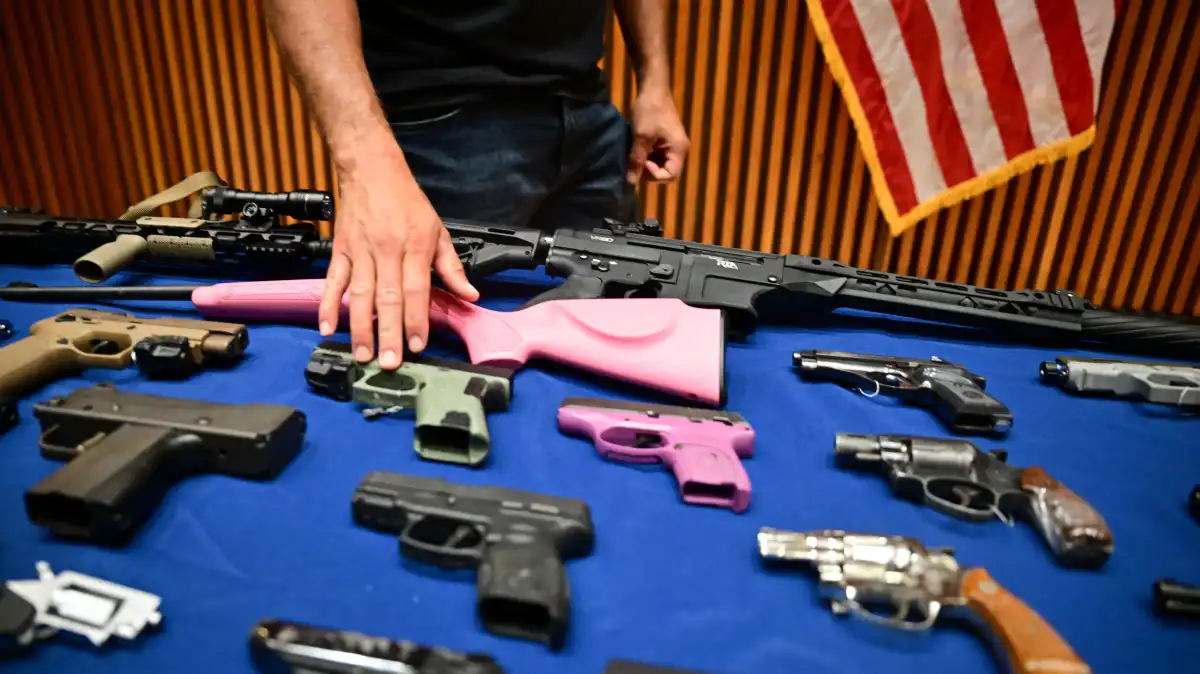
Manhattan District Attorney Alvin Bragg led a nationwide group of prosecutors in pushing the country’s biggest 3D printer companies to do more to prevent people from using the devices to print their own unlicensed ghost guns at home.
The group, called Prosecutors Against Gun Violence and made up of 20 prosecutors across the U.S., sent letters on Monday to major 3D-printer companies Bambu Lab, Creality and Flashforge, urging them to proactively implement printer-based solutions blocking the manufacturing of 3D-printed firearms and parts and requesting a meeting with the companies’ representatives to ensure the necessary actions take place.
“We write to you today with an urgent concern about the growing threat of 3D-printed firearms that are being manufactured using your company’s printers,” one of the letters the group wrote reads. “We urge you to expeditiously work on a printer-based solution to identifying and blocking the manufacture of all 3D-printed firearm parts … It is imperative that your company takes swift action towards the implementation of these commonsense safeguards.”
The prosecutors say the 3D printer companies need to equip all 3D printers sold in the country with blocking technology, which uses blueprint-detection algorithms to scan and identify design files and stops the printer from creating unauthorized objects, like unlicensed and illegal firearms and firearm parts.
3D printing guns is dangerous, the prosecutors say, because they lack serial numbers and the availability of 3D-printing technology makes weapons easily accessible to “dangerous individuals,” including those convicted of felonies or domestic abuse and those with restraining orders. People are able to circumvent background checks and prohibitions on owning firearms by manufacturing their own firearms and firearms parts privately, and, because 3D printing allows individuals to construct firearms out of plastic, they may also be able to evade metal detectors at critical security checkpoints, increasing the risk of violence in secured facilities like courthouses or airports, the prosecutors hold.
The group told the 3D printer companies that guns made from their printers are “increasingly playing a central role in the arsenals of violent extremists,” like domestic terrorists, and those looking to commit untraceable crimes.
“The ability to manufacture 3D-printed firearms at home is a very real and present national public safety threat,” said Bragg, who leads the group, in a statement about the letter. “New York has taken monumental strides to combat the proliferation of 3D-printed guns, but trafficking does not stop at state borders. Prosecutors from across the U.S. are calling on major 3D-printer companies to protect our constituents, including their customers: act swiftly to prevent your machines from producing dangerous firearms.”
Last month, the State of New York became the first jurisdiction in the United States to pass a law requiring 3D printers sold to have safeguards preventing the printing of firearms and firearm parts. Other state legislatures, including California and Washington, have similar legislation pending.
