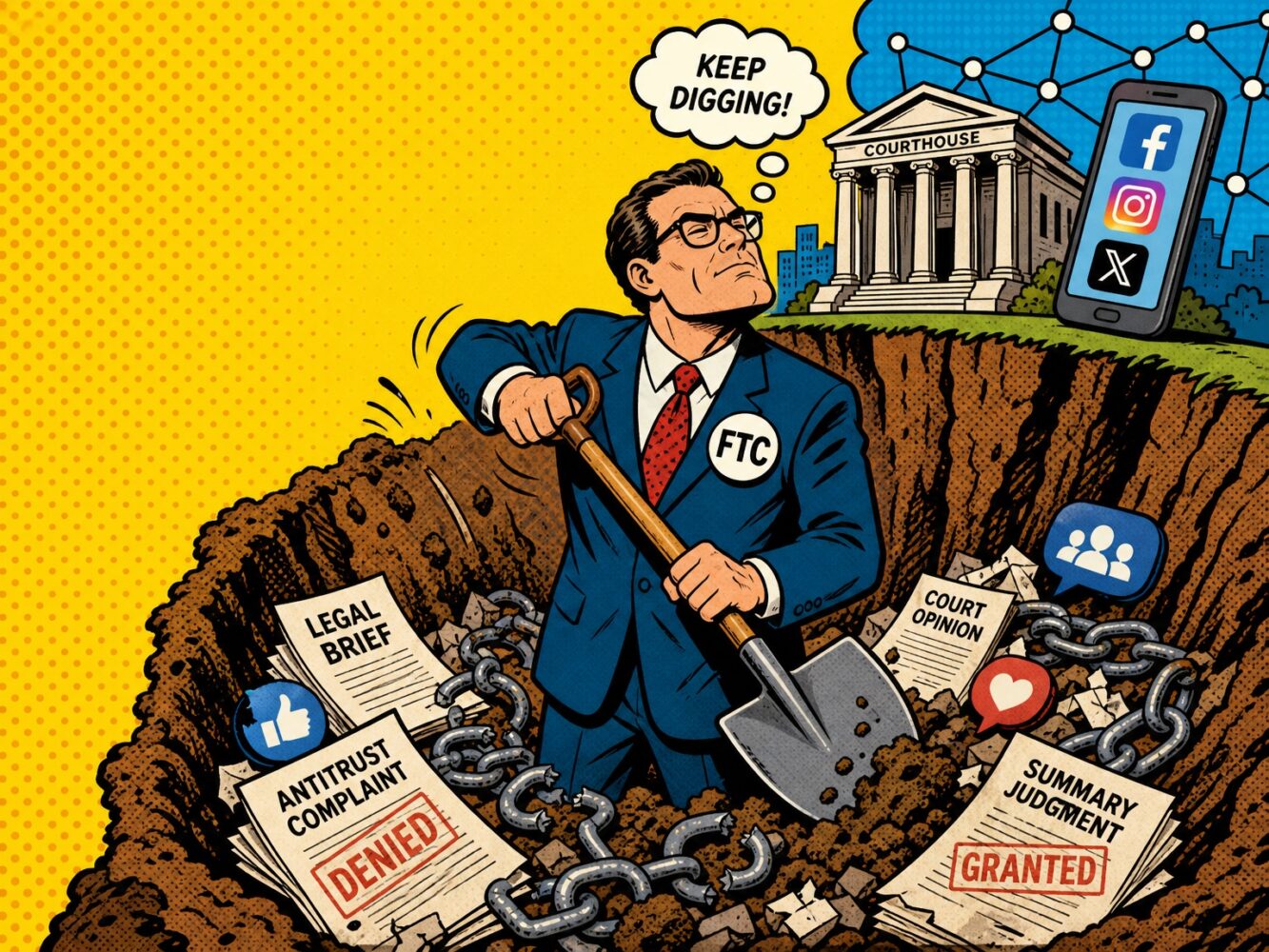
The first rule of holes is supposed to be: stop digging. The sunk-cost fallacy is realized when we keep digging anyway—and then call it resolve.
We—people—often have a hard time letting a bad thing go. That’s true even for those who are well acquainted with the sunk-cost fallacy and should know better. I’ve been there. I’ve felt that misguided determination, and I’ve felt the consequences.
The same is true of the people who run federal agencies, including the two with which I’m most familiar: the Federal Trade Commission (FTC) and the Antitrust Division of the U.S. Department of Justice (DOJ).
Which brings me to . . .
The Appeal of a Sunk Cost
On May 22, the FTC filed an appeal in FTC v. Meta Platforms, Inc.; that is, the FTC filed its opening brief appealing the agency’s loss in November 2025 before the U.S. District Court for the District of Columbia (readers might do well to consult the revised December 2025 opinion, which is largely the same as the November opinion, but with fewer redactions). As I noted back in April 2025, the FTC’s case seemed to me (among many others) an uphill battle. And as I noted in December 2025, Judge James Boasberg’s decision:
Doesn’t exactly provide the law & economics analysis I would have produced, had anyone asked for it. But it is, nonetheless, a good decision by a thoughtful, generalist trial-court judge wrestling with both the evidence before him and relevant precedent. He got key things right, not least of which was the decision for the defendant.
For additional critiques of the FTC’s case, see Brian Albrecht, Mark Jamison, Joe Coniglio, Alden Abbott, and—for a banger Tech Policy Podcast—Geoff Manne. For additional background, see Daniel Crane and Herbert Hovenkamp’s critique of the “monopoly broth” theory applied to what was originally the Facebook case, albeit in an amicus brief filed in another matter.
I won’t recapitulate most of the case against the FTC’s position. There’s plenty to be found in the opinion itself (linked above), and I discuss many of these points in the Truth on the Market posts I identified (and linked) above.
Here, I want to focus on the FTC’s appeal, which gets a bit into the weeds of the FTC Act and the Sherman Act, both in terms of statutory construction and jurisprudence. I’m sorry about that, but that’s the law part of law & economics, and law & economics is “the business we have chosen.”
The brief advances two arguments that, on the FTC’s account, identify “fundamental and independent ways” in which the district court erred, “each of which warrants reversal.” The second seems to me to hint at the FTC’s basic challenge on appeal. There, the commission argues that the district court “misapplied fundamental antitrust law principles by failing to recognize the validity of the PSN [personal social networking] market, whether in 2020 or 2025.”
I think that’s wrong, but I’m not going to spend this blog post rehashing the better part of Judge Boasberg’s 89-page decision identifying the central reason the FTC lost at trial: the burden of proof belonged to the plaintiff, and the plaintiff did not meet it. The challenge for the FTC is that the U.S. Court of Appeals for the District of Columbia Circuit is not about to review the case de novo, nor is it likely to repudiate the trial court’s findings of fact.
I think that’s why the FTC leads with an argument about the proper reading of Section 13(b) of the FTC Act. The goal is to identify a reversible error by the trial court. In practical terms, that would have to be an error of law, and a reversible one at that. It’s all about timing, and while the issue is presented as a simple matter of statutory construction, it’s not so easy.
The FTC’s argument about Section 13(b) was nowhere in my mind when I first wrote about the case in 2023, long after the FTC filed its complaint, but well before the matter went to trial. Nor is it what interests or concerns me most about the appeal. But it is the agency’s principal argument at this stage, so here goes.
The FTC’s Section 13(b) Detour
The heart of the commission’s appeal, as it presents the matter, can be found in this passage from the brief’s introduction:
Start with the major premise—that the FTC was obligated to prove a 2025 monopoly. The court’s cursory analysis focused on Section 13(b) of the FTC Act, which authorizes the Commission to “bring suit” in certain cases “[w]henever” it “has reason to believe” that the defendant “is violating, or is about to violate” any law the Commission enforces. 15 U.S.C. § 53(b), (b)(1). By its plain terms, this is a pleading requirement that applies at the time of the complaint. Nothing in the statutory text requires the Commission to make any substantive showing as of the time of decision. . . .
That simple observation resolves the appeal. As a result, this Court need not consider the broader question of whether Section 13(b)(1) applies here at all. The answer is no. This case was brought under the second proviso of Section 13(b), which empowers the Commission to seek permanent injunctive relief in federal court. Section 13(b)(1) is located in a different part of Section 13(b) and does not apply to second-proviso cases.
I think I see where they’re going with this, but it’s a bit confusing, not least because the latter paragraph is wrong. And the FTC repeats the mistake multiple times, in multiple sections of the brief. On page 16, it asserts that “fundamentally, Section 13(b)(1) does not apply to cases like this one, where the Commission seeks a permanent injunction . . .” directly in federal court. We find more of the same on page 20, and again on pages 30-32.
But it’s hard to see any way around the opposite conclusion. That “different part of Section 13(b)” is Section 13(b)(2), and the plain language of the statute does not permit 13(b)(1) and 13(b)(2) to be separated.
The relevant section of the FTC Act, 15 U.S.C. § 53, authorizes the commission to bring suit in federal court. Section 13(a) addresses suits involving advertisements, where the commission has “reason to believe” the ads violate Section 12 of the FTC Act.
Then comes Section 13(b), which authorizes suit under two conjunctive conditions. First is Section 13(b)(1)—the forward-looking provision. Second is Section 13(b)(2), which authorizes suit for a temporary restraining order when the commission has reason to believe there is, or is about to be, a violation of “any provision of law enforced by the Federal Trade Commission.” That same provision also states that “in proper cases the Commission may seek, and after proper proof, the court may issue, a permanent injunction.”
But the statute bundles Sections 13(b)(1) and 13(b)(2) together. It is Section 13(b)(1) and Section 13(b)(2)—both satisfied—that authorize the commission to go to court. It’s all Section 13(b), all the time. The subheading for Section 13(b) is somewhat misleading because it references “[t]emporary restraining orders; preliminary injunctions.” But there is no other relevant part of Section 13(b). You cannot get to Section 13(b)(2) without first passing through Section 13(b)(1), and both preliminary and permanent injunctions appear in Section 13(b)(2).
What about Section 13(b)(3)? Well, there “ain’t no sanity clause,” and there’s no such thing as Section 13(b)(3), either.
The whole business about “a different part of Section 13(b)” is a distraction. The claim that Section 13(b)(1) does not apply to that “different part” is wrong—or, in the language of Section 5, “deceptive” (that is, material and false or misleading).
The commission also tries to support its position with precedent, including the Supreme Court’s opinion in Alaska v. United States. The citation is strained, at best, and provides no support for the FTC’s conclusion that “[t]he permanent injunction proviso in Section 13(b) grants an additional power not contingent on anything that precedes it.” For that matter, neither Alaska nor the FTC’s accompanying citation to Beaty concerns the meaning or construction of any provision of the FTC Act, much less Section 13(b).
Enough of that aside. I don’t think the argument works. But I also think it’s something of a red herring.
The opinion does state that “[t]o win the permanent injunction that it seeks here, the FTC must prove a current or imminent legal violation.” That’s right there, in black and white, on page 23 of the 89-page memorandum opinion.
What difference that makes is a separate question. According to the FTC, Judge Boasberg’s reading “could improperly deprive courts of the power to remedy past unlawful action even if it threatens to recur or continues to cause grievous harm.”
I don’t think that’s right. And I’m not entirely sure the commission believes it, either.
The brief is clear enough—at least later in the game—that its authority to go directly to district court seeking a permanent injunction “in proper cases” comes from Section 13(b)(2). The two sitting commissioners, along with the staff in the FTC’s Bureau of Competition, are experienced attorneys and more than capable of reading the conjunction that joins Sections 13(b)(1) and 13(b)(2).
There may well be difficult questions of statutory interpretation lurking in this portion of the opinion. But Section 2 of the Sherman Act (allegedly violated by the Instagram and WhatsApp acquisitions) and Section 7 of the Clayton Act (typically at issue in merger challenges, although the FTC did not plead a Section 7 violation here) are both forward-looking. Yet neither bars challenges to consummated mergers.
As the FTC’s opening brief itself puts it, the relevant question is whether the conduct at issue is harmful and whether it “threatens to recur or continues to cause grievous harm.”
I don’t think there is any serious argument that Judge Boasberg was confused about that. Which suggests that the FTC’s appeal is really about a different question of timing.
The Timing Problem
To get at that question, I’ll construct an abridged—if not brief (sorry)—timeline.
February 2004: Facebook launches (as “the Facebook”).
2006: Facebook continues expanding its reach, adding functionality, and developing its business model.
By the end of 2007, Facebook has surpassed MySpace in social-media traffic (a metric the FTC would later distinguish from its proposed PSN market).
2012: Facebook acquires Instagram. The proposed transaction is reported to the antitrust agencies and cleared to the FTC for review. Following an investigation, the FTC votes 5-0 to close the matter and issues a closing letter.
Yes, there were the supposed “hot docs.” But they weren’t that hot, and they didn’t—and shouldn’t—have made a case.
At the time of the acquisition, Instagram had just 13 employees, and its app was one of many photo-sharing apps on the market, including Google’s predecessor to Google Photos.
The staff—and the Commission—rightly concluded that this was a defensible buy-or-build decision to add functionality, not a “killer acquisition,” not a violation of Section 7 of the Clayton Act. I don’t recall whether any time was wasted considering a Sherman Act Section 2 complaint.
The FTC was hardly alone in that view. The UK Office of Fair Trading also reviewed the transaction, concluding that it “does not believe that it is or may be the case that the merger may be expected to result in a substantial lessening of competition within a market or markets in the United Kingdom.”
Had the commission possessed a crystal ball, it would have seen what we know now: there were still many photo-sharing apps in 2020, and there are still many today, all with far greater functionality than Instagram offered in 2012.
2014: Facebook acquires WhatsApp—roughly the same story, albeit with less drama.
WhatsApp operated a paid messaging app. It was tiny and barely present in the U.S. market. There were many other messaging apps.
The transaction was reviewed by the FTC, which again voted 5-0 to close the investigation.
The European Commission likewise reviewed the deal, concluding that Facebook and WhatsApp were not close competitors and that the transaction posed no threat to competition in online advertising.
Had the commission possessed a crystal ball here, it would have found much the same result.
2020: On Dec. 8, the FTC filed a monopolization complaint alleging that the Instagram and WhatsApp acquisitions—transactions the commission itself had previously reviewed and declined to challenge—were key elements of a broader scheme of unlawful monopoly maintenance in violation of Section 2 of the Sherman Act.
FWIW, I don’t recall any economists in the bureau of economics—or anyone in my office, the Office of Policy Planning—who thought bringing the case was a good idea.
2021: Facebook moves to dismiss. On June 28, Judge James Boasberg dismisses the complaint, albeit with leave to amend.
Reading the complaint now, it strikes me as rushed and, I’m sorry to say, not very good. Judge Boasberg was right to dismiss it.
Later in 2021, the FTC files an amended complaint and then a substitute amended complaint.
2022: Facebook again moves to dismiss. This time, Judge Boasberg concludes that the FTC has cleared the pleading bar, while cautioning that “Ultimately, whether the FTC will be able to prove its case and prevail at summary judgment and trial is anyone’s guess.”
2024: The parties file cross-motions for summary judgment. On Nov. 13, Judge Boasberg largely denies both motions, and the case proceeds.
2025: A six-week bench trial takes place in April and May. In November, Judge Boasberg rules for Meta. An unredacted version of the opinion follows on Dec. 2.
AND THAT SHOULD HAVE BEEN THE END OF IT.
But it brings us back to the timing issue, and to pages 22-24 of the opinion.
The language there, too, might be a bit confusing. The FTC is hanging its first—and primary—hat on this hook: “Throughout this case, the [district] Court has held that the agency must prove that Meta is violating the law now.” And that, the opinion says, should be distinguished from a finding that there is “lingering harm” from a past violation of the FTC Act.
The FTC and the opinion do not disagree about the high-level requirements for establishing a Section 2 violation. As the Supreme Court held in United States v. Grinnell Corp., “[t]o prove monopolization under Section 2, a plaintiff must show ‘(1) the possession of monopoly power in the relevant market and (2) the willful acquisition or maintenance of that power as distinguished from growth or development as a consequence of a superior product, business acumen, or historic accident.’”
The opinion maintains that the FTC must show monopoly power and willful (impermissible) maintenance of that monopoly as, for example, through exclusionary conduct. The FTC agrees. But while the opinion says the FTC had to make that showing in 2025—presumably at the time of trial, although the FTC conjectures that “now” means the time at which Judge Boasberg drafted or published his opinion—the FTC says no. According to the commission, the immediate implications of Section 13(b)(1) are merely pleading requirements and, in any event, do not bear on the FTC’s authority to seek a permanent injunction under Section 13(b)(2).
Rather, citing Grinnell, the FTC argues that “[t]he relevant market in a Section 2 case is the market at the time of the alleged anticompetitive conduct.”
The brief doesn’t put a date on that. Given that the Instagram and WhatsApp acquisitions were the conduct at issue, we might suppose 2012. Or 2014. Or the period between the two acquisitions. Or thereabouts. Again, the FTC doesn’t quite nail it down.
There is a line early in the brief stating that “as far as Section 13(b) is concerned, what matters is the . . . time of the complaint.” I think what the FTC means is that the time of the complaint governs pleading. If that’s right, there’s no tension between that statement and the brief’s citation to Grinnell. If that’s wrong, the appeal has a more serious problem.
That brings us to . . .
The Minor Premise That Ate the Brief
Up top, I guessed that the FTC structured its brief as it did—and led with the argument about the proper construction of Section 13(b) of the FTC Act—because it knew that an appeal challenging findings of fact would be tough sledding. At best.
It really is a guess. I have no special insight into the thinking of the two sitting commissioners when the case first went to trial—Chairman Andrew Ferguson and former Commissioner Melissa Holyoak, now U.S. Attorney for the District of Utah. Commissioner Mark Meador was confirmed two days into the trial. And I have no special insight into the thinking of the Bureau of Competition personnel taking the laboring oar on appeal.
But the guess might also explain why, if the “simple observation” about Section 13(b) “resolves the appeal,” the FTC spends so much time arguing against what it calls the opinion’s “minor premise”: “that Meta’s personal social networking monopoly had somehow dissipated between 2020 and 2025.” It also may explain why the FTC devotes pages 36-69 of its 69-page brief to the claim that “THE COMMISSION DEMONSTRATED THAT META HELD MONOPOLY POWER IN THE MARKET FOR PSN SERVICES.”
That “minor premise” occupies a good deal more space than what the FTC casts as its main argument—the one that supposedly “resolves the appeal.” There is nothing improper about arguing in the alternative. But while the FTC does not quite present it as such, this second argument reads like an attempt to relitigate the merits—and the findings of fact—below.
The stated focus may be monopoly power. But the brief also addresses findings about the FTC’s personal-social-networking-services market definition, the FTC’s allegation that Facebook had monopoly power in that market, and the FTC’s allegations of competitive harm caused by the exploitation of that alleged monopoly power.
I will not rehash Judge Boasberg’s findings of fact. There were many. They are covered in some detail in the opinion, and I have sketched them already—both in anticipation, based on the pleadings, and in discussing the 2025 opinion itself.
I do not argue that every point raised in this 30-plus-page section of the brief is wrong. But I do think key parts are wrong, that some of it misrepresents Judge Boasberg’s opinion, and that much of it is conclusory. It sketches evidence the FTC presented in its pleadings, pokes here and there at the court’s treatment of that evidence, and does little to refute or rehabilitate most of the shortcomings in the FTC’s own case.
But to return to the timing issue so central to the first part of the FTC’s appeal: rather little in the FTC’s affirmative case seemed to address monopolization at the time the FTC says matters. As noted above, citing United States v. Grinnell Corp., the FTC argues that “[t]he relevant market in a Section 2 case is the market at the time of the alleged anticompetitive conduct.” And while the agency does not quite put a date on it, the mergers alleged to be anticompetitive under Section 2 were the chief courses of “conduct” in the FTC’s allegations, and they were noticed, screened by the FTC, and consummated in 2012 (Facebook/Instagram) and 2014 (Facebook/WhatsApp).
The second part of the FTC’s brief argues that the 2025 decision against the agency turns on the notion “that Meta’s personal social networking monopoly had somehow dissipated between 2020 and 2025.” But neither 2012 nor 2014 falls within that interval. Having a monopoly does not violate Section 2. And most of the allegations in the FTC’s complaint—and most of the evidence the FTC presented at trial—addressed or purported to address conditions many years after the acquisitions.
Of course, evidence about competitive conditions, including competitive harm, might bear on “lingering effects” or the long-term consequences of the acquisitions. But beyond conclusory allegations and selected “hot docs,” there is not much that goes to whether the FTC’s personal-social-networking-services market definition, first introduced in 2020, was viable—much less correct—in 2012. Nor is there much to show that Facebook had monopoly power in such a market in 2012, or that any such monopoly power was achieved by dint of the Instagram acquisition. With respect to Instagram, 2012 is “the time of the alleged anticompetitive conduct.”
The FTC could, of course, argue that Facebook later engaged in unlawful exclusionary conduct, given the 2012 and 2014 acquisitions. And it is not as if the agency has said nothing on that score. But it did not say—never mind prove—all that much.
As I have covered before, the FTC’s economic witness, C. Scott Hemphill, raised some good points about certain issues in Meta’s defense, but he offered a mysteriously weak—indeed, dubious—account of the FTC’s case in chief. The PSN market definition seemed, and still seems, gerrymandered: the product of a hash of the subjective and long-discredited “Brown Shoe factors.” As Herbert Hovenkamp has observed, “[t]he so-called Brown Shoe factors are wrong in most cases” and, in any case, even as described by the Supreme Court in its poorly aging opinion, “there was no reason to think that it was doing anything more than summarizing fact findings for that particular case.”
And the “indirect evidence” of monopoly power that turned on that hash was no better. Neither was the “direct evidence” of monopoly power presented in the alternative, which tried to hang a story about competitive harm on a weak claim about declining product quality, based solely on ad load—and no other nonprice factors—rather than price or output effects.
Judge Boasberg rightly identified some key flaws in that evidence, which, not incidentally, was not about monopoly power in 2012 or 2014 either.
As for the selective hot docs: feh. They are mostly about alleged anticompetitive intent and easily misread. For a substantial discussion of the background issue, I will point you to Geoff Manne and E. Marcellus Williamson’s article, “Hot Docs vs. Cold Economics: The Use and Misuse of Business Documents in Antitrust Enforcement and Adjudication.” For now, I will simply quote part of my earlier assessment:
The problem with email generally is that C-suite executives, like kids, can say the darndest things. Indeed, they should say and consider many things. Selected excerpts from a multitude of documents (and discovery yields multitudes) might suggest any number of things about intent. What dated excerpts show about current intent is anyone’s guess.
More than that, the excerpts in question seem suggestive of complex concerns and interests, just as one might expect. It’s not at all obvious that they signal an intent to acquire instead of competing. The deals were not “killer acquisitions”; Instagram and WhatsApp were nurtured, not killed.
And, of course, while email “hot docs” evidence “is not necessarily irrelevant, to the extent it might provide a circumstantial bolster for allegations of effects,” it is also true that:
effects matter directly, and intent is not an element of a Section 2 claim: there’s no mens rea issue here. Moreover, a decade or more post-merger, that sort of evidence can cut both ways, as it underscores the question why there isn’t better direct evidence of competitive effects.
For a bit more, see Will Rinehart’s 2023 discussion and, while we’re at it, David Balto’s 2014 post, “Spicy Documents Serve up a Paltry Antitrust Meal.”
Knowing When to Fold
No doubt the commission can answer the question “why appeal?” by saying that it is right on both the law and the facts and, in particular, in alleging ongoing harm to competition and consumers flowing from the allegedly anticompetitive acquisitions. It can say that reversal is necessary to reach the correct liability determination and, in turn, a remedy that will set things right.
Right.
Then again, the puzzle of persistence is not merely that people stick with a losing hand, sunk costs notwithstanding. It is that we sometimes convince ourselves that we should stick with a losing hand, even when we should know better.
The FTC might also argue that it seeks to correct a dangerous precedent regarding its authority under Section 13(b) of the FTC Act. But the district court’s holding in FTC v. Meta is not binding precedent on any other federal court or, for that matter, even on the U.S. District Court for the District of Columbia in future cases. It is, at most, persuasive authority. That’s not nothing, but it is less.
Still, I’m left wondering why the commission thinks this is a good case when it really wasn’t. The case was weak on the pleadings and weaker still at trial. And it was weak quite apart from the correct construction of Section 13(b).
I’m also left with concerns I’ve had all along.
One is that a bad liability decision—a false positive—is likely to produce remedies that do more harm than good. That means harm not merely to Meta as a competitor, but to competition itself and, critically, to consumers.
Moreover, while the district court’s decision establishes no new legal precedent, a successful appeal could. I don’t think that’s very likely, but I don’t know enough to put a meaningful subjective “probability” on my own assessment.
And ultimately, I think this is a substantial waste of scarce resources.
Current FTC leadership has rightly emphasized that the agency must exercise discretion in choosing cases. The FTC’s jurisdiction is astonishingly broad, and its resources are limited. That reality applies not only to bringing cases in the first instance, but also to deciding which losses are worth appealing.
The work already devoted to this appeal could have been put to more productive use. And the appeal is not over. More time. More resources.
And if the FTC succeeds, then what?
A reversal and remand would send the case back to the district court. More process. More resources. And all of it would carry us further down the timeline, into 2027 and perhaps beyond, in a market that has remained dynamic and differentiated, and in a case that, as Judge Boasberg rightly recognized, was always about dynamic and differentiated competition.
What are the chances of a procompetitive remedy at such a remove from the acquisitions in question—even assuming, for the sake of argument, that the FTC was right to file the complaint and wrong to clear the mergers in 2012 and 2014?
I think the agency should drop it.
It won’t.
But it should.
