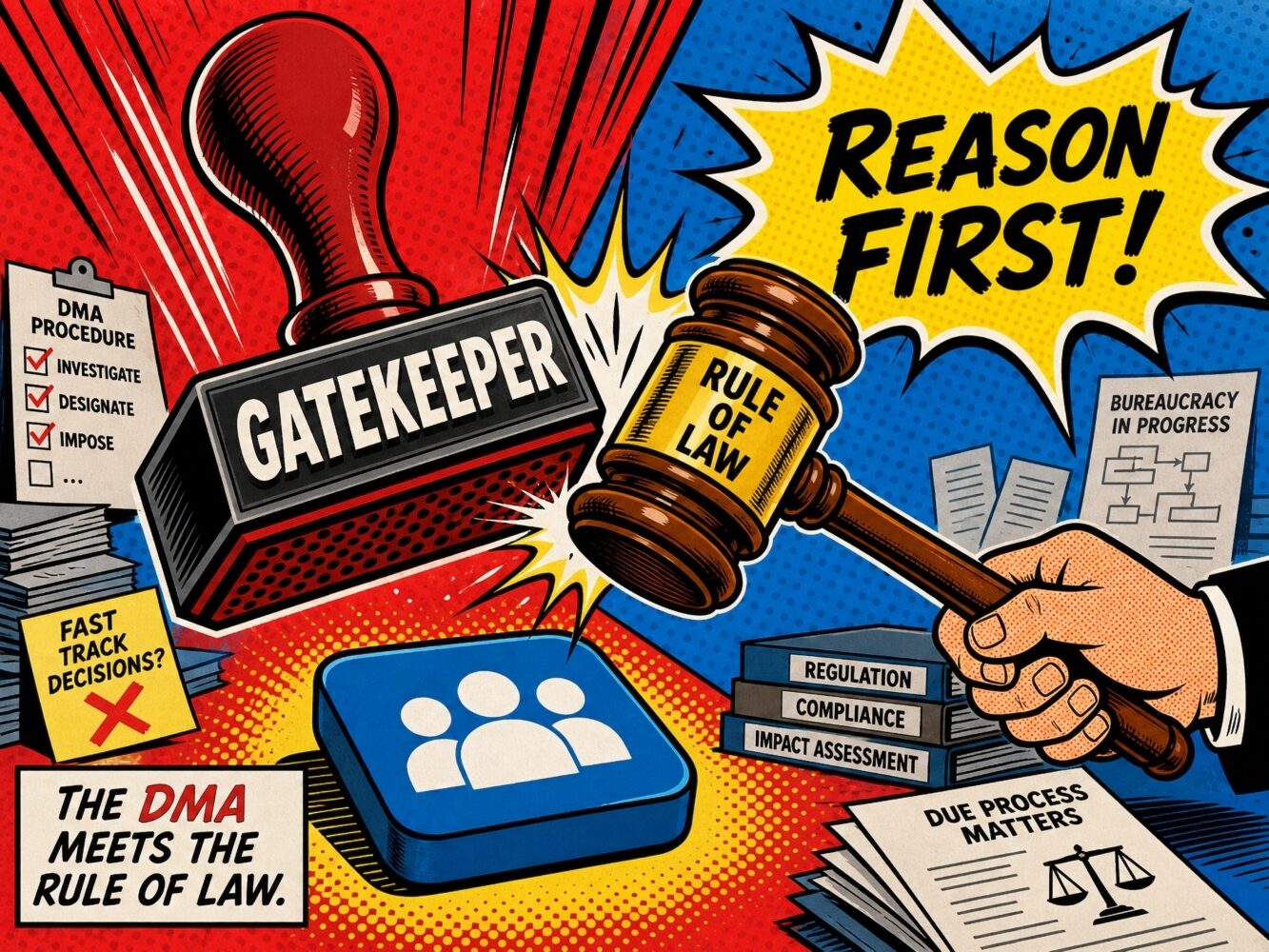
The European Union’s Digital Markets Act was built to move fast: designate gatekeepers, impose obligations, and reshape digital markets before the lawyers can finish sharpening their pencils. But in Meta Platforms Ireland v. Commission, the General Court offered a useful reminder: even Europe’s new digital rulebook still has to pass through an old-fashioned door marked “legal reasoning.”
The court’s partial annulment of the European Commission’s Digital Markets Act designation of Meta—limited to Facebook Marketplace—is not a revolution. It did not invalidate the DMA. It did not reject the Commission’s authority to designate large digital platforms as gatekeepers. It did not save Meta’s Messenger service—a standalone instant-messaging platform that lets users send texts, share high-definition photos and large files, and make voice or video calls without needing a phone number—from the DMA’s reach.
Formally, the decision is narrow. The court upheld the Messenger designation, while annulling the designation of Facebook Marketplace—a digital classifieds platform embedded in the Facebook app and website—because the Commission had not adequately justified its analysis.
Precisely because the judgment is narrow, it may prove significant. It suggests how European Union courts can discipline regulatory overreach without openly repudiating the political choices embodied in modern EU digital regulation.
Labels Are Not Analysis
The decision matters because it insists that even ex ante regulation—rules imposed before specific competitive harm has been proved—must receive close legal scrutiny.
The Commission may be tempted to treat gatekeeper designation as an administrative shortcut: identify a large firm, invoke the statutory thresholds, and impose behavioral obligations meant to reshape digital markets in the name of fairness and contestability. But the General Court’s Marketplace holding suggests that labels matter, statutory categories matter, evidence matters, and reasons matter.
If a service is to be treated as a core platform service, the Commission must explain why the legal category fits the economic reality. It cannot infer legal consequences from the size, notoriety, or political salience of the undertaking.
That is a modest but valuable judicial signal. The greatest danger in contemporary competition policy is not merely that regulators sometimes err. Error is inevitable. The more serious danger is that regulators will institutionalize a framework in which mistakes are cheap for the state and expensive for markets.
The DMA, like other ex ante regimes, lowers the Commission’s burden relative to traditional antitrust. It replaces case-by-case proof of competitive harm with categorical obligations triggered by designation. That makes procedural discipline especially important. When a legal regime operates before harm has been demonstrated, courts should be more—not less—demanding about whether the triggering conditions have been satisfied.
The Meta judgment therefore has implications beyond Marketplace. It may become part of an emerging judicial vocabulary for reining in excessive interventionism—not by announcing a deregulatory manifesto, but by requiring the Commission to match regulatory ambition with legal precision and economic evidence.
The court’s message is not that large platforms are immune from regulation. It is that even politically disfavored platforms deserve intelligible reasoning. In a legal order committed to the rule of law, this should be uncontroversial. In practice, it may be transformative.
When Competition Policy Becomes Product Management
The Commission’s modern competition and digital-policy agenda has increasingly moved from policing exclusionary conduct to engineering market structure and product design.
The DMA does not merely prohibit certain anticompetitive acts. It often dictates how integrated services must be unbundled, how data may be combined, how app stores must be opened, how default settings must be designed, and how interoperability must be supplied. This represents a shift from antitrust as law enforcement to competition regulation as ongoing industrial administration.
That shift should concern anyone who takes dynamic competition seriously. Digital platforms compete not only through price, but also through integration, security, convenience, network effects, data-driven improvements, and rapid product iteration. Treating seamless integration as presumptively suspect risks sacrificing real consumer benefits to a static vision of market structure.
The point is not that integration is always benign. It is that integration is often how innovation reaches consumers. Search linked to maps, messaging linked to commerce, operating systems linked to app distribution, and social networks linked to marketplaces may all create risks. They may also reduce transaction costs, improve quality, and make products easier to use.
The DMA’s core danger is that it can convert this ambiguity into a regulatory presumption against scale and integration. If a large platform improves a service by connecting it to another service, regulators may characterize the improvement as leveraging. If it designs a seamless ecosystem, they may call that self-preferencing. If it maintains a closed architecture for privacy or security reasons, they may attack that as foreclosure. If it opens the architecture, they may blame it for new security risks.
That is a difficult environment in which to innovate.
The General Court’s ruling does not solve those problems, but it offers a procedural foothold. If the Commission must justify the classification of each service, then it must conduct a matter-specific economic evaluation, rather than rely on administrative convenience.
Facebook Marketplace, for example, could not simply be swept into DMA coverage because it sat inside the Meta ecosystem. The Commission had to show why Marketplace fit the relevant statutory concept and why Meta’s arguments did not undermine that conclusion. Requiring that kind of analysis can force regulators to confront tradeoffs that broad political narratives obscure.
Five Ways Courts Can Keep the DMA Honest
Future General Court and Court of Justice cases could develop this discipline in several ways.
First, EU courts should insist on genuine service-by-service analysis. The DMA’s structure invites a dangerous conflation between the undertaking and the service. A company may be large, but not every service it offers necessarily functions as an important gateway between business users and end users.
Treating every service offered by a large digital firm as presumptively gatekeeping would collapse the statutory inquiry into a company-level judgment. Courts should resist that move. The question should not be whether Meta, Apple, Google, Amazon, or Microsoft is important. The question should be whether the specific service at issue satisfies the legal and economic conditions for designation.
Second, courts should require the Commission to address countervailing evidence meaningfully. If a platform argues that a service is declining, that users multi-home, that business users have alternative routes to customers, that the service is not monetized as the Commission assumes, or that the relevant functionality is ancillary rather than independent, the Commission should not be able to wave those points away with conclusory language.
The duty to state reasons should become a duty to confront the economic record. That would not turn DMA designation into a full Article 102 abuse case, but it would prevent designation from becoming a rubber stamp.
Third, courts should scrutinize remedy specification. The most intrusive DMA interventions may arise not at designation, but during compliance and specification proceedings. Once a firm is designated, the Commission can exert substantial pressure over product architecture.
Courts should therefore remain attentive to proportionality. A compliance measure that degrades privacy, cybersecurity, product quality, or innovation incentives should not be accepted merely because it increases the formal number of choices available to users or rivals. Choice is valuable when it improves welfare. It is not valuable when regulators manufacture it by degrading the default product or forcing users through confusing consent screens and fragmented experiences.
Fourth, courts should revive administrable limits on open-ended concepts like fairness and contestability. These terms are politically attractive but economically slippery. A market can be contestable because entrants can challenge incumbents. It can also become less efficient if regulation props up less capable rivals.
A practice can be called unfair because it disadvantages competitors, but competition law should not confuse harm to competitors with harm to competition. EU courts need not import the American consumer-welfare standard wholesale to recognize that competition policy requires limiting principles. Without them, fairness becomes a license to redistribute rents from successful firms to less successful rivals.
Fifth, the Court of Justice should use appeals to clarify that ex ante regulation remains subject to proportionality, legal certainty, and institutional competence. The Commission is not a legislature with roving authority to redesign the digital economy. Nor is it a venture capitalist charged with choosing the optimal architecture of future markets.
The Commission’s powers derive from the treaties and from legislation adopted under them. When it uses those powers to impose obligations with major economic consequences, courts should require a clear legal basis, a reasoned explanation, and a plausible relationship between the measure and the statutory objective.
Europe Does Not Need More Regulatory Swagger
This kind of judicial reining-in would not be anti-European. On the contrary, it may be essential to Europe’s economic renewal.
The Draghi report and related commentary on Europe’s competitiveness problem have highlighted a sobering reality: Europe has strong institutions, educated workers, sophisticated consumers, and deep scientific capabilities, but it has struggled to generate and scale world-leading technology firms.
The problem is not a shortage of regulatory ambition. Europe has produced the General Data Protection Regulation, the Digital Services Act, the DMA, the Artificial Intelligence Act, and numerous national initiatives. The problem is that regulatory ambition has not translated into entrepreneurial dynamism.
Innovation requires more than subsidies, research programs, and public strategies. It requires permission to experiment. It requires the possibility of scale. It requires exit opportunities for startups, including acquisition by larger firms. It requires predictable rules that allow entrepreneurs and investors to estimate risks. It requires tolerance for business models that policymakers may not fully understand at inception.
An economy that regulates first and learns later will tend to get less of the experimentation that produces transformative growth.
The Costs You Cannot Count
A market-oriented approach to EU competition law should therefore emphasize error costs. False positives—mistakenly condemning beneficial conduct—are especially damaging in innovation markets.
If regulators mistakenly prohibit or burden a practice that would have benefited consumers, the lost innovation may never be observed. A delayed product launch, an abandoned integration, a startup that cannot find a buyer, or a platform feature never introduced in Europe will not always appear in enforcement statistics.
The Commission can count investigations, workshops, designations, and fines. It is much harder to count the innovations that regulation prevented.
Those unseen costs matter. When compliance burdens fall on large platforms, some observers assume the costs fall only on wealthy foreign companies. That is a mistake. Large platforms are infrastructure for smaller firms, developers, advertisers, creators, retailers, and consumers.
If regulation makes platforms less efficient, less integrated, or slower to deploy new tools, the costs propagate through the ecosystem. European startups may find fewer distribution channels, fewer acquisition opportunities, fewer integrated services, and less access to frontier technologies. Consumers may receive products later than users in the United States or Asia. Small businesses may face more fragmented marketing and transaction systems.
A judicially enforced discipline of evidence and proportionality could help reverse this pattern. If the Commission knows courts will demand careful reasoning, it may become more selective. If it must explain how a designation or remedy improves competition rather than merely handicaps a large firm, it may focus on clearer cases of exclusion. If it must account for innovation and product-quality tradeoffs, it may avoid interventions that make digital services less useful.
Such discipline would not eliminate EU regulation. It would improve it.
Competition Is a Process, Not a Diorama
The implications extend to traditional EU competition law. The Commission’s Article 101, Article 102, and merger-control enforcement has often been more interventionist than the American approach, particularly in its suspicion of dominance, vertical integration, rebates, tying, self-preferencing, and mergers involving potential competition.
But recent decades have also seen EU courts require more rigorous effects analysis in important cases. That trend should be strengthened. The future of EU competition law should not lie in abandoning economics for administrability. It should lie in using economics to make administrability honest: clear rules where experience justifies them, but serious evidence where intervention threatens dynamic rivalry.
A more market-oriented EU competition policy would begin with several presumptions. It would presume that competition is a process, not a market-design endpoint. It would presume that scale can be efficient, especially in markets characterized by network effects, high fixed costs, data complementarities, and global rivalry.
It would presume that consumer welfare includes quality, privacy, security, convenience, and innovation—not merely the number of competitors or the formal availability of alternatives. It would presume that intervention should be justified by a theory of harm and disciplined by a theory of error costs. And it would presume that protecting competitors from hard competition is not the same as protecting competition.
This approach could enhance innovation in the EU in concrete ways.
First, it would make Europe more attractive for product launches. Firms are more likely to introduce new technologies in jurisdictions where legal risk is predictable and proportionate.
Second, it would help startups by preserving efficient integration with larger ecosystems. Many startups do not become standalone giants. They succeed by being acquired, by partnering, or by building on platform infrastructure.
Third, it would encourage European firms to scale. A policy culture that treats size as a problem will not produce many large technology firms.
Fourth, it would reduce fragmentation. One promise of EU law is the creation of a single market, but overlapping EU and national interventions can recreate fragmentation through compliance complexity.
Fifth, it would shift attention from performative enforcement to welfare-enhancing enforcement.
A More Interesting Brussels Effect
The Meta decision may also have transatlantic implications. American competition law has recently flirted with more interventionist theories, particularly through neo-Brandeisian critiques of bigness, platform integration, and merger policy. Some American commentators have cited the DMA as a model for regulating large technology platforms.
But if EU courts begin to cabin the Commission’s discretion, the lesson for the United States may change. Europe may not show that aggressive ex ante regulation is the future. It may show that judicial review remains an essential corrective to administrative enthusiasm.
American antitrust law already contains doctrinal resources that support a market-oriented approach: burdens of proof, effects analysis, skepticism toward protecting competitors rather than competition, and concern for administrable rules. A European judicial turn toward evidence, proportionality, and dynamic competition could reinforce those tendencies.
It would make it harder for American interventionists to claim that the global consensus favors structural regulation of digital markets. It would also give American courts and agencies comparative support for a humbler proposition: competition policy should be especially cautious in fast-moving markets.
There is an irony here. For years, the so-called “Brussels effect” was invoked to suggest that EU regulation would become the global default because large firms would conform worldwide to Europe’s rules. But the Meta judgment hints at a different possibility: a rule-of-law Brussels effect. If European courts insist that the Commission justify intervention with rigor, the EU could export not regulatory maximalism, but regulatory discipline.
That would be a healthier model for both sides of the Atlantic.
Small Rulings Can Cast Long Shadows
One should not overstate the likelihood of a dramatic shift. The General Court upheld Messenger’s designation, and the DMA remains politically popular in Brussels. The Commission is unlikely to abandon its view that large platforms require close supervision. The Court of Justice may also proceed cautiously on appeal, especially where the legislature has expressly chosen an ex ante regulatory model.
The path toward a more market-oriented European competition law will therefore be incremental. But incremental judicial discipline can matter. Competition policy is shaped not only by grand doctrines, but also by burdens of explanation.
If the Commission must explain more, it may assume less. If it must address tradeoffs, it may intervene more carefully. If it must classify services according to legal criteria rather than political narratives, it may narrow its targets. If it must defend product-design mandates in terms of proportionality and welfare, it may hesitate before turning competition law into engineering supervision.
The Meta Marketplace ruling is best understood in that light. It is a small legal defeat for the Commission, but potentially a larger institutional warning.
Europe’s competitiveness problem will not be solved by giving regulators more discretion to rearrange markets. It will be solved, if at all, by allowing markets to discover better arrangements, while reserving intervention for cases where evidence shows genuine competitive harm. Courts cannot create European dynamism by themselves. But they can remove some obstacles by insisting that economic regulation remain tethered to law, evidence, and proportionality.
A market-oriented reading of the decision therefore sees hope in its restraint. The court did not announce that the Commission is wrong to care about digital competition. It announced that caring is not enough. The Commission must reason. It must justify. It must respect categories. It must answer arguments.
In a legal order increasingly tempted by technocratic management of markets, that is a message worth taking seriously.
If future EU courts build on this foundation, they could help restore a better balance between competition enforcement and economic liberty. They could remind regulators that innovation often comes from the very practices—scale, integration, experimentation, and ecosystem design—that interventionist policy tends to distrust. They could help Europe move from a culture of precautionary control to one of competitive discovery.
And, in doing so, they might influence American antitrust at a crucial moment by strengthening those who argue that the goal of competition law is not to punish success, but to preserve the market process that makes success contestable.
That would be a Brussels effect worth welcoming.
