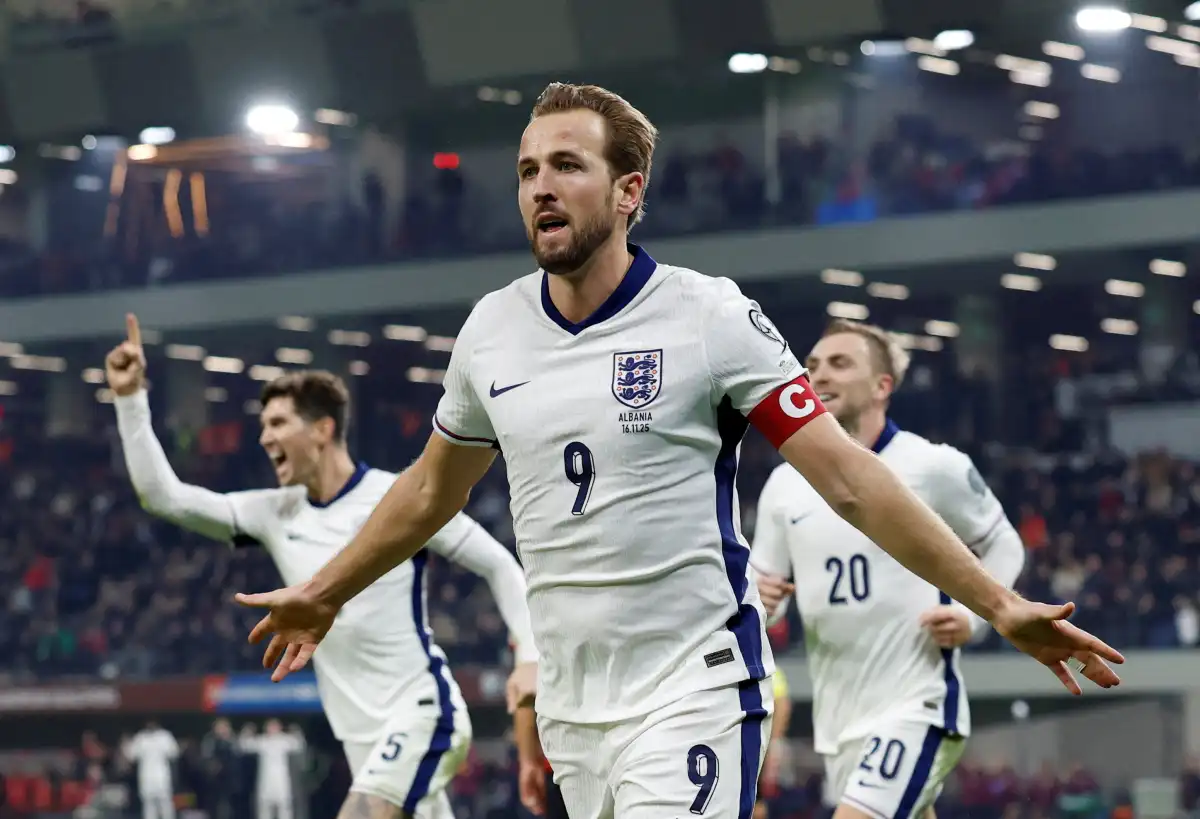
For the so-called epicenter of “football,” England’s trophy cabinet certainly does not reflect that.
But coming into the 2026 World Cup, the Three Lions have been a consistent threat to win serious silverware, yet have continued to come up short at the doorstep. The hope is that they will score their biggest victory on American soil since the War of 1812, and they certainly have the firepower to do it.
England
- Region: UEFA
- Qualification: Top of UEFA Group K
- Manager: Thomas Tuchel
- World Cup appearances: 17
- Best Finish: Winners (1966)
Is this to finally be England’s year?
It is the question posed by the English press before each international tournament for decades, usually answered with a resounding “no.”
But England has been knocking on the door for the best part of a decade, finding an unlikely resurgence through Gareth Southgate, who led the Three Lions to a fourth-placed finish at the 2018 World Cup in Russia before back-to-back Euros finals – either side of a quarter-final exit at the hands of France in Qatar.
The question now is whether England’s window to win international silverware has closed, with the emergence of new powers on the global stage and Thomas Tuchel’s fairly underwhelming 26-man squad.
Of real concern is the lack of depth up front. Harry Kane is coming into the tournament off the back of a spectacular season that saw him score 61 goals across all competitions for Bayern Munich and England. If Kane should get injured, however, England look decidedly lightweight, with either Ivan Toney or Ollie Watkins likely to deputize.
At the back, the exclusion of Harry Maguire removes a significant chunk of big-game experience, while the inclusion of Dan Burn and Djed Spence over the likes of Lewis Hall has raised eyebrows.
England strolled through qualifying without conceding a goal and will likely stroll through their group of Panama, Croatia, and Ghana, but how they fare against the elites remains to be seen.
It has been 30 years since Baddiel, Skinner, and the Lightning Seeds bemoaned 30 years of hurt in the iconic anthem “Three Lions,” a song better known by its chorus of “Football’s Coming Home” that has become synonymous with England’s appearances at international tournaments. That hurt could go on after the World Cup concludes in North America.
Player to Watch: Harry Kane
Harry Kane is absolutely crucial to England’s World Cup hopes, and he will be out to right the wrongs of four years ago, when he ballooned a penalty over the crossbar in England’s 2-1 defeat to France. With that miscued attempt, England’s best chance of winning a World Cup since 1966, given the fact that they would have fancied themselves against Morocco in the semi-finals and proved at least equal to Argentina in the final.
Kane is in red-hot form for Bayern Munich and is, without a doubt, England’s most important player. Kane needs three goals at the tournament to replace Gary Lineker as England’s top goalscorer in World Cup history, and it would be a major shock if he didn’t reach that tally.
26-man roster
Goalkeepers: Jordan Pickford (Everton), Dean Henderson (Crystal Palace), James Trafford (Manchester City)
Defenders: Reece James (Chelsea), Ezri Konsa (Aston Villa), Jarell Quansah (Bayer Leverkusen), John Stones (Manchester City), Marc Guéhi (Manchester City), Dan Burn (Newcastle United), Nico O’Reilly (Manchester City), Djed Spence (Tottenham Hotspur), Tino Livramento (Newcastle United)
Midfielders: Declan Rice (Arsenal), Elliot Anderson (Nottingham Forest), Kobbie Mainoo (Manchester United), Jordan Henderson (Brentford), Morgan Rogers (Aston Villa), Jude Bellingham (Real Madrid), Eberechi Eze (Arsenal)
Forwards: Harry Kane (Bayern Munich), Ivan Toney (Al-Ahli), Ollie Watkins (Aston Villa), Bukayo Saka (Arsenal), Marcus Rashford (Manchester United), Anthony Gordon (Newcastle United), Noni Madueke (Arsenal)
Croatia
- Region: UEFA
- Qualification: UEFA Group L winners
- Manager: Zlatko Dalic
- World Cup appearances: 7
- Best finish: 2nd Place (2018)
What does Croatia have in store for us this time around?
Constantly defying the odds, the small European nation of fewer than 4 million has been one of the most consistent teams at the World Cup since gaining independence in 1991 and being recognized by FIFA in 1994. They have finished in third place or higher in three of their first six World Cups, which included a second-place finish to France in 2018 and a third-place finish in Qatar four years ago.
For as much as things remain the same — Zlatko Dalic is still in charge, the immortal Luka Modric captains the side at 40 years old, and Mateo Kovacic still thrives — change is aplenty for the Vatreni. This will be the first time the world gets to see that change
One Player To Watch: Luka Sucic
At 23, Sucic appears to be the next great Croatian midfielder, poised to take the torch from the likes of Modric and Kovacic. The Real Sociedad talent has already been playing in the top leagues of Europe for six years, and he just had his best season yet in La Liga, with nine goal contributions in 22 league appearances.
26-man roster
Goalkeepers: Dominik Livakovic (Dinamo Zagreb), Dominik Kotarski (Kobenhavn), Ivor Pandur (Hull City)
Defenders: Josko Gvardiol (Manchester City), Duje Caleta-Car (Real Sociedad), Josip Sutalo (Ajax), Josip Stanisic (Bayern Munich), Marin Pongracic (Fiorentina), Martin Erlic (Midtjylland), Luka Vuskovic (Hamburg)
Midfielders: Luka Modric (AC Milan), Mateo Kovacic (Manchester City), Mario Pasalic (Atalanta), Nikola Vlasic (Torino), Luka Sucic (Real Sociedad), Martin Baturina (Como), Kristijan Jakic (Augsburg), Petar Sucic (Inter Milan), Nikola Moro (Bologna), Toni Fruk (Rijeka)
Forwards: Ivan Perisic (PSV Eindhoven), Andrej Kramaric (Hoffenheim), Ante Budimir (Osasuna), Marco Pasalic (Orlando City), Petar Musa (FC Dallas), Igor Matanovic (Freiburg)
Panama

- Region: CONCACAF
- Qualification: 3rd Round Group A winners
- Manager: Thomas Christiansen
- World Cup appearances: 2
- Best finish: Group stage (2018)
Qualifying for its second-ever World Cup, Panama is attempting to adopt a new identity of a technically sound, threatening side rather than the physical, grind-it-out squad that has given the United States fits in recent years. Much of that has to do with the work done by the Dutch-Spanish manager, Thomas Christiansen, who has instituted patient play and marauding play down the wings.
One Player To Watch: Adalberto Carrasquilla
The centerpiece of Panama’s new scheme is the 27-year-old Carrasquilla, who starred with the Houston Dynamo in Major League Soccer before making a high-profile move to Pumas UNAM in Liga MX. He is Los Canaleros’ main playmaker, whose vision in the midfield makes him one of the top facilitators in North America.
26-man roster
Goalkeepers: Orlando Mosquera (Al Fayha), Luis Mejía (Nacional), César Samudio (Marathón)
Defenders: César Blackman (Slovan Bratislava), Jorge Gutiérrez (Deportivo La Guaira), Amir Murillo (Beşiktaş), Fidel Escobar (Saprissa), Andrés Andrade (LASK), Edgardo Fariña (Pari Nizhny Novgorod), José Córdoba (Norwich City), Éric Davis (Plaza Amador), Jiovany Ramos (Puerto Cabello), Roderick Miller (Turan Tovuz)
Midfielders: Aníbal Godoy (San Diego FC), Adalberto Carrasquilla (Pumas UNAM), Carlos Harvey (Minnesota United), Cristian Martínez (Ironi Kiryat Shmona), José Luis Rodríguez (Juárez), César Yanis (Cobresal), Yoel Bárcenas (Mazatlán), Alberto Quintero (Plaza Amador), Azarias Londoño (Universidad Católica)
Forwards: Ismael Díaz (León), Cecilio Waterman (Universidad de Concepción), José Fajardo (Universidad Católica), Tomás Rodríguez (Saprissa)
Ghana

- Region: CAF
- Qualification: Top of CAF Group I
- Manager: Carlos Queiroz
- World Cup appearances: 4
- Best Finish: Quarter-finals (2010)
Ghana qualified for the World Cup in convincing fashion, topping their group six points ahead of Madagascar in second after taking 25 points from 10 games, but the manager responsible for that performance will not lead them out in North America this summer.
Otto Addo was relieved of his duties just 72 days before the start of the World Cup after a friendly defeat to Germany in March made it four friendly defeats in a row. Addo, despite leading Ghana to World Cup qualification, had also failed to qualify for the Africa Cup of Nations.
Carlos Queiroz was appointed in April after resigning from his role with Oman and will now lead the Black Stars out at the World Cup.
Queiroz has plenty of World Cup experience, having managed at each of the last four tournaments and several international teams in between. But it remains to be seen how much influence he can have with such a short window to prepare.
Ghana’s squad is not at the same standard as the squad that was a crossbar away from reaching the World Cup semifinals in 2010, perhaps evidenced by the fact that Jordan Ayew remains the nation’s captain despite coming off a season with Leicester City that saw the former Premier League champions relegated to the third tier of English soccer. But Queiroz does have the mercurial Manchester City forward Antoine Semenyo at his disposal, along with a number of other talents across Europe.
Ghana opens its World Cup campaign against Panama, a must-win game before outings against European heavyweights England and Croatia.
Player to watch: Antoine Semenyo
At both Bournemouth and then at Manchester City after completing a mid-season move, Antoine Semenyo was a revelation in the 2025/26 season.
A nominee for Premier League Player of the Season, Semenyo scored 17 league goals for City and Bournemouth on top of scoring the only goal in City’s FA Cup final win over Chelsea last month with a delightful backheel. Ghana will very much need him at his best if they are to make inroads this summer.
26-man roster
Goalkeepers: Benjamin Asare (Accra Hearts of Oak SC), Lawrence Ati-Zigi (St Gallen), Joseph Anang (St Patrick’s Athletic)
Defenders: Baba Abdul Rahman (PAOK Salonika), Gideon Mensah (AJ Auxerre), Marvin Senaya (AJ Auxerre), Alidu Seidu (Stade Rennais), Abdul Mumin (Rayo Vallecano), Jerome Opoku (Istanbul Basaksehir), Jonas Adjetey (VfL Wolfsburg), Kojo Oppong Peprah (Nice), Derrick Luckassen (Pafos)
Midfielders: Elisha Owusu (AJ Auxerre), Thomas Partey (Villarreal), Kwasi Sibo (Real Oviedo), Augustine Boakye (Saint-Étienne), Caleb Yirenkyi (FC Nordsjælland), Abdul Fatawu Issahaku (Leicester City)
Forwards: Kamal Deen Sulemana (Atalanta), Christopher Bonsu Baah (Al Qadsiah), Ernest Nuamah (Lyon), Antoine Semenyo (Manchester City), Brandon Thomas-Asante (Coventry City), Prince Kwabena Adu (Viktoria Plzen), Iñaki Williams (Athletic Club), Jordan Ayew (Leicester City)
Group L schedule
- Wednesday, June 17: England vs. Croatia, 4 p.m. ET (Arlington)
- Wednesday, June 17: Ghana vs. Panama, 7 p.m. (Toronto)
- Tuesday, June 23: England vs. Ghana, 4 p.m. (Foxborough, MA)
- Tuesday, June 23: Panama vs. Croatia, 7 p.m. (Toronto)
- Saturday, June 27: Panama vs. England, 5 p.m. (East Rutherford, NJ)
- Saturday, June 27: Croatia vs. Ghana, 5 p.m. (Philadelphia)
For more like this World Cup Group L preview, visit AMNY.com