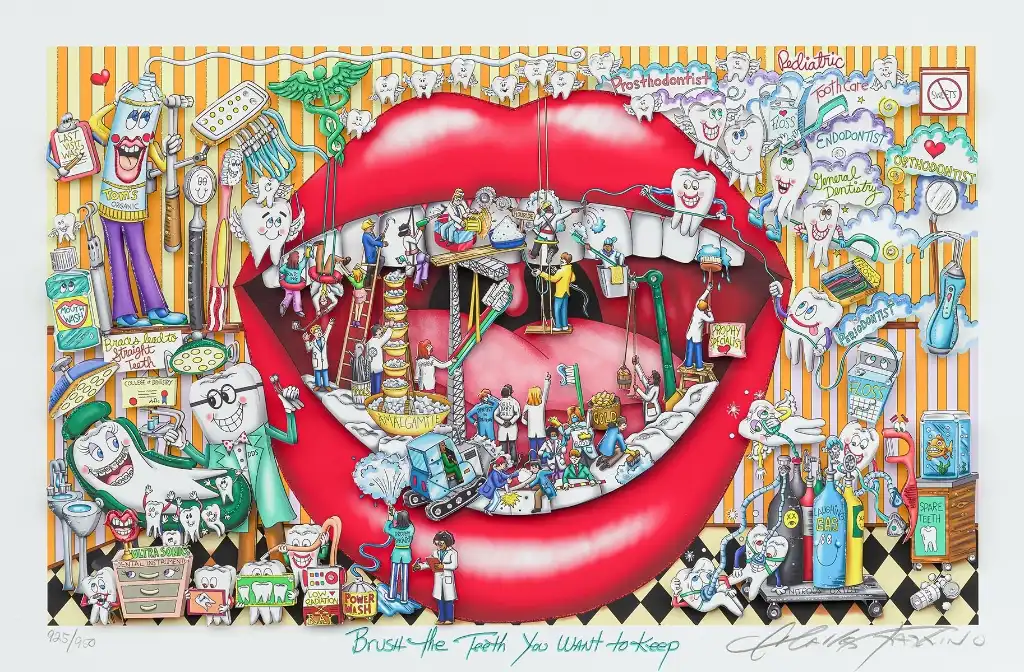
Everyone who comes to New York comes, in some way, to take a bite out of it. The Big Apple may be myth, marketing, madness, and miracle all at once, yet let’s be honest: every transplant who has dragged a suitcase across a fifth-floor walk-up or walked home beneath a skyline too cinematic to be real came here to taste something larger than themselves. New York is not a city people simply inhabit. It is a city people pursue, devour, survive, romanticize, and remake in their own image.
Charles Fazzino understands that appetite better than almost anyone.
He does not merely paint New York. He pops it open. His work carries the manic electricity of the city itself, bright, crowded, seductive, sentimental, and impossible to ignore. Fazzino’s universe is not quiet, nor should it be. It is stacked, glittered, cut, built, and pushed forward with the kind of theatrical confidence only New York can truly understand.
A celebrated pop artist known for his highly detailed, three-dimensional compositions, Fazzino has built a career around turning popular culture into collectible visual electricity. His works do not sit politely on the wall waiting to be admired. They perform. They wink. They pull the eye into a delicious frenzy of discovery, as every inch seems to hold another small revelation. His art is fun, certainly, yet it is never flimsy. Beneath the color and sparkle is a serious understanding of how people attach themselves to places, icons, and memory.
Born in New York in 1955, Fazzino came from a household already alive with making. His mother, Irene, was a sculptor, and his father, Salvatore, was a shoe designer, which meant construction, style, and dimensional thinking were part of the atmosphere from the beginning. By seventh grade, he was already finding his way into art, and he later attended the School of Visual Arts in New York City, graduating in 1977 with a focus in illustration and printmaking.
The great pivot came by accident, which is often how New York stories begin. In 1981, while searching for art supplies in Florida, Fazzino came across a paper tole class, a technique that uses layered paper to create a three-dimensional effect. It reminded him of the pop-up books his parents bought him as a child, and suddenly the whole machine clicked. He returned to New York and began cutting up old prints, especially cityscapes, rebuilding them outward into dimensional scenes. Collectors responded almost immediately. The city, in his hands, was no longer just depicted. It was built.
“The process really comes from doodles as a child, and then I love pop-out books and did a little bit of printmaking in school,” Fazzino has said. “Everything came together.”

That sentence feels almost too modest for what he created. Everything does come together in a Fazzino: childhood wonder, New York bravado, printmaking discipline, sculptural instinct, and the chaos of a life fully lived. His process is painstaking. A single work can take up to a week to create, beginning with research that may last months before he produces a flat drawing, turns it into a silkscreen, cuts and layers the elements, and finishes the surface by hand with glitter and crystals. Drawing on his Italian heritage, he has described the layering as almost like lasagna, which is, frankly, the most deliciously appropriate explanation for an artist whose work feeds the eye until it is nearly drunk on detail.
Of course, the joy is obvious. The rigor is what makes it last. Fazzino’s art may look like a party, yet it is a highly organized one, full of rhythm, balance, and timing. The compositions hold because he understands density. He knows how to make abundance feel exhilarating rather than chaotic, and how to make a city’s frenzy feel intimate enough to hang in a home. That is where the magic lands for collectors. A Fazzino piece does not whisper from across the room. It changes the temperature of the room entirely.
Unsurprisingly, Park West Gallery has long understood the power of that proposition. At its SoHo location, where the language of collecting meets the voltage of downtown New York, a number of Fazzino’s works offer viewers the chance to experience his universe up close. Park West has represented him for years, and in that context, his work becomes more than decorative. It becomes deliciously metropolitan: a way to bring the city’s color, wit, and appetite into the private space of the home.

For collectors, this is the seduction. In a sleek apartment, a Fazzino brings wit. In a collector’s study, it brings movement, conversation, and metropolitan punch. It is elevated but accessible, polished but not bloodless, collectible but never cold. Fazzino gives people permission to love the art they live with, not merely respect it from a reverent distance.
His cultural reach only reinforces the point. Fazzino has created artwork for major cultural and sporting events, from the Super Bowl to the Grammy Awards, and his rotating three-dimensional sculpture of an American Airlines plane at JFK International Airport welcomes travelers to New York. The placement feels almost cosmically correct. Who better to greet the arriving dreamers than the artist who understands the city as fantasy, machine, memory, and appetite?
In a world that often mistakes seriousness for austerity, Charles Fazzino offers a necessary correction. Art can be intelligent and joyful. It can be collectible and playful. It can be technically disciplined and still burst with charm. It can wink without becoming shallow, sparkle without becoming silly, and celebrate popular culture without surrendering to disposability.
Fazzino gives collectors a way to bring the city home, not as a postcard, but as a living, glittering, three-dimensional love letter to ambition itself. His New York is not flat, since New York has never been flat. It rises, collides, seduces, overwhelms, and dazzles. It dares you to take the bite.
Then, somehow, it bites back.
