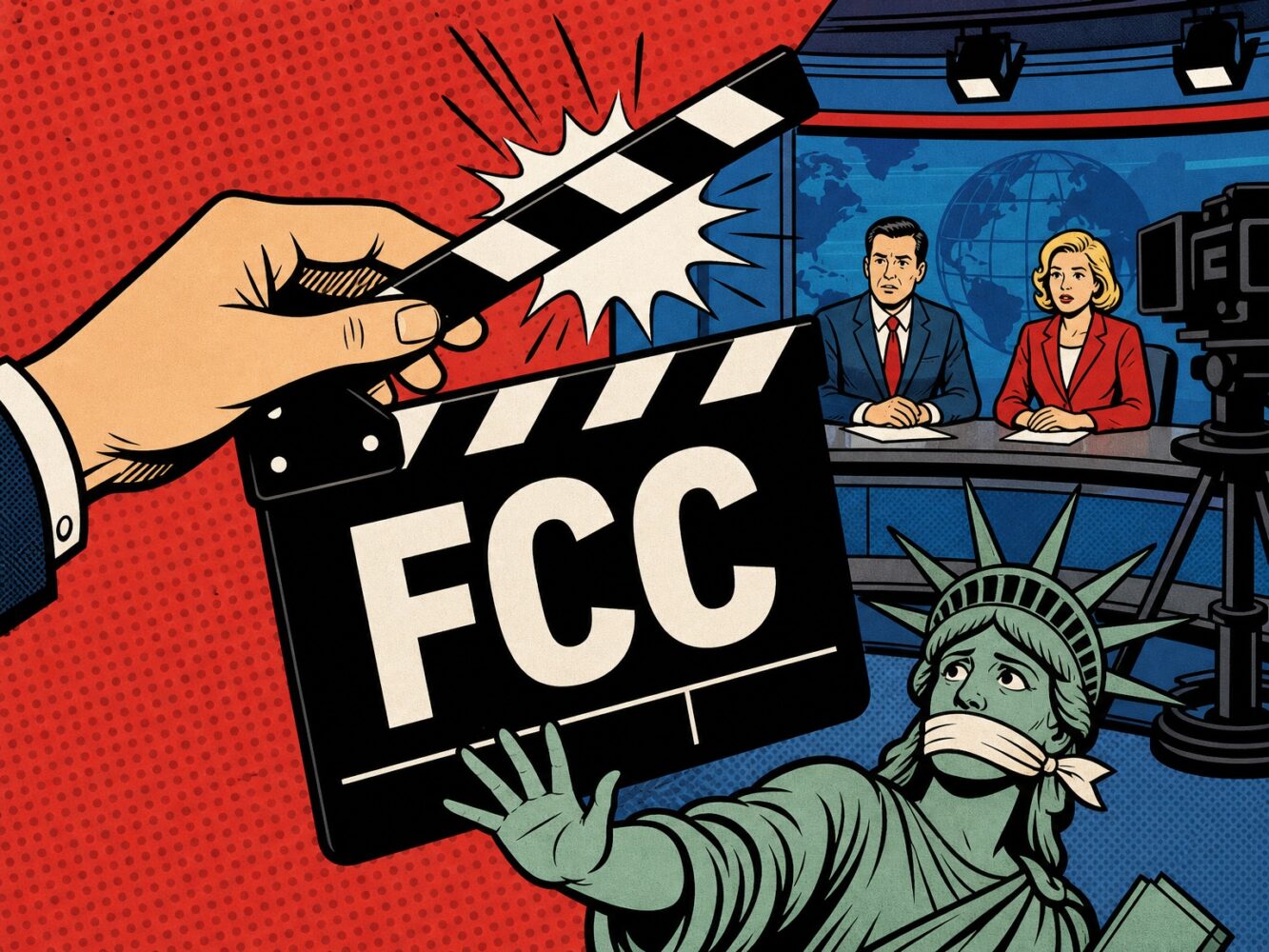
The government does not need to burn books when it can threaten licenses. Why bother with an inquisitor’s bonfire when a regulator’s raised eyebrow can do the trick?
That is the modern First Amendment problem. Censorship no longer arrives only as an outright ban. More often, it comes dressed as “oversight,” “public interest,” or “compliance”—all perfectly respectable words, right up until they become tools of political pressure.
Recent actions by the Federal Communications Commission (FCC) against Disney-owned ABC have sparked a high-stakes legal fight. This is not merely a technical dispute over “equal time” rules or corporate diversity policies. It points to a troubling pattern of censorship by proxy: government officials leaning on private actors to suppress or reshape speech the government disfavors.
By pushing back, ABC is defending more than its own editorial independence. It is helping hold the line for the “marketplace of ideas.”
The FCC Doesn’t Need a Muzzle When It Has a Licensing Bureau
The core issue is “jawboning.” As I explain in my recent International Center for Law & Economics (ICLE) white paper, “Censorship-by-Proxy: Jawboning in the Marketplace of Ideas,” jawboning occurs when government officials use informal pressure—threats of regulation, litigation, investigations, or license reviews—to coerce private actors into suppressing speech.
Because the First Amendment bars the government from directly banning protected speech, officials sometimes target intermediaries—the “proxies”—that host, distribute, or amplify it. If the government can threaten a network’s multimillion-dollar broadcast licenses, for example, it does not need to pass a law to get its way. The network may “voluntarily” self-censor to avoid financial ruin.
Shortly after taking office in January 2025, President Donald Trump issued executive orders aimed at ending federal censorship and the weaponization of government. Even so, the subsequent conduct of both the FCC and the Federal Trade Commission (FTC) suggests the underlying tensions remain. Both agencies wield substantial discretionary authority over firms operating in speech-adjacent markets. Recent FCC enforcement and oversight activity—carried out under the agency’s sprawling “public interest” standard—shows how that discretion can still raise familiar First Amendment concerns, even when framed as advancing pro-speech goals.
The most prominent FCC example discussed in the white paper is the commission’s order requiring ABC to seek early license renewals for its eight owned-and-operated stations. Those licenses were not scheduled for review until 2028-31. The FCC accelerated the process after public calls from the White House to fire Jimmy Kimmel over a controversial late-night monologue.
The FCC says the review concerns Disney’s diversity, equity, and inclusion (DEI) practices and alleged “unlawful discrimination.” The timing, though, has led observers to ask whether the licensing process is being used to influence the network’s editorial decisions.
ABC to the FCC: See You in Court
Recent reporting suggests ABC has decided not to capitulate. In a sharpy worded filing led by veteran Supreme Court litigator Paul Clement, the network argues that the FCC’s actions “threaten to upend decades of settled law and practice and chill critical protected speech.”
The dispute centers on The View. The FCC is investigating whether the show violated “equal time” rules by featuring a political candidate without offering equivalent airtime to rivals. Those rules generally require broadcasters that give airtime to one legally qualified candidate to offer comparable access to opposing candidates. They also include important exceptions, including for bona fide news programming.
ABC’s response has two parts. First, it argues that The View is, indeed, a “bona fide news program” that has long qualified for exemptions allowing news-oriented programs to cover political figures without hosting every opposing candidate. Second, ABC argues that the equal-time rule itself violates the First Amendment.
The first argument rests on longstanding FCC practice. The commission has treated The View as exempt from equal-time requirements since 2002. The second argument is far more consequential. ABC contends the rule rests on outdated constitutional assumptions that no longer fit the modern media market.
Specifically, the filing argues that the equal-time rule traces back to the FCC’s broad “public interest” authority over broadcasters, which the Supreme Court upheld in Red Lion Broadcasting Co. v. FCC (1969) and related cases. Those decisions relied heavily on the so-called “scarcity rationale”—the idea that broadcast spectrum was so limited that government regulators could exercise greater control over broadcasters than over newspapers or other speakers.
That logic made more sense in the 1960s and 1970s, when most Americans received news and entertainment from a handful of over-the-air television networks. Today’s media environment looks nothing like that world. As I explain in my ICLE white paper:
The factual assumptions underlying those decisions no longer reflect modern media markets. … Cable television, satellite providers, streaming services, internet-video platforms, podcasts, and social media now compete aggressively for audience attention. Even traditional broadcast content is increasingly consumed through cable, satellite, or internet distribution rather than over-the-air antennas.
The modern media ecosystem therefore bears little resemblance to the world in which Red Lion and [FCC v. Pacifica Foundation (1978)] were decided. Treating ABC differently from CNN or Netflix because ABC content can theoretically still be accessed through “rabbit ears” increasingly makes little practical or constitutional sense.
ABC makes much the same point, arguing that “Red Lion’s factual predicates no longer obtain…. These justifications were dubious then… But they are unsupportable now in an age of information ubiquity.”
The constitutional problems do not stop there. Even deciding what qualifies as “newsworthy” programming—and therefore merits exemption from equal-time requirements—requires the FCC to make content-based judgments about speech. Outside the broadcast context, courts would almost certainly treat that kind of government line-drawing with deep skepticism.
As ABC put it:
Given the inherent value-laden judgments that the FCC must make when determining whether a particular program is newsworthy, the risk that the FCC will use its authority to suppress disfavored content and viewpoints is overwhelming.
Preserving this scope of FCC authority leaves open the possibility that agency discretion will burden protected speech. That is precisely the sort of censorship and governmental weaponization Trump’s executive orders were supposed to prevent.
The FCC May Have Finally Picked the Wrong Fight
ABC’s pushback makes a court fight increasingly likely over how far the FCC’s “public interest” authority extends into editorial content. If that happens, the case could become a vehicle for the Supreme Court to revisit Red Lion itself.
There are already signs the justices may be open to doing so. Both Justice Clarence Thomas and the late Justice Ruth Bader Ginsburg suggested, from opposite ends of the ideological spectrum, that the Court should reconsider Red Lion. An FCC overreach case involving The View or Jimmy Kimmel could provide the opportunity.
That would likely be a good thing. The First Amendment rests on the premise that editors—not regulators—decide what counts as newsworthy speech. If the FCC can decide which programs qualify as “news” based on whether regulators approve of the host’s politics, then the “public interest” standard starts looking less like neutral oversight and more like a mechanism for state-influenced media control.
The practical consequences matter, too. If every controversial monologue, interview, or joke can trigger license scrutiny, broadcasters will inevitably become more cautious. That is the classic “chilling effect” in First Amendment law: speakers self-censor because the risks of speaking freely become too high. Over time, only the safest and most government-friendly content survives.
By forcing the FCC to defend its actions in court, ABC is demanding something fundamental: that administrative agencies remain bound by constitutional limits. Put differently, ABC is insisting that the government cannot use sprawling regulatory discretion to accomplish indirectly what the First Amendment forbids it from doing directly.
Keep the Government Out of the Writers’ Room
The marketplace of ideas works only when decentralized private actors—broadcasters, platforms, publishers, and creators—remain free to exercise their own editorial judgment. Once the government starts using its regulatory teeth to shape those decisions, the marketplace stops functioning as a marketplace and starts looking more like managed speech.
ABC’s refusal to yield to the FCC is therefore about far more than Jimmy Kimmel or The View. Whether you find either program insightful, obnoxious, funny, or unbearable is beside the point. What matters is that government officials should not be able to jawbone media companies into silence by dangling licensing threats and regulatory scrutiny over their heads.
That principle cuts to the core of the First Amendment. A free society cannot preserve open debate if agencies can pressure speakers indirectly whenever direct censorship would be unconstitutional.
In this fight, ABC is not merely defending a pair of television programs. It is defending the idea that the government does not get to decide who may speak, what counts as “news,” or which viewpoints are too risky to broadcast. And if the FCC’s tactics ultimately lead the courts to bury Red Lion once and for all, that may be the funniest punchline Jimmy Kimmel never had to write.
The post The FCC Wants Final Cut appeared first on Truth on the Market.
