A cathedral does not begin in stone. It begins, more quietly and perhaps more daringly, as an act of thought so exacting it approaches the invisible—a line set down with enough conviction to anticipate the weight of heaven.
To understand the Gothic period is to recognize a moment in which Europe recalibrated its relationship to structure, proportion, and meaning. Emerging in the mid-12th century, often associated with the ambitions of Abbot Suger at the Basilica of Saint-Denis, Gothic architecture introduced a disciplined rethinking of how space could be constructed and experienced. Mass gave way to articulation. Load was redistributed with increasing sophistication. The pointed arch, the ribbed vault, the flying buttress—each innovation functioned not as ornament, though as a precise solution to structural ambition, allowing buildings to extend vertically while maintaining stability and coherence.
There is a tendency to encounter these cathedrals as resolved achievements, as if they arrived fully formed, though their origins reveal a far more rigorous and intellectually charged process.
Draftsmanship, during this period, operated as both method and inquiry. Builders and designers worked through drawing, testing proportion, refining geometry, negotiating forces that could not yet be realized materially. The line was not descriptive. It was generative. It carried within it the logic of the structure to come, anticipating tension, balance, and distribution with remarkable foresight.
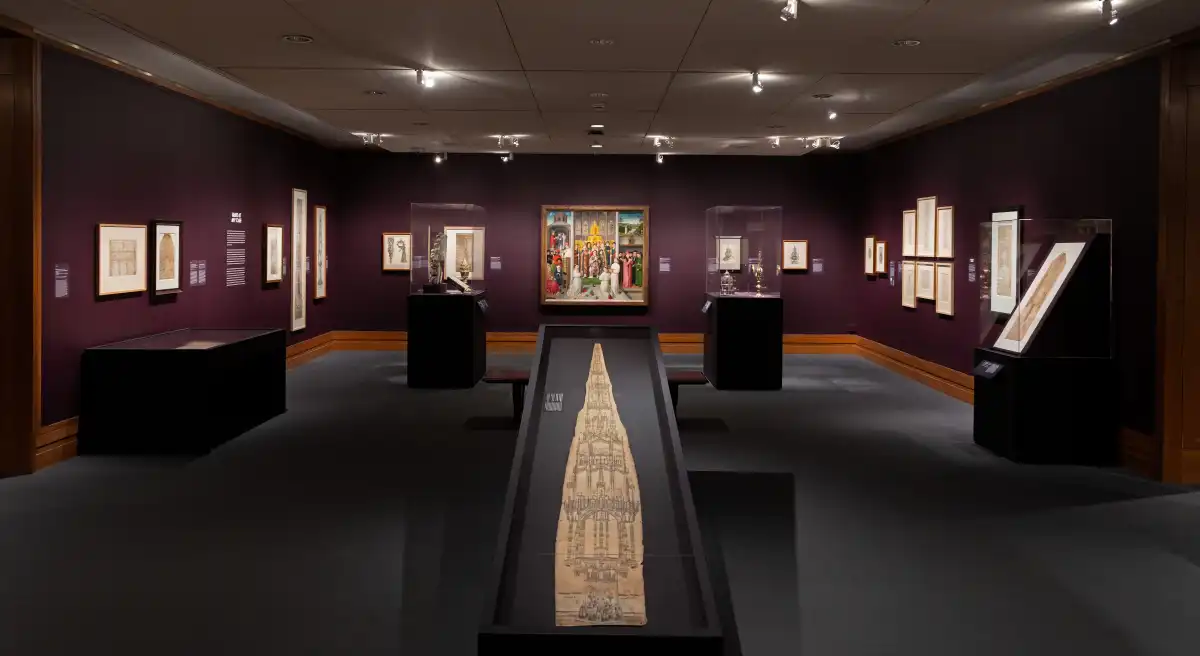
The exhibition Gothic by Design: The Dawn of Architectural Draftsmanship at The Metropolitan Museum of Art brings this origin into sharp and rather revelatory focus.
Over ninety works—drawings, manuscripts, prints, and design objects—are presented not as auxiliary materials, though as central works of artistic and intellectual significance. Under the curatorial direction of Femke Speelberg, these objects begin to assert their presence, revealing a practice grounded in both aesthetic consideration and technical clarity.
What becomes increasingly evident is that Gothic architecture is, at its core, an art of disciplined imagination.
Line functions as proposition rather than outline. A curve anticipates the lift of a vault. Repeated geometries evolve into systems capable of sustaining immense scale. These drawings reveal a process that is iterative and collaborative, where form is tested, recalibrated, and refined through sustained engagement. A visual rhythm emerges, structured yet dynamic, suggesting movement long before any physical construction begins.
Authorship, long obscured within the Gothic tradition, begins to surface through these works.
While cathedrals have historically been attributed to collective endeavor, these drawings reveal individual intelligence at work—designers engaged in acts of problem-solving that shaped the visual and structural language of an era. As Max Hollein notes, the exhibition offers “a glimpse into the meticulous design process that imbued Gothic architecture with its most sublime qualities,” drawing attention to a level of creative agency that has remained largely unacknowledged.
The material range within the exhibition further expands this understanding.

Gothic by Design: The Dawn of Architectura Draftsmanship, on view April 16 – July 19, 2026 at The Metropolitan Museum of Art.
Manuscripts, prints, and goldsmith designs suggest a fluid exchange between disciplines, where the boundaries between art, craft, and architecture become increasingly permeable. Goldsmiths, often overlooked in architectural narratives, appear here as contributors to a broader design culture, influencing not only ornament, though structural conception itself.
A more expansive question begins to take shape.
Where does architecture reside—in the built form or within the conceptual framework that precedes it? These works suggest that the drawing holds equal significance. It becomes a site of possibility, where aesthetic ambition converges with structural reasoning. Contemporary research, including contributions from ETH Zurich, extends this dialogue into the present, demonstrating that Gothic design principles continue to inform approaches to sustainability and structural innovation.

The Gothic period, viewed through this lens, feels less distant and far more instructive.
It reveals a culture deeply invested in precision, in the refinement of ideas, in the belief that space could be shaped through intellect as much as through labor. Draftsmanship emerges not as a secondary act, though as the origin point—the moment where vision takes its first tangible form.
A cathedral, in all its authority, begins there.
Not in stone, though in the deliberate gesture of a line that understands exactly what it intends to become.
Visit Metmuseum.org
