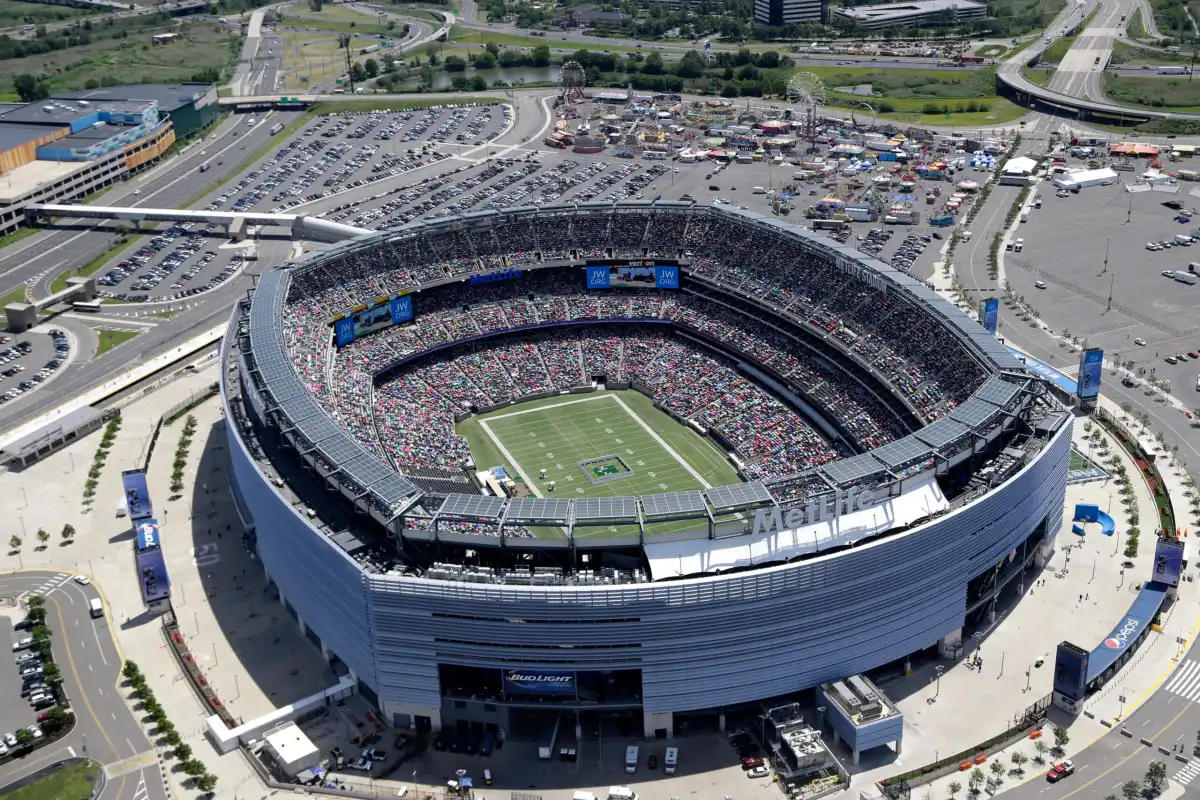
NJ Transit plans to charge more than $100 for round-trip rail journeys to MetLife Stadium for all eight World Cup games set to be hosted at the venue this summer, according to reports.
The measure, first reported by The Athletic’s Adam Crafton, would result in an almost eightfold increase in round-trip prices for journeys to and from the East Rutherford venue, which typically cost $12.90.
The rail journey from New York’s Penn Station to MetLife Stadium, which involves a changeover at Secaucus Junction, is expected to play a major role in bringing fans to and from World Cup games at the stadium.
NJ Transit moved 153,154 people to and from the East Rutherford venue during the nine Club World Cup games held at MetLife Stadium last summer. The transit agency anticipates that the number of commuters traveling to the venue for the World Cup this summer will increase significantly, estimating that up to 40,000 fans will use the system to travel to each game at MetLife Stadium in the summer.
Such a large increase in ridership has forced the transit agency to implement a number of measures to mitigate increased rail demand. NJ Transit announced last week that it would shutter its section of Penn Station to all but World Cup-bound trains four hours before each game at MetLife due to heightened security and demand.
NJ Transit is also building a new bus terminal, anticipated to be completed in May, that would facilitate transit between Secaucus and MetLife. The agency expects these buses to run every 30 seconds during matches to augment rail capacity. It is not clear how much such a journey would cost.
The agency estimates that it will cost roughly $48 million to ramp up capacity and increase security across the eight days when World Cup games are taking place at MetLife.
A spokesperson for NJ Transit said prices have not yet been finalized for the World Cup but pointed to recent remarks from New Jersey Gov. Mikie Sherrill, who said Monday that she would not pass the cost of service improvements onto New Jersey taxpayers.
“The ticket prices for match day travel have not been finalized,” a NJ Transit spokesperson said. “However, as the Governor has clearly stated, the cost for the eight matches will not be borne by our regular commuters. We can confirm that the overall cost to the agency is approximately $48 million for the eight matches.”
Speaking to reporters on Monday, Sherrill said she had made a commitment not to pass the cost of hosting the World Cup onto New Jerseyans. Sherrill added that she has directed NJ Transit President Kris Kolluri to “really push” New York to help with capacity issues.
“I wanted to make sure that we were not going to be paying for moving the people who were viewing the World Cup on the backs of New Jersey taxpayers and New Jersey commuters,” Sherrill said Monday. “And so we’ve worked together closely to make sure that the cost will not be borne by New Jerseyans.”
Gov. Kathy Hochul criticized the move in a post on X, formerly Twitter, describing the prices as “awfully high.”
“The World Cup should be as affordable and accessible as possible,” Hochul wrote. “Charging over $100 for a short train ride sounds awfully high to me. That’s not happening on the MTA.”
Neither City Hall nor the New York/New Jersey World Cup Host Committee have responded to a request for comment.
However, the host committee encouraged fans to take public transport to World Cup games at MetLife last month when it announced that there would be no general parking available at MetLife throughout the World Cup. There will be a limited number of parking spots available at the nearby American Dream mall for $220.
FIFA has also not yet responded to a request for comment.
However, soccer’s governing body, which passes the majority of infrastructure and operational costs onto host nations, has come under intense scrutiny over the proposed fare hikes.
U.S. Sen. Chuck Schumer (D-NY) blasted FIFA in a statement Tuesday afternoon, accusing the organization of orchestrating a “shakedown” of host cities.
“FIFA is set to reap nearly $11 billion from this summer’s World Cup, yet New York area commuters and residents are being handed the bill,” Schumer said in a statement. “NJ Transit may be forced to charge fans an eye-popping $10o-plus for a train ride that normally costs $13, because FIFA’s hosting agreement dumps added transportation and security costs onto states and cities while FIFA keeps the revenue from tickets, broadcasting, and concessions.
“That is not a partnership, that is a shakedown because World Cup tickets already cost fans a fortune.”
Schumer called on FIFA to “step up” and cover transportation costs for host cities and states, adding that residents in the New York metropolitan area should not “subsidize an $11 billion windfall.”
This is not the first time a host state has announced a major hike in transit costs ahead of the upcoming World Cup. Last week, Massachusetts’ MBTA announced round-trip fares of $80 for trips between Boston and Foxborough Stadium, with tickets typically costing $20 for NFL games at the venue.
FIFA President Gianni Infantino has repeatedly stated that the upcoming World Cup will be the “most inclusive” tournament in history, but FIFA – and Infantino – have come under consistent criticism over the cost of match tickets at the tournament, with fan group Football Supporters Europe (FSE) estimating that an individual fan would pay an average of $8,000 to follow their country all the way to the World Cup final.
Meanwhile, a significant hike in transit costs marks a departure from recent major tournaments. At the World Cup in Qatar in 2022, ticket holders received free access to Doha’s metro system throughout the tournament, while ticket holders also had free access to public transport during the recent Euro 2024 championships in Germany.
Brooklyn Assembly Member Robert Carroll also pointed to the recent Winter Olympic Games in Milan Cortina, where public transport was offered free to ticket holders.
“This is preposterous,” Carroll wrote on X. “I was just in Milan for the Winter Olympics, every venue sat on a subway or tram line, and fares didn’t spike a dime.”
