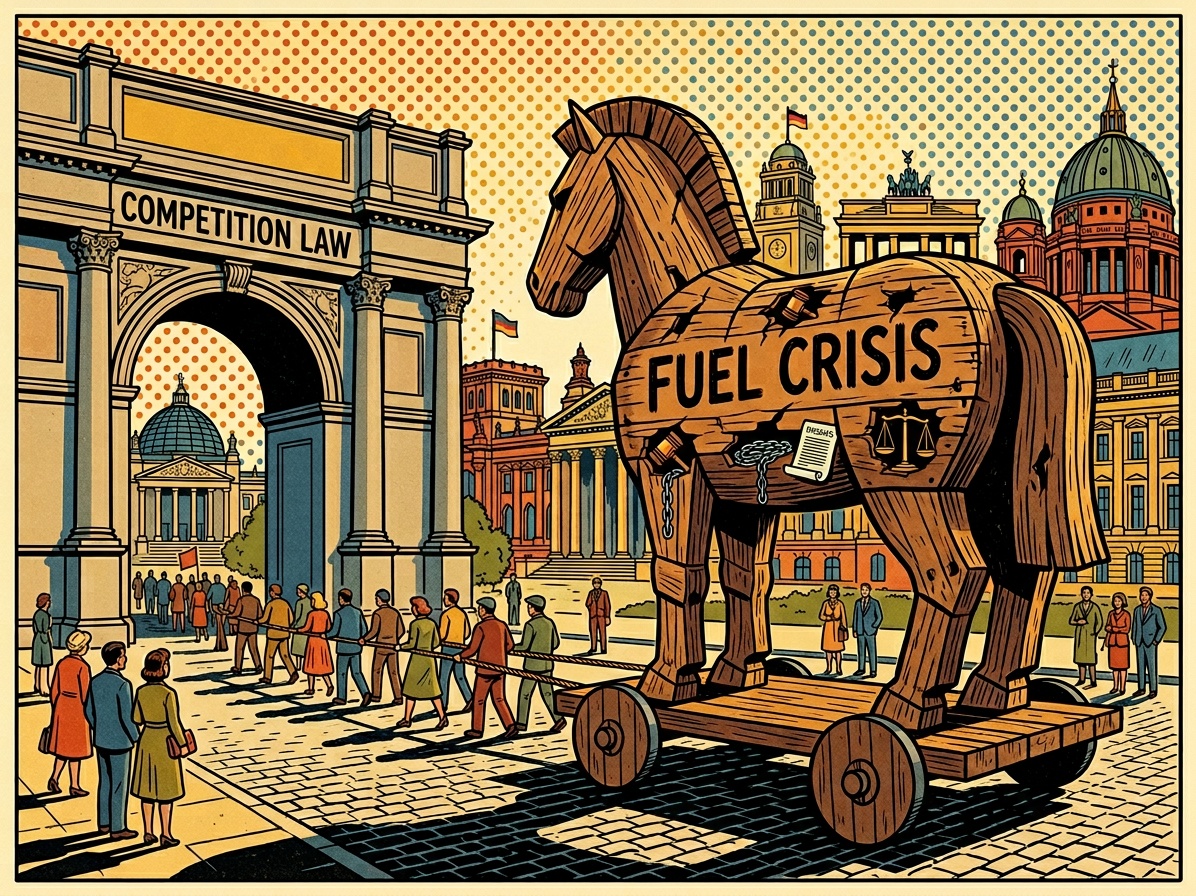
Geopolitical shocks rarely just move markets. They move policy—and not always in good ways.
Fuel prices are climbing sharply across Europe following military escalation in the Middle East and disrupted shipping through the Strait of Hormuz. The political demand for “something to be done” can be nearly irresistible.
In Germany, several major political groups have answered that demand with the “Kraftstoffmaßnahmenpaket,” or “Fuel Market Intervention Package.” Lawmakers filed the draft legislation March 17, and the lower house of the Bundestag has already approved it. The government is targeting April 1 for entry into force.
The speed alone should raise concern.
The bill’s explanatory memorandum admits, with unusual candor: “No substantive contributions from third parties were considered in drafting.” Policymakers considered no alternative approaches. The process ran from filing to final vote in nine days. There was no consultation. No meaningful impact assessment. The only estimate—a back-of-the-envelope calculation—suggests compliance costs (“Erfüllungsaufwand”) “should not exceed” €200,000 for the State.
As for costs to businesses and citizens, the bill claims the “draft law will not create any compliance costs.” That assertion is plainly wrong to anyone familiar with price controls or similar interventions. For legislation that restructures a core instrument of German competition enforcement, the lack of scrutiny is hard to defend.
Crisis conditions create political urgency. But, as Roberta Romano suggests, “legislating in the immediate aftermath of a public scandal or crisis is a formula for poor public policymaking.”
The procedural critique, though valid, is not the most interesting one.
The more consequential problem lies in what the Kraftstoffmaßnahmenpaket does to the law—specifically, to Section 32f of the Act Against Restraints of Competition (ARC), the market-investigation tool introduced through the 11th ARC Amendment in 2023.
The bill frames its changes as temporary responses to a fuel crisis. In fact, they are not limited to the fuel sector. They apply across all markets. And what the bill describes as a procedural simplification turns out, on closer inspection, to be something quite different: a substantive expansion of state authority over lawful commercial conduct, one that stretches well beyond what competition policy can coherently justify.
Antitrust Without the Filters
To understand what has changed, start with what Section 32f already did.
In 2023, Germany introduced what its architects called a “fourth pillar” of competition policy, loosely modeled on the UK Competition and Markets Authority’s market-investigation regime. Section 32f allows the Federal Cartel Office (FCO) to impose behavioral and structural remedies—up to and including forced divestiture—following a sector inquiry, even where no competition-law infringement has been established.
A firm need not have broken any law. It need only operate in a market where the FCO finds a “significant and continuing disruption of competition.” That framework already marked a sharp departure from traditional competition-law enforcement.
The conventional model relies on two filters that discipline regulatory intervention. The first is market power. Competition law targets dominant firms, because only firms with substantial market power can restrict output, raise prices durably, or exclude rivals in ways that reduce consumer welfare. As William Landes and Richard Posner explained in their canonical 1981 analysis, antitrust should focus on the ability to sustain a profitable price increase above the competitive level—not on firm size or market structure in isolation.
A firm in a competitive market that raises prices simply loses customers. Remedies aimed at firms without meaningful market power do not improve consumer welfare. They distort it, penalizing success and discouraging efficient conduct.
The second filter is competitive harm. Even where market power exists, enforcement is justified only when the exercise of that power harms competition—typically through exclusionary conduct or coordination among competitors. This requirement ensures that enforcement targets genuine problems, rather than conduct that merely appears objectionable from the outside.
Section 32f, as enacted in 2023, weakened both filters.
It replaced the market-power requirement with the broader concept of a “significant and continuing disruption of competition,” defined through non-exhaustive, open-textured indicators. It replaced the harm requirement with a structural diagnosis: the FCO identifies a market it considers distorted and imposes remedies on firms it concludes have contributed to that distortion.
Even so, one limiting principle remained. The addressee of a remedy order had to have “materially contributed, through its conduct, to the competition disruption in its specific manifestation.” This requirement—former § 32f(3) sentences 2 through 5—created a link between the firm’s behavior and the identified problem.
It was no substitute for the traditional market-power and harm filters. But it served a similar function: it constrained the FCO’s authority to firms with some causal connection to the market failure it sought to address.
The Kraftstoffmaßnahmenpaket eliminates that constraint entirely.
Proportionality Is Not a Filter
The explanatory memorandum justifies the deletion in two sentences.
First, it claims the conduct-nexus requirement “is not considered conducive to the objectives of a structural protection instrument” like Section 32f. Second, it asserts that firms remain protected by “the high requirements for the existence of a competition disruption and the selection of possible remedy measures.” In other words, proportionality review is supposed to substitute for the conduct filter.
That reasoning does not withstand scrutiny.
Competition law’s traditional requirements—market power and evidence of harm to competition—are not bureaucratic hurdles or “mere technicalities.” They are filters in the precise sense that Judge Frank Easterbrook described in his canonical 1984 article, “The Limits of Antitrust”: sequential screens designed to identify cases
…in which the risk of loss to consumers and the economy is sufficiently small that there is no need of extended inquiry and significant risk that inquiry would lead to wrongful condemnation or to the deterrence of competitive activity as firms try to steer clear of the danger zone.
These filters do more than protect individual defendants. They calibrate the system. Properly applied, they deter anticompetitive conduct without chilling procompetitive behavior by firms operating near that “danger zone.”
To be clear, even with such filters, competition law generates error costs. But removing them compounds those costs. A proportionality review of individual remedy orders—however careful—operates downstream of the problem. It may limit the severity of a given intervention. It cannot restore the ex ante certainty that threshold filters provide to firms deciding how to behave before any investigation begins.
As discussed above, Germany had already weakened those filters. The bill now removes them altogether.
If enacted, the FCO could impose significant behavioral or structural obligations on a firm simply because it operates in a market the authority has identified as distorted. It would not matter whether the firm contributed to that distortion. It would not matter whether the firm holds a dominant or otherwise meaningful market position. It would not matter whether its conduct has harmed consumers or competitors.
Proportionality would constrain how far the remedy goes—but not who gets targeted. That shift matters.
Competition law has long rested on a simple principle: intervention is justified when a firm’s conduct causes, facilitates, or threatens competitive harm, and when the firm possesses sufficient market power to make that harm durable. Both elements are necessary. Market power without harmful conduct does not justify intervention. Harmful conduct without market power is a problem markets can often correct on their own.
Only their combination warrants the extraordinary step of ordering a firm to change how it runs its business—who it supplies, how it prices, or which assets it may retain. Remove those filters, and enforcement becomes discretionary in ways that make error costs difficult to estimate and legal certainty effectively impossible.
Firms will no longer be able to assess risk by examining their own conduct and market position. Instead, they must guess which markets the FCO might investigate and whether their industry has become politically salient at a given moment. That kind of discretion invites abuse. It also creates incentives to lobby—and to capture—the regulator.
As Herbert Hovenkamp recently observed, “[a]ntitrust law’s requirement of competitive harm is also important as a means of limiting legislative capture by specific interest groups.”
The German government does not deny the breadth of this change. The bill’s own summary states that the amendment to Section 32f will apply to competition enforcement “across all sectors.”
The crisis supplied the political opening. The change itself is structural—and permanent.
A Price Control by Another Name
The bill’s most visible feature is the “Fuel Price Adjustment Rule” (“Kraftstoffpreisanpassungsgesetz”). It limits petrol stations to one price increase per day, at noon. Violations carry fines of up to €100,000.
The government frames this as a transparency and consumer-protection measure, modeled on Austria’s 2009 regime. A more accurate description is simpler: it is an indirect price control, with the same familiar downsides as the direct kind.
At first glance, a rule that restricts “only” when and how often prices may rise can seem modest—certainly less intrusive than a price cap. In practice, it interferes with the same core mechanism: the real-time signaling function of prices.
During a supply shock, price increases do three things at once. As Ben Sperry explains, they ration scarce supply to its highest-valued uses, signal producers and distributors to increase output, and attract substitution around bottlenecks. A rule that allows prices to fall at any time, but permits increases only once per day—at a fixed hour—disrupts all three functions.
The result is not just higher prices or lower output. It is misallocation.
As Brian Albrecht, Alex Tabarrok, and Mark Whitmeyer show, the costs of price controls extend beyond the standard Harberger triangle. They arise from all-or-nothing allocations that emerge when prices can no longer adjust continuously. Without that constant feedback, supply does not flow to where it is most needed.
The 1970s gasoline crisis offers a familiar example. Policymakers at the time also invoked the “rocket-and-feather effect.” The result was not a modest 9% reduction in supply per market, but a breakdown: severe shortages in some states, surpluses in others. Price controls prevented tanker shipments from moving to their highest-value destinations.
The Austrian experience—the model this bill invokes—points in the same direction, though the government does not acknowledge it.
In a 2014 study, Martin Obradovits modeled a two-period duopoly with consumer search and showed why this type of rule can backfire. When firms can raise prices only once per day, they build a risk premium into that single adjustment to hedge against cost increases they cannot pass through later. The noon price rises strategically. It does not fall.
Austria’s own ÖAMTC traffic club reached a similar conclusion when commenting on a recent tightening of the regime to three permitted price increases per week: “We see no potential for immediate and sustainable relief in this proposal.”
German industry groups have been just as direct. In a joint statement, they note that more than half of pump prices consists of taxes and duties. “If you want to reduce fuel prices permanently,” they argue, “you have to talk about government price components—not about interfering in competition.”
Stacking the Deck
The bill’s third component—the new § 29a ARC—reverses the burden of pleading and proof in abuse-of-dominance cases in the upstream fuel market.
Under this provision, suppliers with a dominant position or relative market power must demonstrate, in proceedings before the FCO, that their prices are cost-justified and—where costs significantly exceed market norms—that those costs are reasonable. The FCO retains the initial burden of showing that prices unreasonably exceed costs. Once it meets that threshold, the evidentiary burden shifts to the firm.
Viewed in isolation, this measure is more limited than the changes to Section 32f. It applies to a defined sector and only to firms already found to possess market power. Nor is it entirely novel. Section 29 ARC already contains a similar rule for the energy sector, and burden-shifting frameworks are not uncommon in comparative competition law.
The concern lies in how this provision interacts with the weakened Section 32f standard.
Taken together, the changes substantially expand the FCO’s toolkit. The authority can initiate a sector inquiry, identify a “significant and continuing disruption of competition,” and impose remedies on any undertaking in the sector—without establishing that the firm contributed to the disruption. At the same time, it can pursue pricing investigations against dominant firms under a reversed burden of proof.
The result is not just a broader set of tools, but a system in which the constraints that once structured their use have largely fallen away.
A Crisis Is a Terrible Thing to Waste
Germany’s “Fuel Market Intervention Package” would make a near-perfect case study for a Public Choice class: a genuine crisis used to justify a regulatory response that goes well beyond what the problem requires.
Germany’s fuel market may well raise competition concerns. The FCO identified several in its February 2025 sector inquiry and proposed targeted remedies. This bill does not build on that analysis.
Instead, it imports a contested retail price-increase cap that Austria’s own traffic club has deemed ineffective. It introduces a burden-of-proof reversal that, while problematic, at least remains sector-specific and rooted in an existing framework.
And then there is the central change.
The deletion of the conduct-nexus requirement from Section 32f—presented as procedural housekeeping—is nothing of the sort. It is a permanent, economy-wide expansion of the FCO’s discretionary authority over firms engaged in lawful, rational conduct, including firms that have not been found to possess significant market power. The oil crisis supplies the pretext. The change itself is structural.
Competition law derives both its legitimacy and its effectiveness from analytical discipline. It requires findings of market power because, without them, there is no basis to infer durable harm. It requires evidence of competitive harm because, without it, intervention risks punishing efficiency, rather than protecting the competitive process. And it requires a causal connection between a firm’s conduct and the harm being addressed—not as a procedural nicety, but as the line between a genuine competition remedy and a populist intervention.
Remove those constraints, and competition law does not become more flexible. It becomes a vehicle for politically responsive intervention, rather than rule-bound enforcement.
