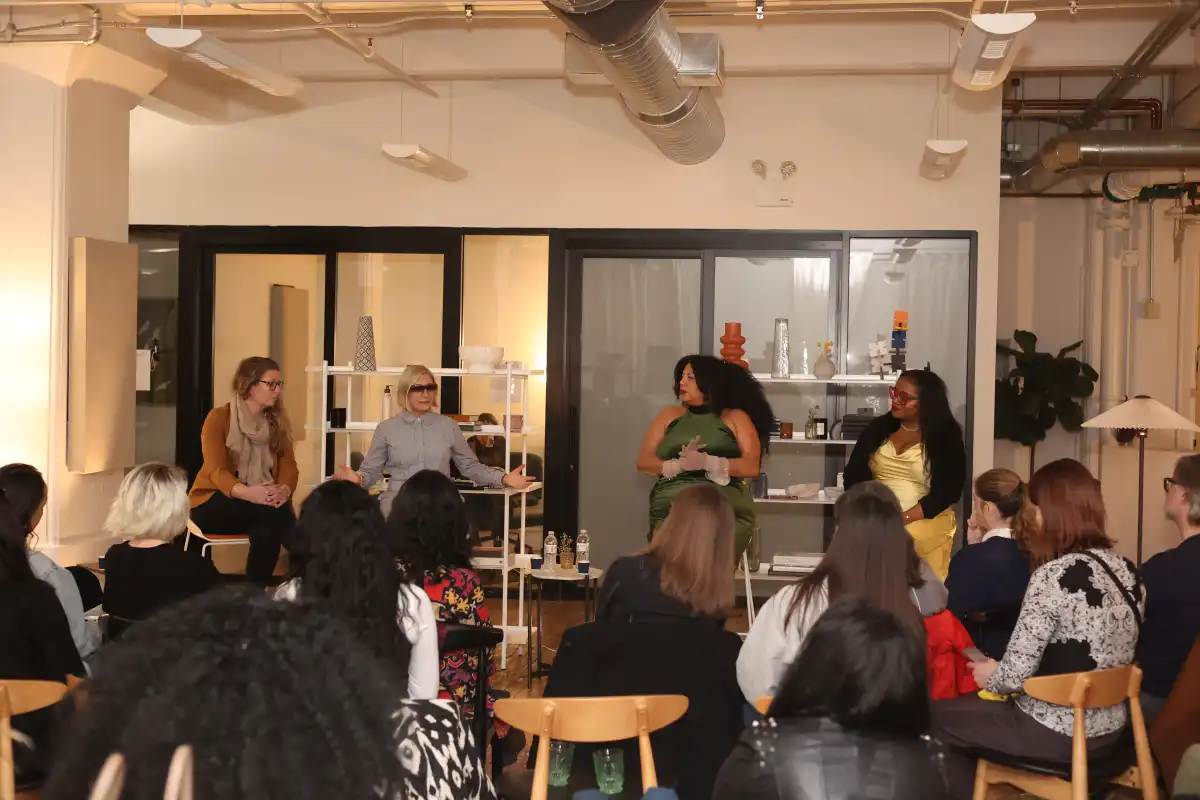
Art in Times of Change, hosted by Women of Culture
Photo: Nettie Atkisson
Art has never been born from comfort. It emerges, almost without exception, from rupture—from the moment a system fractures, a belief collapses, a body or a nation or a psyche can no longer sustain the illusion of permanence. One need only trace the lineage. The Black Death gives way to the Renaissance not as a gentle awakening, but as a desperate insistence on life. The wreckage of war births Dada, then Surrealism—movements that refuse logic precisely because logic had failed. Even Impressionism, so often softened into pastoral charm, was in fact a rebellion against fixed vision, a refusal to accept that reality could be held still. Upheaval, perhaps unsurprisingly, does not silence artists; it clarifies them.
What surfaced that evening—what insisted on being named—was something far older than any movement, far more embedded than any canon: change is inherently female. Not as metaphor, but as origin. Eve reaching for the apple was never about disobedience. It was, rather, an act of authorship—a refusal of imposed stillness in favor of knowledge, consequence, and self-determined evolution. The female body, inarguably, understands what systems attempt to suppress. It moves in cycles, sheds, renews, anticipates change not as disruption but as design. The universe behaves in much the same way—expansion, contraction, collapse, rebirth. To be female is to exist in rhythm with that truth, whether acknowledged or not. To reject transition, then, is to reject life itself, though patriarchal structures have long attempted to recast stillness as virtue and predictability as moral clarity. A woman in motion—intellectually, emotionally, economically—can quickly be rendered suspect. Control, after all, requires stagnation. Evolution dismantles it.

That tension pulsed through Art in Times of Change, hosted by Women of Culture in the final days of Women’s History Month. Fabrik in DUMBO became less a venue and more a threshold—something quietly ending, something else not yet fully formed. At the center, Alexandra Harper continues to build an ecosystem that resists passivity, insisting that women engage not only socially, but intellectually, economically, and culturally, with rigor and consequence. Shakira Politeguided the conversation with a steady, incisive hand, allowing it to stretch without losing tension, while Jillian J. Fosterbrought analytical precision, dismantling the illusion that certainty is ever available, particularly in moments of reinvention. Grimanesa Amorós spoke through the language of light—fluid, borderless, connective—reminding us that illumination, much like transformation, resists containment. My own contribution circled a sharper truth: art is not indulgence; it is authorship, capital, and survival, a mechanism through which one asserts presence in systems that often prefer silence.
A question, deceptively simple, shifted the air entirely: what is womanhood. My answer came instinctively—rebellion—though the room refused singularity. Love emerged, not as softness but as force. Presence, as a refusal to disappear. Perseverance, as the quiet discipline of continuing despite resistance. The power lived in that multiplicity, in the refusal to collapse into something easily defined. Like all rooms where intelligent, capable women gather with intention, something alchemical occurred. The conversation moved beyond performance into something far more necessary, equal parts therapeutic and galvanizing, offering not comfort but clarity, not resolution but recognition.

Ritual, importantly, grounded the evening back into the body. Chef Carla Contreras led a cacao ceremony that felt ancient in its cadence, while Nettie Atkisson of The Chocolate Connection offered a Peruvian tasting that carried geography and lineage in every note. Flying Whale Wine, under the direction of Maba Ba, introduced a measured ease that softened the sharper edges of discourse without dulling them, while cocktails by Dio added a precise counterpoint. VitaMoss, co-founded by Yusuf bin Ismaili, sustained the room with a cleaner, more deliberate energy aligned with clarity and vitality. Eaton Botanicals returned the palate to something restorative, and jewelry by Sem F. Dione shimmered as identity made visible. Nothing felt incidental. Transformation was not treated as theory; it was embodied.
There is, perhaps, a quiet arrogance in the belief that upheaval is something to be avoided, something to be solved quickly, neatly, without disruption. Nature does not operate that way. The female body does not operate that way. The universe does not operate that way. Upheaval is not the failure of the system; it is, more often than not, the system correcting itself. Calm will come, as it always does, though it arrives not as a return to what was, but as the emergence of something entirely new. The question is not whether change is occurring, but whether one has the courage to move with it. The women in that room did not shy away from transition; they stepped into it, fully aware that evolution is not gentle, yet understanding that it is the only path forward.
Eve reached. We are still reaching.
To follow any of the panelists and to see what Women of Culture is doing next:
