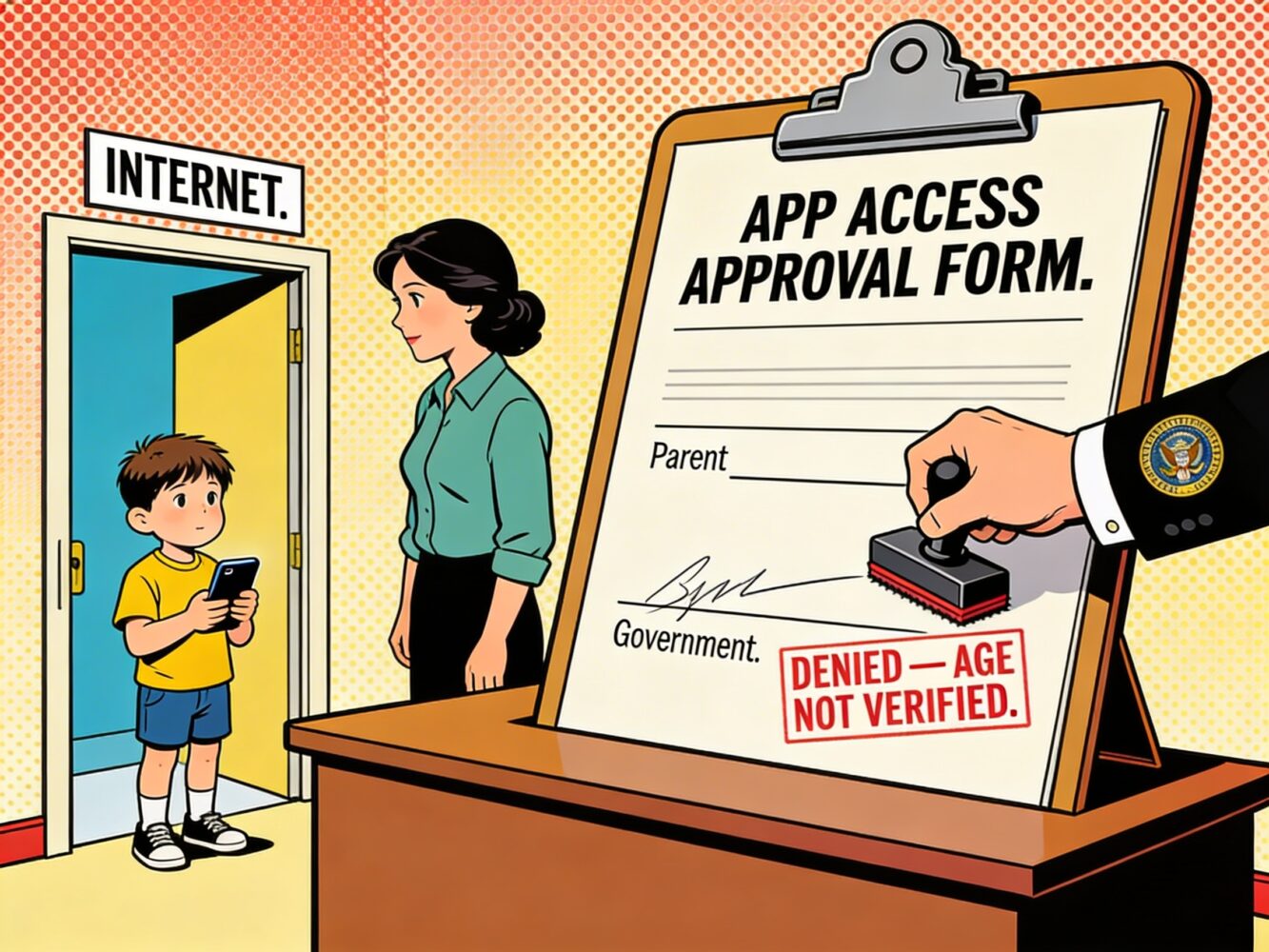
The struggle over the way to defend youngsters on-line underneath the First Modification has intensified within the opening weeks of the 12 months. Two product-liability trials lately started asking whether or not social-media providers reminiscent of Instagram and YouTube qualify as unsafe merchandise for minors due to allegedly faulty design options. On the identical time, federal and state lawmakers have launched payments that may impose legal responsibility on app shops in the event that they fail to confirm customers’ ages and procure parental consent earlier than minors obtain apps.
Debate has largely centered on who ought to bear duty for harms to youngsters on-line: the app shops or the apps themselves. The extra essential query, although, is when legal responsibility is smart in any respect.
This submit examines that query by a legislation & economics lens, with specific consideration to H.R. 6333, the Mother and father Over Platforms Act (POPA). Sponsored by Reps. Jake Auchincloss (D-Mass.) and Erin Houchin (R-Ind.) the invoice cleared the Home Vitality and Commerce Subcommittee on Commerce, Manufacturing, and Commerce in December and now awaits consideration by the total committee.
Parental Management or Authorities Default?
A legislation & economics framework clarifies each questions. Figuring out who ought to face legal responsibility requires figuring out the lowest-cost avoider, whereas accounting for transaction prices. Figuring out when legal responsibility is smart requires asking whether or not enforcement advantages exceed social prices.
Beforehand, once I examined these points, I wrote:
Right here, one might make a powerful argument that, since app shops usually have already got some type of knowledge on the date of beginning that was entered by a tool proprietor, in addition to the already current capability to supply controls to folks, they’re able to supply a type of “age verification” (nonetheless imperfect) and parental consent at comparatively low price. On this gentle, in comparison with social-media corporations and different functions, they do appear higher positioned to assist monitor and management what minors entry.
However, it’s nonetheless an open query whether or not app shops are lower-cost avoiders than customers (encompassing each minors and their mother and father) themselves. One argument already talked about is that app shops usually have already got some knowledge on the gadget consumer’s age, in addition to the capability to permit mother and father to present consent. However, there might nonetheless be substantial danger of collateral censorship in requiring parental consent for each single app interplay. The established order is that gadget makers already do give mother and father controls that permit them monitor app utilization at a granular degree. Assuming it by some means passes constitutional overview, nonetheless, [app store age verification and parental consent requirements] would change the defaults and basically require parental approval for each app interplay on a telephone. It will due to this fact impede mother and father who would favor to allow extra liberal use of apps and purchases even when they belief their youngsters and like comparatively fewer notifications.
Put merely, not each mother or father needs to undergo the effort of approving each single certainly one of their minor youngsters’s app interactions. Whereas the transaction price for anyone occasion of consent could also be comparatively low—notably if carried out through some sort of push notification requesting approval on one’s telephone or different gadget—the associated fee isn’t zero. Relying on the quantity of consent requests (which might be required even for innocuous child-friendly apps), these prices could possibly be substantial. The consequence might find yourself limiting minors’ entry to protected First Modification speech in methods which are paternalistic, moderately than parental authority-enhancing…
The default is essential the place there are transaction prices. Right here, the default of no entry would probably imply that minors are restricted from some quantity of protected speech. Collateral censorship is a social price that probably outweighs the advantages of enhancing parental management, particularly if the management is past what mother and father want to train in lots of instances.
That reasoning has already discovered assist in court docket. The primary federal district court docket to overview Texas’ App Retailer Accountability Act discovered the legislation probably unconstitutional, emphasizing the collateral-censorship downside created by individualized parental-consent necessities:
It restricts entry to an enormous universe of speech by requiring Texans to show their age earlier than downloading a cellular app or accessing paid content material inside these apps and requires minors to acquire parental consent. The Act is akin to a legislation that may require each bookstore to confirm the age of each buyer on the door and, for minors, require parental consent earlier than the kid or teen might enter and once more after they attempt to buy a e book.
Nor does the Supreme Court docket’s resolution in Free Speech Coalition v. Paxton change the evaluation. App-store age verification restricts entry to all speech out there in apps, not merely speech obscene to minors. As I beforehand famous:
The Court docket utilized intermediate scrutiny solely “[b]ecause speech that’s obscene to minors is unprotected.” It harassed that solely “the place the speech in query is unprotected” might states impose content-based restrictions “with out triggering strict scrutiny.”
It’s due to this fact puzzling that proponents of app-store age-verification mandates proceed to argue that Free Speech Coalition resolves the constitutional query. For instance, Georgetown College’s Meg Leta Jones contends courts can “prolong[] the logic past porn to industrial regulation… prohibit[ing] minors from getting into industrial relationships with app platforms with out parental consent….”
If the problem had been that straightforward, the California statute in Brown v. Leisure Retailers Affiliation would have survived First Modification overview. That legislation restricted minors’ capability to buy violent video video games, partly on the speculation that it bolstered parental authority. Writing for the Court docket, Justice Antonin Scalia rejected that declare:
Such legal guidelines don’t implement parental authority over youngsters’s speech and faith; they impose governmental authority, topic solely to a parental veto.
The identical downside seems right here. Stopping a minor from downloading even innocuous apps containing protected speech absent parental permission doesn’t empower mother and father; it substitutes the federal government’s judgment for theirs. As Brown additional noticed:
[W]e word our doubts that punishing third events for conveying protected speech to youngsters simply in case their mother and father disapprove of that speech is a correct governmental technique of aiding parental authority.
Ask the Mother and father, Not the Authorities
Once I beforehand evaluated a federal app-store accountability proposal, I concluded the sooner invoice probably violated the Structure. I additionally famous:
A special legislation would possibly require app shops which have precise data of customers’ ages to comply with mother and father’ acknowledged needs with respect to what content material is suitable. Such a legislation would possibly, certainly, move constitutional muster.
The Mother and father Over Platforms Act seems designed to do precisely that.
POPA requires “Software Distribution Suppliers” to ask account holders to declare their age at account creation. The supplier should then generate an “Age Sign” indicating whether or not the consumer is a minor or an grownup. With the consumer’s or mother or father’s permission, the app retailer shares solely that restricted sign with apps, moderately than a birthdate or different delicate private data.
The construction issues. POPA lets apps activate security options, prohibit grownup content material, and block personalised promoting to minors with out conducting their very own age checks or amassing further knowledge. The invoice intentionally avoids the intrusive age-verification mandates courts have rejected in social-media and app-store instances. As an alternative of impartial verification, it depends on parental enter throughout gadget setup, which the app retailer interprets right into a standardized sign apps can use.
That sign drives the remainder of the framework. Mother and father obtain instruments to dam minors from downloading or utilizing specific apps. Builders should disclose whether or not their apps deal with minors otherwise and should take affordable steps to find out whether or not a consumer is a minor or an grownup, together with reliance on the app-store sign.
If an app contains restricted content material, the developer should acquire parental consent earlier than a minor can entry it. Builders additionally should forestall minors from utilizing adult-only options and will not serve behaviorally personalised promoting to minors.
The allocation of duty follows sensible traces. Mother and father resolve what their youngsters might entry. App shops handle device-level controls and transmit age classes. Builders implement app-specific restrictions primarily based on that data.
The invoice additionally limits how age knowledge could also be used or shared, shields app shops and builders from legal responsibility for good-faith compliance efforts, and authorizes the Federal Commerce Fee (FTC) to implement violations as unfair or misleading practices. The statute preempts conflicting state legal guidelines and would take impact two years after enactment.
Mother and father stay the lowest-cost avoiders of hurt of their youngsters’s on-line exercise. POPA doesn’t exchange parental authority; it enhances it by requiring app shops to ask the related query at setup and by making certain the reply has sensible impact throughout the cellular ecosystem.
Security With out Censorship?
Defending youngsters on-line requires greater than selecting between app shops and apps. The actual job is figuring out who can cut back hurt on the lowest price, whereas preserving lawful speech. First Modification doctrine and legislation & economics each level in the identical path: insurance policies ought to empower mother and father, not exchange them with government-imposed defaults.
Earlier proposals tried to drive age verification on the level of entry. Courts rightly considered these regimes as collateral censorship as a result of they conditioned broad classes of protected speech on proof of age and repeated parental permission. These guidelines didn’t improve parental authority; they displaced it, burdening households that didn’t need fixed oversight, whereas limiting minors’ entry to lawful expression.
POPA takes a special strategy. As an alternative of gatekeeping speech, it operationalizes parental alternative. Mother and father present age data as soon as throughout gadget setup. App shops transmit a restricted age sign. Builders then implement app-specific safeguards, together with restrictions on grownup content material and behavioral promoting to minors. Accountability follows operate: mother and father set preferences, platforms convey them, and apps apply them.
No coverage will eradicate on-line danger. However a framework that reduces transaction prices, avoids collateral censorship, and preserves entry to protected speech comes nearer to the constitutional and financial steadiness the legislation calls for. POPA strikes in that path by strengthening parental authority with out turning the First Modification right into a permission slip.
