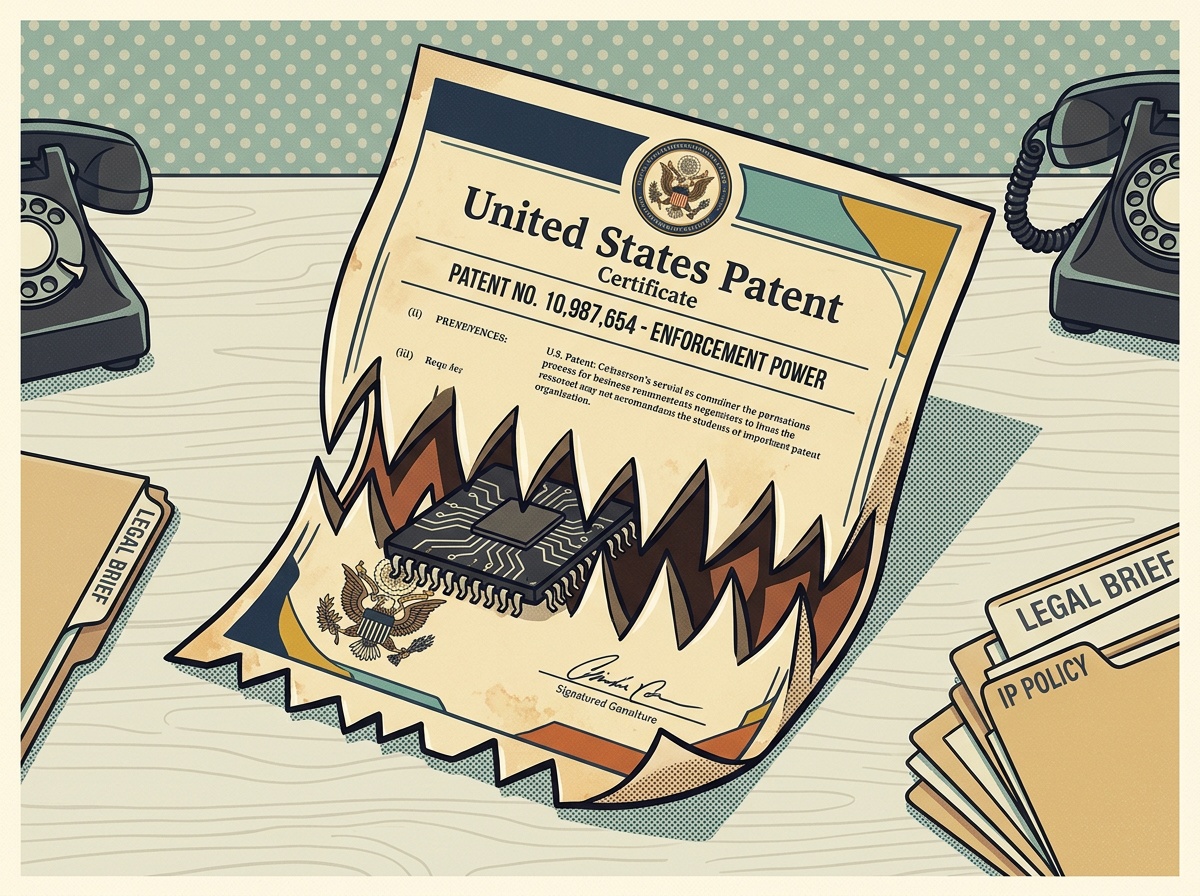
The U.S. Division of Justice (DOJ) and U.S. Patent and Trademark Workplace’s (USPTO) Feb. 27 joint assertion of curiosity in Collision Communications v. Samsung indicators a attainable shift again towards the primary Trump administration’s “New Madison Method” to patent coverage. That framework—largely deserted in the course of the Biden administration—handled patents as property rights and defended the central position of injunctions in defending them.
The submitting suggests the present administration could also be transferring to revive that strategy. In that case, the implications for patent treatments—and for innovation coverage extra broadly—could possibly be important.
A short have a look at the financial position of patent injunctions, and at what the Collision Communications assertion of curiosity (CCSOI) truly says, helps clarify why. It additionally raises the chance that even stronger pro-patent initiatives might quickly observe.
Why the Proper to Exclude Issues
The first financial justification for routine injunctions is safety of the “proper to exclude.” That precept is grounded within the U.S. Structure and lies on the core of the patent system.
Routine injunctive reduction transforms a patent from a mere proper to gather royalties into a strong property proper. It permits innovators to commercialize their innovations with confidence whereas requiring rivals to contribute new advances to {the marketplace}, somewhat than free experience on current ones. The result’s stronger incentives for analysis and growth (R&D), higher funding, and extra sturdy innovation cycles.
Routine injunctions additionally strengthen innovation incentives in a number of methods. First, they assist innovators recoup the substantial prices of creating new applied sciences. In high-risk sectors comparable to prescription drugs, corporations usually make investments lots of of hundreds of thousands of {dollars} to deliver a product to market. Injunctions assist protect market exclusivity, permitting innovators to recuperate these prices and earn a return on their investments.
Second, robust patent safety strengthened by injunctive reduction indicators a agency’s R&D capabilities to exterior traders. By lowering info asymmetries, credible patent rights can improve market valuations and enhance entry to the capital wanted to finance future improvements.
Third, injunctions deter “predatory infringement”—conditions wherein rivals use patented know-how with out authorization and power the patent holder to pursue compensation via litigation. By preserving the rewards promised by the intellectual-property system, injunctions assist maintain a steady cycle of innovation.
Competitors within the Shadow of Injunctions
Injunctions additionally play a vital position in facilitating environment friendly market negotiations. They set up the situations for personal bargaining over licensing, somewhat than leaving courts to estimate damages after the very fact. An injunction preserves the property proprietor’s potential to refuse an insufficient supply, stopping coerced transfers of mental property.
Absent the credible menace of exclusion, potential infringers might discover it worthwhile to make use of a know-how and delay fee till litigation compels them to pay damages. That dynamic dangers turning patents into de facto obligatory licenses. Injunctions push licensing negotiations again into strange market contracting.
Additionally they scale back valuation errors. Courts usually battle to calculate correct financial damages for distinctive, non-fungible innovations. Injunctions as a substitute apply a property rule that leaves valuation to the market contributors greatest positioned to evaluate a know-how’s value.
Lastly, the specter of an injunction can stimulate competitors by encouraging design-arounds. Rivals excluded from utilizing a patented know-how should develop various options. That course of can generate totally different—and generally superior—applied sciences.
Design-arounds additionally increase the vary of technological approaches and merchandise out there within the market. The result’s higher product variety, stronger competitors, and elevated long-term dynamism in innovation-driven markets.
A Welcome Return to Patent Fundamentals
The CCSOI filed by the DOJ and USPTO underscores the central position of injunctive reduction in selling innovation. The assertion frames robust injunctions as a necessary mechanism for shielding patent holders’ property rights and preserving the incentives that drive analysis, funding, and technological progress. The place can also be per the DOJ’s June 2025 assertion of curiosity within the Radian Reminiscence Programs case.
First, the companies emphasize that the patent holder’s proper to exclude lies on the core of the patent system. Unduly proscribing entry to injunctions weakens that proper and, in flip, diminishes the incentives for future inventors to spend money on R&D. The constitutional construction of the patent system displays the expectation that unique rights will encourage innovation by permitting inventors to seize the worth of their discoveries.
The CCSOI additionally highlights the position injunctions play in encouraging market-based licensing. In keeping with the companies, injunctions are “efficient instruments” for pushing events towards non-public negotiations grounded in market ideas. A negotiated licensing settlement is “far preferable,” the assertion notes, to a “judicial guesstimate” of an affordable royalty—an estimate courts might battle to calculate precisely for distinctive applied sciences.
The companies additionally reject categorical limits on injunctions for non-practicing entities (NPEs), comparable to Collision Communications. Financial damages might not absolutely compensate patent house owners for ongoing infringement, notably when infringement forecloses licensing alternatives or undermines the know-how’s market worth. Denying injunctions solely as a result of a patent proprietor doesn’t manufacture merchandise would improperly slender the scope of the suitable to exclude.
The assertion’s recognition of the significance of standard-essential patents (SEPs) can also be notable. Insufficient compensation for SEPs discourages participation in standard-setting and weakens incentives to contribute superior applied sciences to broadly adopted technical requirements. Over time, that dynamic dangers degrading requirements high quality, slowing innovation, and lowering the standard of downstream services. (A November 2022 Worldwide Middle for Regulation & Economics “Difficulty Highlight” gives further info on the advantages of SEPs and on the faulty nature of the assaults on these vital property rights.)
Lastly, the companies stress that significant entry to injunctions helps deter “environment friendly infringement.” With out the credible menace of exclusion, well-resourced corporations might discover it worthwhile to repeat patented know-how and deal with damages as a price of doing enterprise. Preserving injunctive reduction helps be certain that smaller innovators can defend their innovations and compete on the deserves, somewhat than on litigation budgets.
Three Methods to Put Enamel Again in Patents
The administration’s latest SOIs in trial courts signify a welcome sign of help for stronger patent rights. Even so, further steps might reinforce that message and strengthen the position of injunctions within the patent system.
First, the administration might help laws that restores a presumption in favor of injunctions as soon as a court docket finds patent infringement. Proposals such because the RESTORE Patent Rights Act would transfer patent treatments nearer to conventional property guidelines and reinforce the patent holder’s proper to exclude. (See, for instance, this evaluation of the RESTORE Patent Rights Act.)
Second, the White Home might difficulty a coverage assertion endorsing the ideas of the New Madison Method. That framework emphasizes a number of core propositions: hold-up is just not an antitrust downside, so antitrust legislation mustn’t govern disputes between SEP holders and customary implementers; standard-setting organizations mustn’t facilitate collective motion by implementers that disadvantages patent holders; the suitable to exclude stays a basic factor of patent rights, together with SEPs; and unilateral, unconditional selections to not license a patent must be per se lawful.
Third, the administration might take affirmative steps to problem international insurance policies that weaken U.S. patent rights. The forthcoming administration “Particular 301 Report” is predicted to establish jurisdictions whose insurance policies undermine patent protections. The place applicable, america might pursue commerce responses—together with the potential of sanctions—to encourage reforms.
The Trump administration has taken constructive steps by signaling its patent-policy views via SOIs. The following step could also be to articulate a clearer, governmentwide dedication to robust patent rights. A sturdy patent system helps innovation, funding, and long-run financial progress (see, for instance, right here and right here)—all per the objective of “making the American economic system robust once more.”
