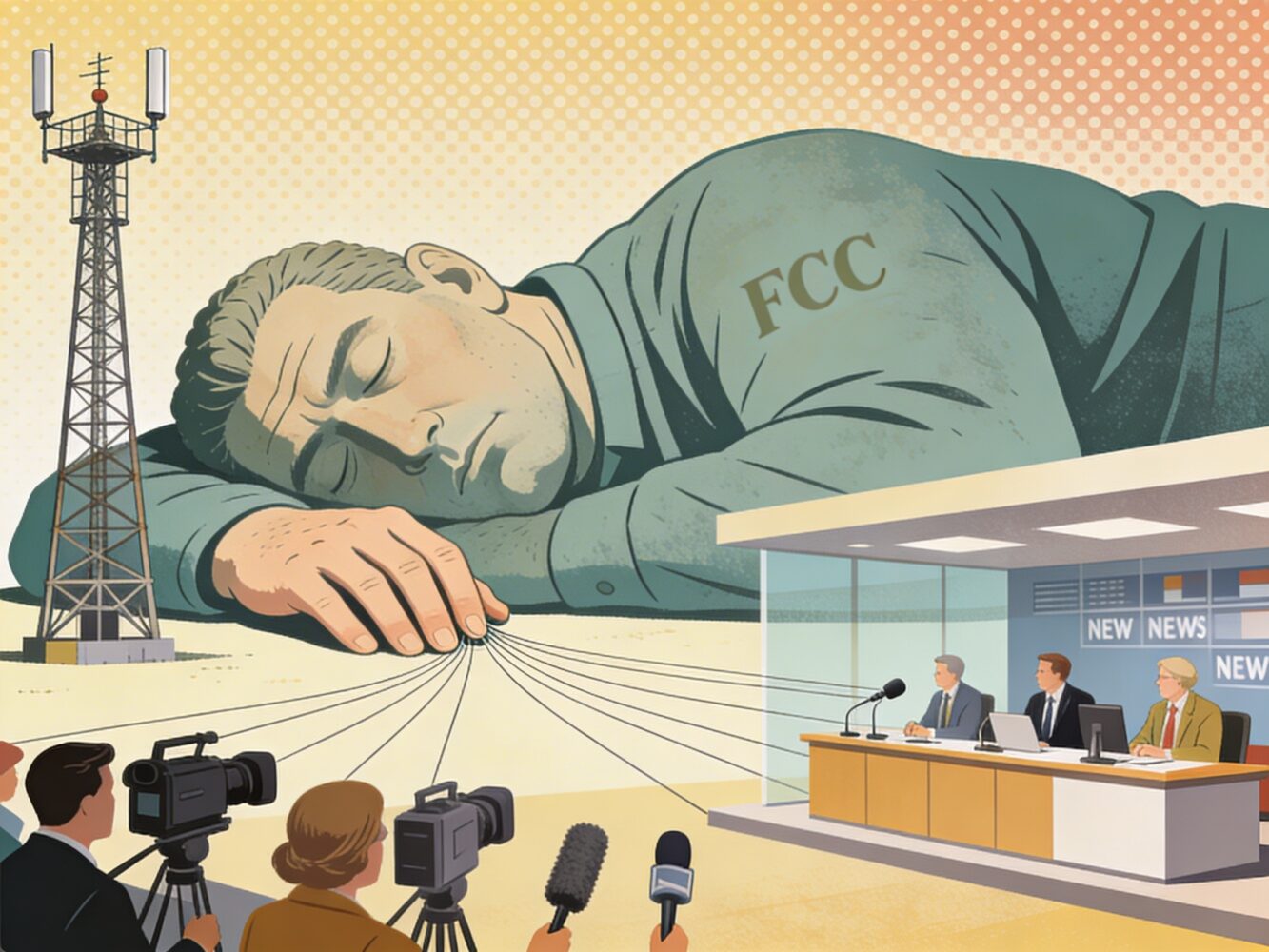
The Trump administration says it desires to finish federal censorship. Its current statements recommend one thing else.
Within the govt order “Restoring Freedom of Speech and Ending Federal Censorship,” the White Home asserted:
The First Modification to the USA Structure, an modification important to the success of our Republic, enshrines the correct of the American individuals to talk freely within the public sq. with out Authorities interference. Over the past 4 years, the earlier administration trampled free speech rights by censoring Individuals’ speech on on-line platforms, typically by exerting substantial coercive strain on third events, comparable to social media corporations, to average, deplatform, or in any other case suppress speech that the Federal Authorities didn’t approve. Underneath the guise of combatting “misinformation,” “disinformation,” and “malinformation,” the Federal Authorities infringed on the constitutionally protected speech rights of Americans throughout the USA in a way that superior the Authorities’s most well-liked narrative about important issues of public debate. Authorities censorship of speech is insupportable in a free society.
The order declared it the coverage of the USA to “make sure that no Federal Authorities officer, worker, or agent engages in or facilitates any conduct that will unconstitutionally abridge the free speech of any American citizen.”
Regardless of that said dedication, the administration has signaled a willingness to fight so-called “faux information” by a little-used and difficult-to-enforce news-distortion coverage. Federal Communications Fee (FCC) Chairman Brendan Carr lately amplified that place on social media, posting a screenshot of President Donald Trump’s Reality Social assertion criticizing protection of the battle in Iran and warning broadcasters:
Broadcasters which can be operating hoaxes and information distortions – also referred to as the faux information – have an opportunity now to appropriate course earlier than their license renewals come up. The regulation is obvious. Broadcasters should function within the public curiosity, and they’re going to lose their licenses if they don’t.
The issue requires precision. The FCC could plausibly declare authorized authority to pursue this strategy. That chance makes the coverage extra—not much less—regarding. This isn’t merely regulatory overreach. It’s a long-dormant energy that has remained on the books for many years, accessible to any administration keen to make use of it.
Congress ought to revisit that authority and remove it. Irrespective of which get together controls the White Home, empowering a federal company to make open-ended judgments about what qualifies as respectable information protection conflicts with core free-speech ideas.
This dialogue proceeds in two components. First, it traces the origins of the news-distortion coverage and explains why it not matches the fashionable media panorama. Second, it exhibits that, even underneath present authorized requirements, no alleged details would suffice to ascertain information distortion in broadcasters’ protection of the battle in Iran.
A Rule Constructed for Rabbit Ears
Part 309(a) of the Communications Act authorizes the FCC to grant a broadcast license provided that doing so serves the “public curiosity, comfort, and necessity.” The news-distortion coverage emerges from that broad normal, which allows the company to overview sure content material selections. On its face, that authority sits uneasily with the First Modification. The Supreme Courtroom, nevertheless, has upheld it within the broadcast context by distinguishing broadcasting from different media.
In Purple Lion Broadcasting Co. v. FCC and FCC v. Pacifica Basis, the Courtroom relied on spectrum shortage. As a result of the federal government allocates restricted broadcast frequencies, it could impose license situations that will not apply to different types of expression. In Purple Lion, for instance, the Courtroom upheld the equity doctrine as utilized to a radio station that refused to offer reply time to a person it had “personally attacked.”
Each the equity doctrine and the news-distortion coverage rested on the similar rationale: “[a] licensee can be abusing his place as a public trustee . . . have been he to withhold from expression over his services related information or details regarding an argument or to slant or distort the presentation of such information.”
That rationale eroded over time. In 1987, the FCC concluded that the equity doctrine “on its face, violates the First Modification and contravenes the general public curiosity.” In 2011, the company formally repealed the underlying guidelines. The news-distortion coverage, in contrast, stays on the books—however largely in identify solely. The FCC has hardly ever enforced it and has not tried to take action in additional than 30 years.
The broader authorized basis for particular regulation of broadcast licensees has additionally weakened. As we now have argued beforehand:
[I]nsofar as FCC authority over broadcast ever made sense, it definitely makes little or no at this time. Broadcasters not have the market energy they as soon as did, when tv shoppers solely had ABC, NBC, CBS, and PBS—later to be joined by Fox, UPN, the WB, and the CW. Cable, satellite tv for pc, and all of the choices of internet-video providers are stiff competitors for community tv. Even content material from community broadcasters is essentially accessed at this time by cable, satellite tv for pc, or the web. Only a few clients depend on over-the-air antennas for tv in any respect anymore.
The media panorama bears little resemblance to the world of the Nineteen Sixties and Seventies, when the Courtroom determined Purple Lion and Pacifica. Broadcast retailers now compete straight with cable networks, streaming platforms, podcasts, and digital publications—and infrequently lose that competitors. Treating ABC otherwise from CNN as a result of it stays theoretically accessible through over-the-air antennas not displays market actuality.
The identical logic that doomed the equity doctrine applies right here. As Eric Fruits put it:
The unique justification for some broadcast regulation stemmed from the restricted variety of accessible broadcast licenses. However such shortage has been eradicated within the Digital Age, with numerous on-line information retailers and platforms accessible to shoppers… This abundance of knowledge sources diminishes the necessity for presidency intervention to make sure the general public receives numerous and correct information.
Briefly, the news-distortion coverage rests on more and more unstable authorized floor. Its decades-long dormancy underscores that time. There’s little justification for treating a section aired on ABC or NBC otherwise from a video on YouTube, a podcast on Spotify, an article in The Wall Avenue Journal, or a submit on The Huffington Publish.
All Allegation, No Proof
Even when the news-distortion coverage stays legitimate regulation, the allegations right here fall effectively wanting what enforcement would require.
Given the constitutional issues at stake, the FCC and reviewing courts have emphasised that the coverage has “extraordinarily restricted scope.” A viable declare should fulfill two parts: (1) the broadcaster will need to have intentionally meant to slant or mislead, and (2) the distortion should concern a major occasion, not a minor or incidental facet of the report.
The intent requirement units a excessive bar. It’s “not sufficient to dispute the accuracy of a information report… or to query the respectable editorial selections of the broadcaster.” A claimant should as an alternative produce “extrinsic proof”—proof past the published itself—comparable to inner directives, outtakes, or proof of bribery demonstrating intentional distortion.
No such proof has been alleged right here. Carr’s tweet depends solely on a screenshot of the president’s Reality Social submit criticizing allegedly deceptive headlines in newspaper protection of the battle in Iran. That falls brief in two respects. The news-distortion coverage doesn’t apply to newspapers or their on-line equivalents. And even when it did, such allegations wouldn’t represent extrinsic proof of deliberate distortion.
Previous instances underscore the hole. Many concerned broadcasters staging or reenacting occasions depicted in information experiences. Even then, the FCC distinguished between materials distortions and “incidental” manufacturing decisions. No comparable conduct has been alleged right here.
Carr’s feedback additionally elevate a separate concern. They transcend describing the regulation and recommend prejudgment. His references to “legacy media” as untrusted purveyors of “faux information” indicate that the result has already been determined and that the company is merely awaiting a proper criticism to behave. That posture might complicate any eventual enforcement motion in court docket.
The Drawback Is the Energy
Carr is as soon as once more warning broadcast licensees that their protection could fail to fulfill his view of the general public curiosity. The FCC’s public-interest normal is broad, however it’s not boundless. Public statements suggesting that information protection violates the news-distortion coverage create an actual threat of backdoor censorship.
Relatively than invoke that authority, the FCC ought to repeal the coverage by its “Delete, Delete, Delete” continuing. The company ought to acknowledge the weak authorized basis for treating broadcasters otherwise in at this time’s media market. The First Modification protects {the marketplace} of concepts. It doesn’t empower regulators to resolve what’s true.
Company restraint, nevertheless, isn’t sufficient. The issue is structural. So long as the coverage stays on the books, any administration—of both get together—can use it to strain the press over unfavorable protection. Congress ought to remove that authority altogether.
The First Modification shouldn’t depend upon the goodwill of regulators. It ought to depend upon regulation that leaves no room for them to resolve what counts as the reality.
