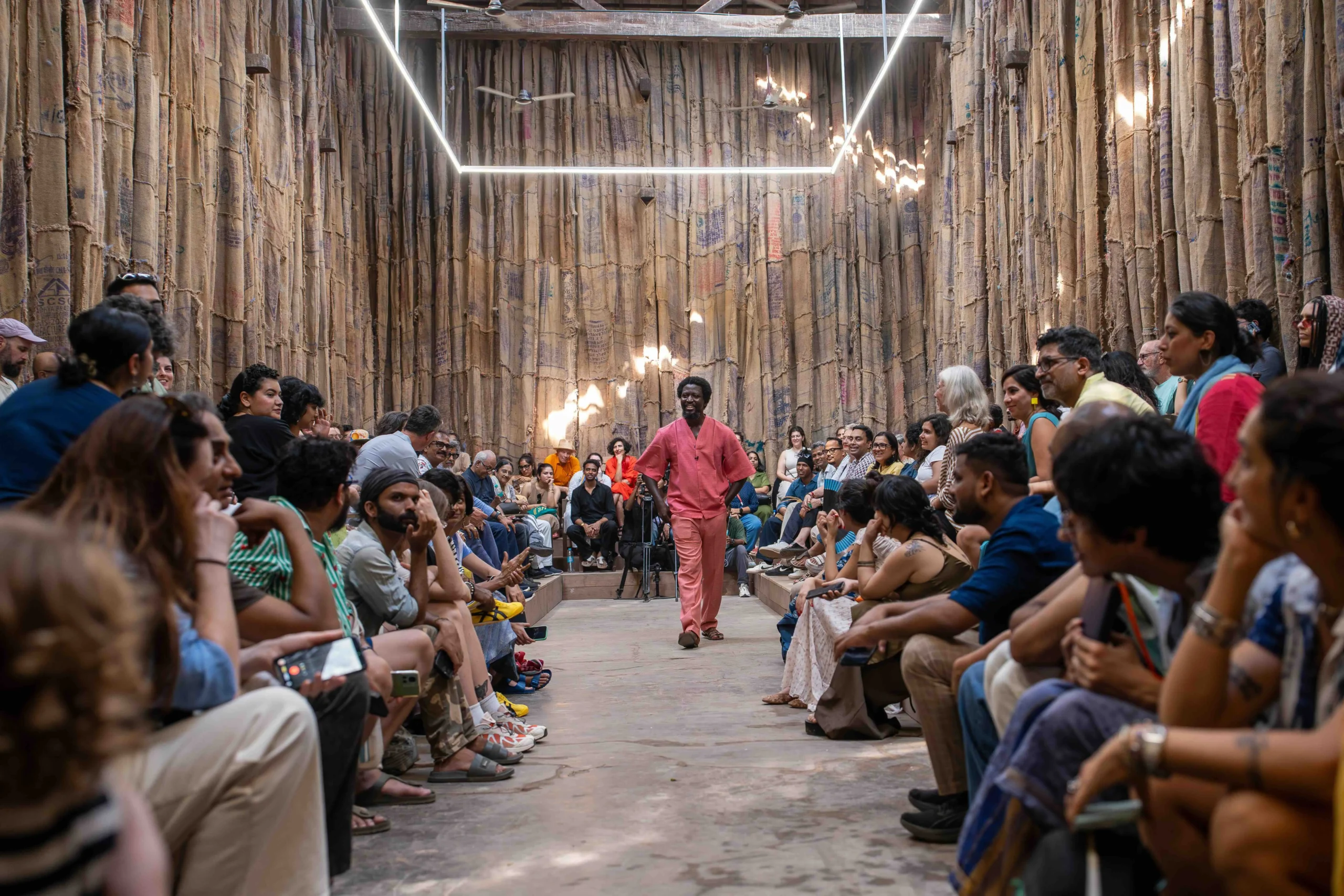
Past the nation-state framework codified by the Venice Biennale, the most influential biennials are people who set up a real dialogue with the locations and communities by which they unfold—past the normal artwork elite—and depart lasting traces that may bloom over time, fostering the expansion of complete cultural ecosystems. Since its founding in 2012 by artists Bose Krishnamachari and Riyas Komu as the one publicly funded worldwide exhibition in India, the Kochi-Muziris Biennale has aspired to be a cultural challenge with actual social, academic and concrete impression. In restored heritage buildings, public areas and deserted industrial and colonial websites in Kochi in southern India, it integrates up to date artwork immediately into the city cloth, making it accessible to the general public whereas prompting reflection on Kerala’s complicated previous and sparking a shared train in imagining its future.
Now in its twelfth version, it has, through the years, grow to be a dwelling laboratory the place native artists, each established and rising, interact in a broader dialogue with worldwide friends. These guests, in flip, are inspired to immerse themselves within the cultural and human context by which they current their work. Working by the top of March below the curatorial path of Nikhil Chopra and HH Artwork Areas in Goa, the 2026 Kochi-Muziris Biennale options the work of 66 artists and collectives from greater than 20 nations in a number of venues, participating immediately with the presence of tourists who traverse them.
Titled “For the Time Being,” this version of the Biennale is worried with the bodily, sensory and emotional filters by which we take up, negotiate and course of our experiences of the world. Staged as a syncretic convergence of voices from numerous backgrounds inside the very cloth of the town, the Biennale, as envisioned by Chopra, succeeds in transcending the boundaries of each self and house. It turns into a follow of human gathering that each restores and responds to our collective want for shared rituals. “The thought is that we measure our expertise within the distance between heartbeats,” Chopra informed Observer earlier than the opening—evoking the rhythm of human encounter, the act of confronting the opposite, inside a liminal house between the dense historical past that prices these locations, the immediacy of lived expertise and the longer term that artwork may assist us think about and form. What the Kochi Biennale levels this yr is a quiet but persistent demonstration of how a biennial can really perform as a energetic and expansive civic organism.

The journey begins at Aspinwall Home, constructed within the nineteenth Century because the headquarters and buying and selling premises of Aspinwall & Firm, a British-owned agency central to Kerala’s colonial-era export economic system, dealing in spices, coir, timber, espresso and rubber. The artists overtly interact with and, kind of immediately, confront this colonial previous—traces of the Dutch and Portuguese are woven into the warp and weft of Kochi itself.
On the entrance to the Coir Godown, Adrian Villar Rojas units the tone with a poignant set up of out of date fridges remodeled into diorama-like vitrines, containing rotting meals that exposes the passage of time and the precept of entropy governing all matter. Like up to date vanitas, these assemblages condense the extractive logic of the Anthropocene into the intimate scale of the home equipment, every ingredient sourced from world provide chains and bearing witness to the capitalistic extractive ideology reshaping the earth.
Within the following room, we encounter an expansive, multilayered presentation by the Panjeri Artists’ Union, a neighborhood of 14 practitioners enacting types of political resistance by a multidisciplinary follow that recontextualizes and reactivates materials traces of collective reminiscence. Rooted in lengthy histories of partition, their deeply collaborative, community-led pedagogical strategies undertake a durational, process-based strategy within the type of a sustained 100-workday presence, remodeling the house right into a platform for dissent and shared wrestle. They stage and restage works and participative actions that embody radical solidarity and creativeness, between revolutionary endurance and counter-hegemonic considering.
Many works within the Kochi-Muziris Biennale are overtly political—one thing institutional artwork, notably inside the biennial format, traditionally embraced, however which, in right now’s disaster of institutional authority and rising governmental scrutiny, has grow to be far rarer. Though publicly funded, the Kochi Biennale has, by many works, denounced, addressed and unearthed particular conditions of inequality and injustice in India and past, typically reviving histories omitted, distorted or totally erased from official narratives.

Indian artist Dhiraj Rabha’s presentation attracts on his childhood in a former ULFA detention settlement to look at the enduring impression of insurgency in Assam—a area absorbed into British India after the Treaty of Yandabo in 1826, the place colonial extraction, demographic upheaval and political marginalization seeded tensions that later erupted into uprisings, state repression and mass displacement. Archival pictures, newspapers and pamphlets are scattered by an set up resembling the stays of a burned home, exposing fractures between official narratives and lived reminiscence. At its heart, a disconcerting backyard of carnivorous flowers with sharp white enamel glows below blue UV gentle, buzzing with information stories on the ULFA motion in Assamese, Hindi and English from the Nineteen Nineties by to 2010, the voices swallowed by noise. Eight watchtowers—modeled on the surveillance buildings present in each camp—provide vantage factors into and past the enclosure, suggesting each the violence of management and the quiet resilience by which communities have solid enduring, if precarious, types of belonging.
Labor exploitation emerges as a vital theme throughout a number of works. New Delhi artist Birender Yadav confronts this actuality by dissected, fragmented our bodies reflecting the precarious lives of seasonal migrant staff, notably these laboring within the brick kilns of Mirzapur, Uttar Pradesh. Terracotta casts of on a regular basis belongings left behind in momentary dwellings are displayed with the indifferent precision of archaeological specimens, showing as indirect biographical fragments scattered all through the set up. It’s the poetry of those reconstructed and reassembled stays that interprets the Biennale’s notion of “embodied histories,” giving kind to the lives of those that got here earlier than us and people who proceed to inhabit this ongoing human epic. Right here, the dominant clay tone concentrates centuries of labor—alongside labor-knowledge and craftsmanship—right into a website of commemoration that restores dignity to particular person microhistories whereas elevating historic native information as soon as intimately sure to the land.

Equally, Smitha M. Babu’s earth-toned portray follow celebrates rituals of reconnecting with nature, labor and neighborhood. Drawing on her lived experiences alongside Ashtamudi Lake in Kollam and her shut statement of the area’s coir-making custom, Babu elevates on a regular basis working-class gestures right into a dwelling archive of fragile information by her watercolors. As embodied data of labor, resilience and cultural reminiscence, portray—alongside her reside performances—turns into a ritual follow that preserves the missed rhythms of a neighborhood whose relationship to land, craft and survival resists historic erasure.
Remnants of collective reminiscence
Recurrent throughout the works is the direct engagement with reminiscence—with relics and fragments of the previous—the place artmaking turns into a instrument not solely to confront loss and the grief of historic trauma, but additionally to affirm survival and gesture towards reconciliation and therapeutic. In Kochi, colonial ruins are remodeled into websites of restore. The precarious architectural buildings of Shiraz Bayjoo, for instance, perform as portals to retrieve symbolically coded and materially embedded resistant oceanic imaginaries and as conduits for interrogating the histories of maritime commerce and colonial extraction throughout the Indian Ocean. These works study their manipulation by the extractive development of so-called “ethnographic” museographies.
Fragments from spiritual and secular websites are mixed into hybrid historic pastiches by Indian artist Ali Akbar PN to disclose how cultural types are repeatedly reshaped by appropriation, historic distortion and fertile cross-cultural hybridization. On the heart of the set up, a seated lion sculpture turns into a charged image of each monument and mutable political life: its formal lineage traces again to Center Jap, Indo-Islamic and Buddhist traditions, the place the lion signified safety and sovereignty. But, its altered, aggressive expression displays up to date appropriation inside ethnonationalist visible tradition. Oscillating between symbolic resistance and erasure inside shared paperwork and identification symbols, his layered reconstruction reveals how monuments are repeatedly re-signified throughout time, their types embodying ideological forces that declare them within the making and unmaking of public reminiscence.

Entangled narratives of commerce, labor and migration are materially embedded in Basha Chakrabarti’s floating quilts, which she describes as “Diasporic Transcriptions.” Suspended in house, the textiles chart layered histories of their making, tracing cross-border actions and the legacies of oceanic slavery. An enveloping soundscape wraps across the set up, carrying the voices of African-American girls in Alabama and Siddi girls in Karnataka, remodeling the house right into a website of remembrance, transmission and belonging.
One of the vital compelling interventions is that of Brazilian artist Cinthia Marcelle, who focuses on the social and poetic life of fabric objects, framing restore as a gesture of care and collaboration—a place to begin for reconciliation and reconnection. A various array of objects marked by put on and time is scattered all through an open store alongside the highway close to Anand Warehouse, seamlessly absorbed into the native ecosystem of economic and artisanal exercise—one other signal of how the Biennale fluidly merges with the town’s on a regular basis life. Gathered from Kochi residents, these objects had been restored by native craftsmen and technicians, remodeling the intervention into a brief archive of the town’s materials histories and welcoming reflection on restore as a radical act of resistance.
A few of the biennial’s artists lean into the extra poetic and metaphorical potentialities of supplies. That is the case within the work of Indian artist Fazia Hassan, who brings the ocean indoors, remodeling the primary flooring into an immersive surroundings the place our bodies of water grow to be repositories of collective reminiscence. The ocean is each archive and threshold, its liquidity holding collectively dispersed temporalities, its floor reflecting the layered entanglements of migration, commerce and belonging.
The monster of materialism, once more with relics from abnormal life, will also be discovered inside Anand Home, with Prabhakar Kamble’s Vichitra Natak (Theatre of the Absurd) (2025), investigating the aesthetic and social architectures of caste. Impressed by the talim—an Indian wrestler’s ring—the place caste is momentarily suspended by the ethics of ability and friendship—the artist condenses the absurdity of those hierarchies right into a extremely symbolic and theatrical surroundings, the place relics of labor, craft and survival grow to be instruments of consciousness of the non secular and aesthetic mechanisms that maintain the caste system.

On the Adasan Warehouse, in Jayashree Chakravarty’s natural choreography of matter, this poetics of restore intersects with notions of symbiosis. Weeds, twigs, grasses, seeds and roots are gathered and pressed between translucent layers of handmade paper, recording refined continuities of the pure world. The works register seasonal shifts, ecological fragility and the persistence of natural interdependence. In an age marked by environmental imbalance, the set up insists on interconnectedness, presenting restore not as restoration of a previous order however as ecological communion—an invite to situate human temporality inside the deeper scale of earthtime and shared habitat.
In the meantime, for Delhi-based artist Niroj Satpathy, landfills grow to be subterranean archives and habitats eclipsed by the bureaucratic glare, the place mutants and legendary creatures can emerge in abyssal expressiveness, channels of each decay and renewal. Drawing on his 5 years as an evening supervisor in Delhi’s Stable Waste Administration Division to gather, segregate and reassemble discarded matter into immersive, unsettling worlds, Satpathy suggests a type of futuristic Indian shamanism that may emerge solely on and below the bottom, past the sanctioned surfaces of right now’s techniques. Taxidermic skulls, wires, seeds, dolls and electronics compress world circuits of extraction and consumption into monstrous figures that expose hyper-materialism’s violence but additionally suggest waste not solely as residue however as a threshold into different realities the place matter, reminiscence and marginalized lives can reclaim company.

In a equally mythological and metaphorical register, the monstrous creature imagined by Sandra Mujinga contained in the MZ Café originates as an ode to amphibious transcoastal communities and the intergenerational lives of fishing cultures. Drawing from ancestral traditions of fishnet making, Mujinga performs with visibility and opacity by imposing darkish types that hover in house—enigmatic beings open to being obtained as guests, sentinels, or kin. Their presence insists on unknowability, gesturing towards what exceeds human mastery and linear time. They embody information transmitted by contact, by labor, by haptic reminiscence.
Artwork as a ritual of collective therapeutic
In lots of instances—notably amongst artists from India and the encompassing area—the symbolic register activated by artmaking has a ritualistic perform. Creation turns into a technique of restoration by which trauma may be acknowledged, metabolized and remodeled. Singapore-based artist Zarina Muhammad, with Omens Drawn by Lightning (2025), has created inside the Biennale a literal sanctuary. A part of a triptych of installation-performances throughout the ports of Kochi, Colombo and Singapore, her work invitations guests to take away their footwear and enter a meditative realm formed by sound, scent and materials presence. Drawing on ceraunoscopy—the divination of omens by thunder and lightning—Muhammad transforms the house right into a threshold between worlds. Carried out at the start and finish of the Biennale, the work reclaims ritual as collective remembrance and regeneration, providing an area the place loss, resistance and therapeutic converge.
Equally, inside the Bungalow, Kerala-born, Amsterdam-based artist Abul Hisham transforms reconstructed fragments of mnemonic structure right into a website of therapeutic. By way of a multisensory orchestration of portray, sculpture, perfume, water and style, Therapeutic Room (2025) encourages a ritualized motion by house, the place the non secular and the lived mix right into a suspended topology of reminiscence. The expertise dissolves bodily boundaries, transcending the immediacy of architectural enclosure.

On the Pepper Home, Jompet Kuswidananto levels a procession of ghostly presences that discover how colonial trauma and resilience are preserved by ballads of melancholia and longing. The set up capabilities each as elaboration and exorcism, remodeling historic experiences of migration, displacement and disillusionment into performative rituals of endurance.
A number of different artists remodel their works into bodily websites of encounter and alternate. Additionally on the Pepper Home, three performances by legendary Tino Sehgal—Kiss (2003), But Untitled (2013) and Untitled (2025)—are re-enacted, staying true to the artist’s ascetic ethos, privileging unmediated “constructed conditions” of reside encounters between guests and interpreters, pulling in everybody inside the neighborhood of human contact. Right here, presence turns into the medium, interplay turns into a type of artwork, leading to a website of human connection and embodied understanding.
One thing related, although infused with a extra oracular, ritualistic tenor, unfolds within the participation of efficiency artwork pioneer Marina Abramović, whose presence on the Kochi-Muziris Biennale extends past the exhibition into the general public program by initiatives linked to her institute and the Abramović Methodology. Arriving in Kochi shortly after the India Artwork Truthful, Abramović appeared on the Samudrika Conference Centre on Willingdon Island for a lecture-performance tracing the historical past and self-discipline of efficiency artwork. Framed as each pedagogy and invocation, the occasion reaffirmed her long-held conviction that efficiency can reactivate artwork’s primordial non secular and ritual dimensions—restoring reside presence, length and shared consideration as devices of collective connection and empowerment.
In the meantime, Hiwa Ok presents an iteration of his participatory challenge Chicago Boys: Whereas We Have been Singing, They Have been Dreaming (2010). By way of an open name, native musicians, storytellers, college students and neighborhood members are invited to play, share experiences and form their very own performances. With no fastened lineup, the momentary band gathers in a carpeted room at Pepper Home stocked with devices, remaining in fixed flux. Members from numerous socioeconomic and cultural backgrounds collaborate no matter musical coaching, recording their concepts, lyrics and evolving processes immediately on paper stretched throughout the partitions—remodeling the room into an archive of collective studying.

One of the vital exceptional interventions on this spirit is Barakah (2025), an outside café pavilion designed by Indian architect Anupama Kundoo and activated by collaboration with Pakistani artist Bani Abidi. Constructed from domestically sourced wooden, thatch and cord utilizing conventional methods, the light-weight construction turns into an area the place guests collect, eat and relaxation. Hospitality is remodeled into shared creative and social follow. Every day meals ready by the ladies’s collective Kudumbashree, utilizing native elements, are served at communal tables, extending the pavilion past structure right into a dwelling website of alternate. In dialogue with Abidi’s broader follow—which employs humor and performative methods to look at nationalism and border politics, notably inside the legacy of Partition and the India-Pakistan battle—the pavilion levels hospitality as a quiet political act, countering division by shared presence and care.
An identical ethos animates Otobong Nkanga’s intervention in Kochi. She transforms a semi-abandoned website right into a dwelling backyard for collective therapeutic and ecological restoration. Developed in shut collaboration with native gardeners, Tender Choices to Scorched Lands and the Brokenhearted (2025) is a durational intervention by which plant progress turns into each gesture and methodology of restore. As guests transfer alongside laterite paths, they encounter soil, roots and water reclaiming a constructed construction—a dilapidated room held collectively by the increasing roots of a banyan tree, alongside a pond inhabited by fish, lotuses and water lilies. The backyard evolves over the course of the Biennale, inviting viewers to witness cycles of regeneration. Mud and laterite seating coated with woven cane and bamboo mats encourage pause and gathering, whereas an enveloping soundscape connects bodily reminiscence with panorama. Conceived as an enviornment of interspecies care, Nkanga’s work insists on the deep entanglement between human and ecological life, revealing fragile ecosystems of shared histories and fates.


