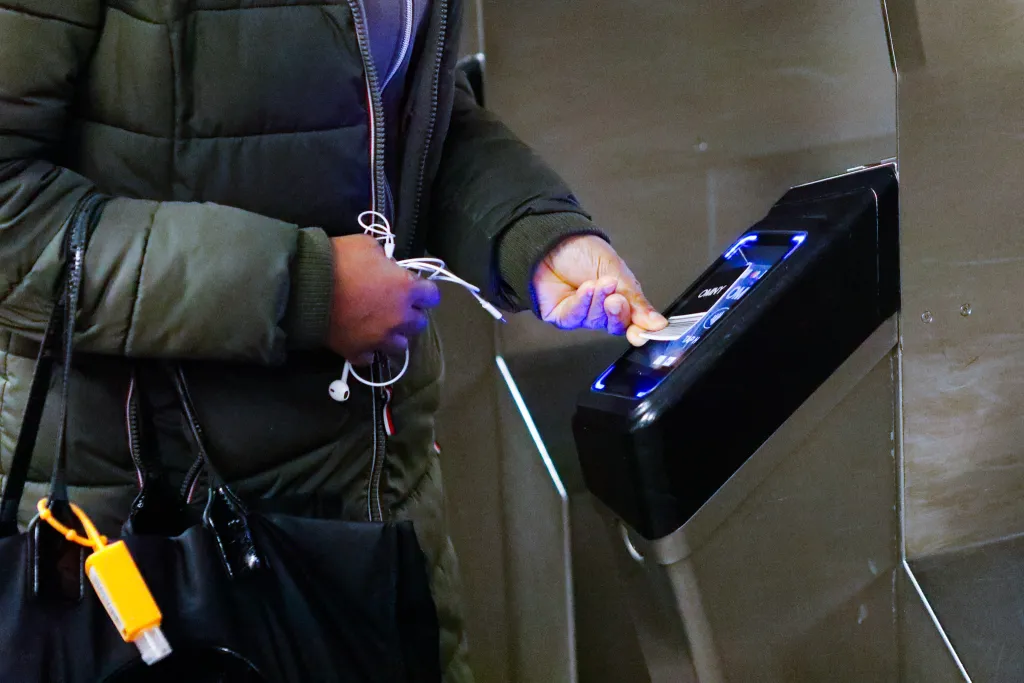
The MTA is pumping the brakes on doling out “millions and millions” of dollars to the tech giant overseeing the troubled rollout of the MetroCard’s replacement.
Nearly a decade after awarding a $573 million contract to Cubic Transportation Systems to develop OMNY, the tap-and-go technology that pays for subway and bus trips, the country’s largest mass transportation authority has paused some payments to the company for repeatedly failing to meet its marks.
Saying “we have a problem with our software developer,” MTA chief Janno Lieber last week confirmed that the authority is following through on threats made at the authority’s October board meeting to withhold money over OMNY software shortcomings.
“We have to keep working with Cubic,” Lieber said. “But they have been a disappointment in many respects and we are holding them aggressively to their contract obligations and withholding payment of millions of dollars to make sure they make good on these commitments.”
An MTA spokesperson declined to specify how much Cubic is being docked on a contract that has ballooned to more than $700 million since it was first awarded. The penalties come as the company is facing financial woes that include getting downgraded by credit rating agencies, with the latest coming last week — and after the MTA officials had hoped OMNY would be “good to go” by the time the MetroCard reached the end of the line at the end of 2025.
According to the MTA, more than 5 billion trips have been via OMNY since it was introduced in 2019 as the MetroCard’s eventual replacement. The fare-payment system pays for rides via mobile devices, contactless credit and cards and MTA-issued fare cards.
But its rollout has been plagued by technical glitches and repeated rider complaints about delays in processing bank card payments, getting double-charged for transfers and having to go online for information on trip history and card balances.
Eileen Robbins, 80, said she has been frustrated for months after her OMNY account stopped automatically replenishing via a credit card once it dipped below $10.
“I found out the hard way,” she said. “But the bus driver let me on.”

After multiple calls to OMNY’s customer-service line, Robbins said she was frustrated enough to take Access-A-Ride from her home in Astoria to an MTA board meeting in Lower Manhattan to complain.
“They seem to be throwing good money after bad, even though they’re withholding some of it,” Robbins told The City Reporter. “In the meantime, they are infuriating their customers, whether it’s the students with their cards or the Access-A-Ride users or the general public.”
Lieber acknowledged the long-running rider frustrations.
“All of those features that people want from OMNY, they’re right,” he said. “We want to deliver those features where there’s more transparency and predictability and people can be confident that they’re getting those transfers and so on.”
MetroCard sales ended at the end of 2025, with the MTA saying almost all paid transit trips are now processed via OMNY.

“The underlying issues from a technology standpoint have made the rollout extremely problematic,” said Brian Fritsch, associate director of the Permanent Citizens Advisory Committee to the MTA. “From my understanding, the system architecture has not been where it needed to handle the number of transactions and the speed at which they need to be computed at the scale that New York City Transit requires.”
Riders who have been caught up in OMNY’s issues said they have been flustered by issues with the new fare-payment system.
Frederic Klein complained to the MTA board that in the last six months, the OMNY card that he has used since 2023 no longer automatically reloads $50 at a time.
“They’ve been paying them a lot of money for, what, nine years now?” the 35-year-old Washington Heights man told The City Reporter. “I think it’s disappointing that it’s taken so long for the MTA and its board to get on the same page with where riders are at and the frustrations with the system, but I am glad that they are finally taking notice and are starting to withhold money.”
Eric Schmidt, said his own problems with OMNY — which centered around being repeatedly double-charged a few years back for transfers — drove him back to using the MetroCard until its retirement.
“It’s wild,” said Schmidt, 41, of the Upper West Side. “OMNY is obviously more convenient because you can tap your card or your phone instead of loading money on a MetroCard, but in almost every other way, it’s worse.”
Cory Shields, a spokesperson for Cubic, told The City Reporter that the company is “committed to working closely with the MTA” to boost the OMNY experience for commuters.
“We take feedback seriously, and that input helps guide our joint efforts to strengthen the system, enhance reliability and incorporate the latest advances in fare-payment technology,” Shields said in a statement.
Fritsch of the PCAC — which last year issued recommendations on how to improve OMNY — said Cubic’s financial struggles compound its problems with the MTA.
Just last month, the company named Lee Sander, a former MTA CEO and executive director, as its new chief executive.
“Cubic can’t really afford serious financial penalties from the MTA,” Fritsch said. “Hopefully, that means they will do everything in their power to make good on their end of the contract in short order.”
Our nonprofit newsroom relies on donations from readers to sustain our local reporting and keep it free for all New Yorkers. Donate to THE CITY today.
The post MTA Seeks ‘Millions and Millions’ Over Bungled OMNY Rollout appeared first on The City Reporter.