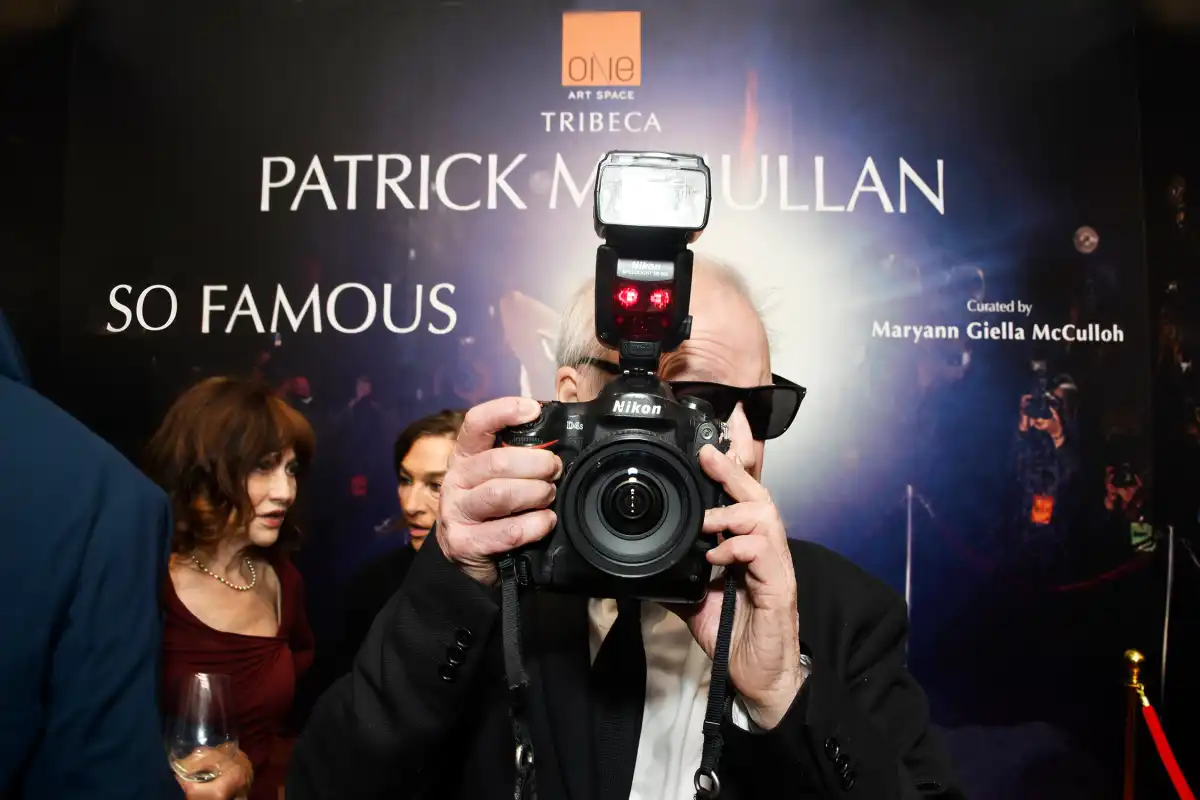
Even at his own show in Lower Manhattan, the celebrated photographer Patrick McMullan could be seen behind his camera, snapping pics of everyone he could. “It’s how I say hello,” he said.
Despite the night’s torrential downpour, One Art Space in Tribeca was packed last week with friends, colleagues and fans as McMullan opened his show “SO FAMOUS,” a sampling of his celebrity work from the 90s in New York City. He had already explored the previous decade with his book “so8os: A Photographic Diary of a Decade,” so when gallery owner and curator MaryAnn Giella McCulloh suggested he do an exhibit, McMullan immediately knew what he wanted to do.
“The 90s was a time when I was really properly successful,” McMullan explained. “You know, I had a column in New York magazine every week. I was in Interview magazine every month. I worked with Vanity Fair. I would work for the newspapers and et cetera.”
McMullan was in a place then where he was getting paid just to show up, before a single picture had been taken — but it wasn’t always like that.
Born in Brooklyn, McMullan had a dad who “was into gadgets” and tended to buy the latest camera that was available, which meant that the young photographer got to play around with the earliest Polaroid cameras and a Kodak Instamatic, to name a few.
“I was always the one that said, ‘I’ll take it!’ I was always the one that would take the family pictures,” he said.
The first camera he bought was a Yashica, purchased with his store discount when he worked at Macy’s, but it was still a while before photography became a profession. Before he graduated from NYU with a degree in marketing, he worked seven days a week for a jewelry parts company, as a busboy in Soho, a photo assistant ($25 a day, plus lunch), at the public library and as an assistant in a PR firm, where he typed letters on an actual typewriter.
Patrick McMullan’s life-changing experience
Whatever momentum he built up came to a screeching halt when, at 26 years old, he was diagnosed with a rare form of cancer, stage four.
“That changed everything,” he recalls. “I lost my job. This was the era of AIDS. I didn’t have any kind of AIDS-related thing, but people were scared.”
His doctor informed him that without treatment he was looking at six months to live, so McMullan made it through a year of chemo and surgeries, with less hair than he started with and frighteningly skinny, but glad to be alive.
Through his friend Ian Falconer, a former roommate (along with Tom Ford), he was invited to recharge his batteries in, of all places, British painter and designer David Hockney’s house in California (sans Hockney, who was out of town).
On his return to New York, he found himself at a party at Danny Fields; apartment, where he met Annie Flanders. Formerly the editor of the Soho Weekly News, she had founded Details magazine.
“It was cool, a very cool magazine,” notes McMullan. “She said, I need somebody who will work with Stephen Saban and go out every night with him, wherever he goes. And so I said, I’ll do that! So I went down there, and I showed Saban a portfolio, and he goes, yeah, you seem fine, you seem fun.”


So began his nightlife odyssey, going out every night to every club — and there were a lot of them — taking pics of every cool person he found.
“I didn’t get paid anything, but I got free drink tickets,” he admits, “so I felt rich!”
Well, he did get paid something. “Three dollars for every picture that ran. But, you know, the idea that I had almost died, what was more important to me was to have my name on things. I insisted on having a credit on each picture.”
Luckily, he had a day job at Terry Stevenson’s studio that gave him free film, so that expense was covered. But that ended when Stevenson sadly became sick with AIDS and McMullan found himself taking all kinds of oddball jobs, like photographing leaky pipes and flooded basements for an insurance company.
“I would go and do that because I’d get $50,” he recalls. “So $50 for one hour, I was thrilled to do that, you know? It wasn’t exactly fun, but I didn’t mind doing it. I would do anything like that, any kind of photography.”
By 1985, he had a column at New York Talk magazine; was the director of photography at 212 magazine (“which meant that I printed every single picture that was in their magazine”); and worked for the East Village Eye as well.
“I didn’t make much money, but I got big credits,” he says. “Of course, the bigger the credit, the less money I got.”
As the 1980s came to a close, Vogue magazine called him with a proposition that he would have been crazy to refuse: “Gabé Doppelt from Vogue said, ‘Hey, if you would shoot color slides, we’d pay for your film and developing.’ I said, really? It was the greatest thing. Thanks to Vogue, my life turned to color.”
McMullan’s business expanded as he became more and more in demand, and he took on other photographers to cover the additional work.
“I think at one point, I had 30 different people that worked for me,” he recalls. “I was always good at training people. A lot of photographers are very tight with their knowledge and their information. I was always very open and always happy to teach people, and those people moved on and did different things.”


McMullan was doing different things himself, getting invited to the Bahamas, Florida, the Dominican Republic, even a nightclub opening in Moscow with Fern Mallis, the creator of New York Fashion Week.
“It was an amazing club,” he recalls. “I couldn’t speak Russian; I was just taking pictures, and at the end of the night somebody said to me, you just photographed the entire Russian mob!”
If you might be inclined to picture McMullan as some kind of paparazzi like Ron Gallela, you’d be somewhat off base. For one thing, people actually like McMullan; Michael Musto used to say that the only reason you’d want to punch McMullan is if he didn’t take your picture!
Curator McCulloh says of him that “Patrick McMullan didn’t just photograph New York’s most famous faces. He captured the people, the energy, and the moments that made this city unforgettable. With SO FAMOUS, I wanted to bring that extraordinary New York back to life.”
“Despite the pouring rain, the opening was a wonderful success,” she continued. “Art collectors, friends and familiar faces from New York’s art and social scene came out to celebrate Patrick. He’s spent decades capturing New York’s most unforgettable faces and moments, and it was wonderful to see everyone there for him. My favorite moment was watching Patrick on the red carpet in front of the SO FAMOUS wall, with cameras flashing all around him. For once, the man behind the camera was the star. This was Patrick’s night.”
After all this time, McMullan has gotten to the point where he can turn down work if it doesn’t interest him, but he says, “I still love taking pictures. I shot Dick Cavett’s 90th birthday party the other day. It’s fun for me to look at my own pictures. I think it’s important that we enjoy our life somewhat. It’s good to enjoy friends; it’s good to take walks. My mother, who is 93, said to me, it’s good to have something simple each day that you look forward to, even if it’s just a cookie.”
“SO FAMOUS” runs through Dec. 13. Info is available at oneartspace.com. You can find McMullan at patrickmcmullan.com and on Instagram at @patrickmcmullan.