This story was reported by Haidee Chu and Carol Chen of The City Reporter, based on original research and data analysis by Stephen Lurie and Matt Daniels of The Pudding. Katie Honan contributed.
When the playground at St. Vartan Park closed for renovations this spring, parents in Murray Hill rallied around one question: Where will the children go to play?
“We thought, well, at least we have the field next to it,” said Rebecca Webber, a 51-year-old mother from the neighborhood. “And every evening we would get sort of ushered off the field by an organization that had a permit.”
Across the East River, at Pier 5 of Brooklyn Bridge Park, a group of eight high school soccer players filmed a public plea addressed to Mayor Zohran Mamdani on Instagram.
“Mamdani! Three fields, three permits, this is crazy,” they said. “We just want to play and now we have to go home. … We propose that one field should be open at all times!”

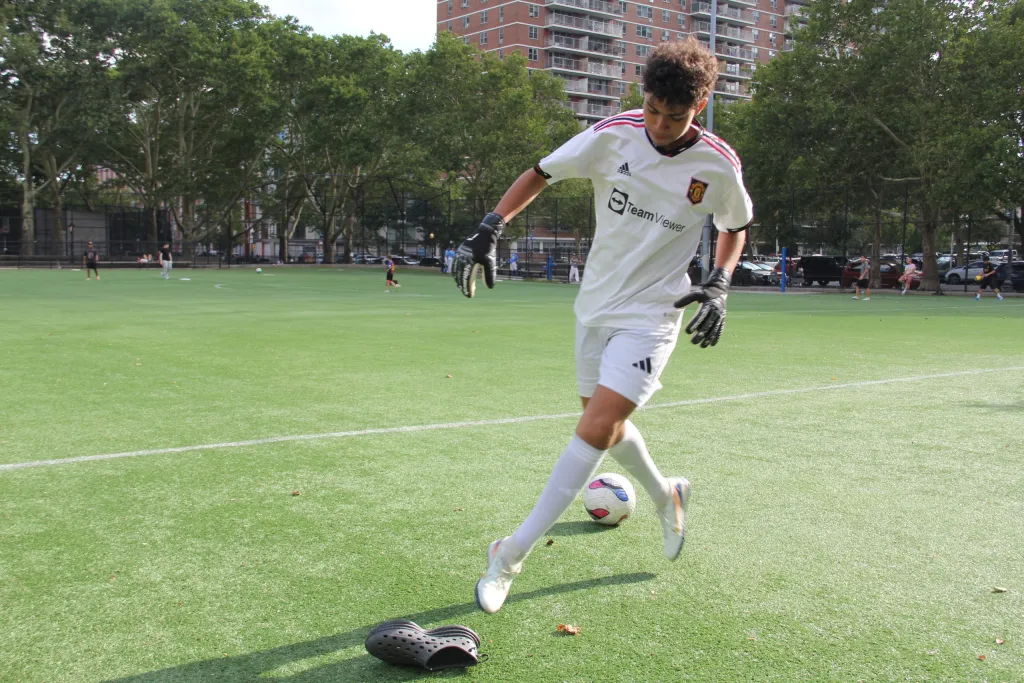
At New York City’s hundreds of public ballfields and soccer pitches, casual pick-up players are feeling the squeeze as demand surges for organized games, practices and sports clinics. But even those with the persistence and resources to score a permit don’t feel like winners. League and club operators say they, too, are struggling to get enough field time as interest in recreational sports explodes.
The Parks Department permitted 48% more daily reservations for organized sports on public athletic fields in 2025 than a decade ago, according to public and internal Parks Department permit data obtained and analyzed by The City Reporter and data visualization site The Pudding. Nearly 1,850 organizations secured permits — roughly 310 more than in 2015.
The proliferation of recreational leagues and sports clinics has at times pitted older neighborhood teams against new entrants in a struggle for field time. In East Williamsburg, for example, longtime residents who’d been playing softball at Sternberg Park for five decades were surprised to learn last year that one of their weeknight league permits had been denied to make space for another group.
“Before, no one wanted this park. It was in bad conditions,” said Hector Perez, who moved to the neighborhood from Puerto Rico as a kid and now plays in the 55-and-up Los Abuelos league. In 2021, the Parks Department unveiled a new artificial turf field at Sternberg Park. That same year, Williamsburg ranked second citywide for new housing construction over the previous decade.

“And now, after the neighborhood’s been gentrified, everybody wants to play here,” he continued. “But we’ve been here the longest.”
On weekends, the park still throngs with cheers as the old-timers compete against one another, while free food is laid out for the crowd ringing the field, folding chairs galore.
“We’ve kept the spirit of baseball going — to not forget our culture — because this is all gentrified, and this is the little bit that we have left,” Perez said.

But amid the growing competition for fields, even the big leagues have struggled with permitting.
“It remains the single most frustrating aspect of this job,” said Tarek Pertew, founder and CEO of NYC Footy, the largest adult recreational soccer league and for-profit permit holder in the city.
It took Pertew three years to score a permit at Brooklyn Bridge Park when he started out in 2010, then another five years to break into Manhattan. Sixteen years later, Pertew said he’s still waiting on McCarren Park in Greenpoint, home to a football field and three baseball diamonds. His waitlist of would-be teams, in the meantime, continues to grow.
“There’s so much demand for this simple service,” Pertew continued. “And we can’t even come close to fulfilling that demand because of these restrictions.”
A Crowded Field
According to Parks Department data, the number of permitted field reservations has grown year over year at least since 2014 — until 2020, when the COVID pandemic forced New Yorkers indoors and demand plunged.
But as coronavirus restrictions began to loosen, permitted field usage didn’t just bounce back. It boomed.
Field usage continued to reach new highs, with 223,860 permitted reservations issued in 2025.
“COVID changed everything,” said Pertew, whose recreational soccer league service exploded with demand overnight. “There was this very natural biological reaction for people that wanted a physical and mental outlet with a social backdrop … It was the perfect combination of what people needed coming out of COVID.”
It was youth sports, however, that accounted for the majority of the permitted field usage during this time. Around 75% of all permitted field reservations every year since COVID, in fact, were issued for youth sports — noticeably more than the roughly 55% from a decade ago.

“In 2020, we started picking up momentum, and we started to see, ‘OK, people value it,’” Sherard Sullivan, 41, said on a recent afternoon at Jesse Owens Playground in Brooklyn’s Bedford-Stuyvesant, where teenagers scrimmaged on one side of the soccer field and parents played with their toddlers on the other. A former teacher, Sullivan founded the non-profit S.S. Soccer Academy in 2015 to serve children from three to 14. “More people aligned with our vision.”
As popularity grew, so did the competition. Sometime around 2023, Sullivan recalled, his permit renewal at Jesse Owens, where he’d been running his program for three years, was denied. His academy’s field time was instead granted to a soccer club based in Williamsburg, he recalled.

“That was one of the hardest nights I ever had in my life. I couldn’t sleep,” said Sullivan. He’d made a commitment to his young athletes that he’d get them college-ready, he said, reminiscing on the way soccer had brought him from his home country of Trinidad and Tobago to New York City, where he played in college.
He continued: “I was really devastated, because all I thought about was all the different kids: What am I gonna tell them? What am I gonna do for them? I hit the ground running and luckily it was rectified.”

In 2024, the Parks Department modified permitting rules to give non-profit organizations like Sullivan’s priority. And youth groups, as is always the case, are prioritized over adults.
But that did little to help the Harlem Jets, a non-profit that has been serving youths for more than two decades.
“We live in Harlem. We’re from Harlem, but we’re forced to come to Randall’s Island because the fields in Harlem were being utilized by other people,” its founder and CEO, Jamel Wright, told The City Reporter while coaching football on the island. “We use any field we can get that we can get on, to be perfectly honest … There’s just a lot of utilization that needs to happen with limited options.”
Wright has always had trouble securing enough field time in Harlem, he said — even after the city unveiled a new artificial turf field last year at General Charles Young Playground.
“That’s part of why we purchased our own bus, so that our kids wouldn’t necessarily have to take the M35 bus,” Wright added. “This team has 30-something children on it. But what do you see here? Maybe 15, 20. That’s because they’re finding it to be problematic to get them from over there, over the bridge, to over here.”

Wright proposed a solution: The city, he suggested, should reserve field space for neighborhood youths during the afterschool hours until the early evening.
“After 8 p.m. every kid off the field — and grown-ups can play until they fall asleep,” he said.
Ken Conyers, director of citywide athletic permits for the Parks Department, said the agency has continued to refine its permitting systems and its scheduling practices to make sure facilities are used “fairly and efficiently.”
“As demand for permits has grown, we’ve worked hard to keep pace,” Conyers said. “Our goal is to make sure everyone who wants to take part in athletics and other permitted activities has a place to do so, and we’ll continue working with our communities to meet that need.”
Let There Be Light
As the fall yields to winter, however, shorter days will begin to eat into available field time.
That’s because just 5% of the city’s 5,850-something active athletic facilities are equipped with lights, according to Parks Department data.
This poses additional headaches especially for soccer, football and lacrosse organizers. These “rectangular ballfield” sports, as the Parks Department calls them, are prioritized in the fall and winter, as opposed to diamond sports like baseball, softball and cricket take precedence in the spring and summer.
“Once daylight loss pushes sunset earlier than 6:00 p.m., fields become effectively unusable for working adults unless they are lit,” Pertew, who operates NYC Footy, wrote in a letter to Parks Commissioner Tricia Shimamura in April.
In the letter, Pertew also urged the city to introduce temporary lighting to expand field access, while investing in permanent lighting infrastructure in areas where adult recreational sport is most in demand.
Pertew’s for-profit organization stands to benefit financially from increased field access, to be sure. By his estimate, however, one single lit field could add roughly 1,200 hours of play each year — offering more field time for not just NYC Footy, but to all park users.
Already, the Mamdani administration has experimented with the idea in partnership with NYC Footy over the summer, as the World Cup fueled fervor for soccer. For a little more than a month, the city kept the lights on overnight at one field in every borough, opening them up for pick-up play from 10:30 p.m. through 8 a.m. for adults.
Parks Commissioner Shimamura herself pointed to the pilot as a success when The City Reporter asked in the late summer how her department can make it easier for New Yorkers to access fields and permits.
“I don’t think we’ve exhausted all of the low-hanging fruit to create more access,” she said. “In the long term, we need more fields and more lights.”
The Parks Department extended the pilot earlier this month, granting one soccer field in each of the five boroughs extended night lights until 2 a.m.
Pertew’s attention, meanwhile, is now focused on St. Vartan Park in Midtown East, where parents, children and sports organizations alike feel squeezed for play time since the playground closure.
While the City Council already voted last year to fully fund the installation of field lights on the multipurpose field there, Pertew is now offering to cover the bill for temporary lighting while the upgrades are pending, he said, so that field access can be expanded for everyone in the neighborhood — so long as Footy can be permitted to play on the field for at least one day each week to cover the cost.

Youth sports could take over in the after-school hours till sunset, he envisioned, followed by community open field time, and adult leagues in the evening.
“If you do that, you are going to drastically minimize the complaints in the conflict because youth is benefitting, community’s benefitting, and the adults get more time as well,” Pertew said. “That is what lights can do.”
Webber, the Murray Hill parent, has missed the daily kids’ meetup at their local playground in the meantime — squirt gun fights and all, she said. She spent the summer at the public pool and exploring playgrounds in other neighborhoods with her son, who still occasionally plays pick-up with his friends at the St. Vartan field.
The children would occasionally sit along the sidelines while the adults played, she said, choosing a player to root for as though they were watching a professional match.
“It’s really cute, so I wouldn’t want to lose it entirely,” Webber said. “I think it’s just about balance, and it’s a really hard question: Who should get the park when and who should get it most, and how do we allocate this?”
Our nonprofit newsroom relies on donations from readers to sustain our local reporting and keep it free for all New Yorkers. Donate to THE CITY today.
The post New Yorkers Want to Play Ball. The Toughest Game is Getting a Field. appeared first on The City Reporter.