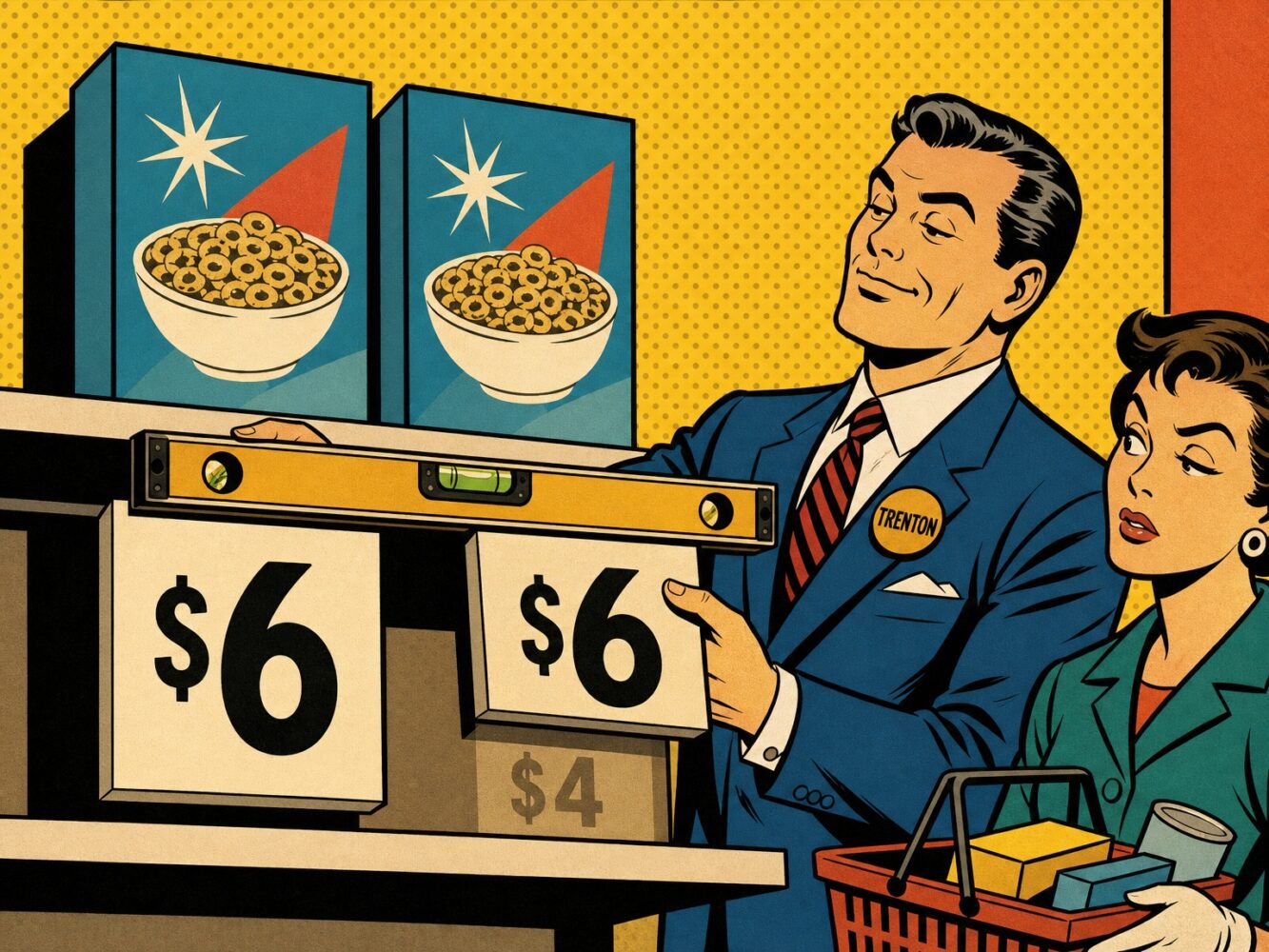
New Jersey lawmakers have found a way to spare small grocers the sting of missing out on a discount: make suppliers think twice about offering one to anybody. If a cereal maker gives Walmart a better deal than a corner market in Newark, a bill before the state’s General Assembly would require the supplier to justify the difference. The easiest way to comply, of course, is to keep prices high for everyone.
Assemblyman Chigozie Onyema (D-Newark) introduced Assembly Bill 5532, the Grocery Retailer Opportunity to Compete Act, on Sept. 17. It would bar grocery suppliers with at least $6 billion in annual New Jersey revenue from offering different “terms of sale” to retailers or wholesalers buying the same product at roughly the same time. Those terms cover prices, discounts, rebates, promotions, packaging, delivery, and payment.
If enacted, the bill would likely mean fewer discounts, higher prices for shoppers, and less bargaining power for the very independent grocers it aims to help.
The Garden State Doubles Down
A5532 closely tracks New York Senate Bill 8563, introduced last November. That bill passed the New York Senate in May 2026 but never reached an Assembly vote before the session ended. I submitted comments to the New York Legislature examining its economics.
Both bills set the same $6 billion supplier threshold and define a “dominant retailer” as one with at least $18 billion in annual sales and a store or distribution center in more than 20 states. Both also let smaller buyers demand anonymized copies of the terms suppliers offered to dominant retailers.
The New York bill’s sponsor, Sen. Cordell Cleare (D-Manhattan), argued that suppliers recoup discounts to big chains by charging small stores more. Economists call this the “waterbed effect”—push prices down in one place, and they rise elsewhere. It makes for a tidy metaphor, but the theory is weak, and no evidence establishes such an effect in retail grocery markets.
New Jersey’s bill goes further in two ways. New York’s version required equal terms only for buyers purchasing the same quantity, up to one truckload. New Jersey drops that condition. A supplier would owe every buyer of “the same grocery product” at “approximately the same time” the same terms, whether the order fills one pallet or a fleet of trucks.
New Jersey also requires courts to award triple damages and attorney’s fees to any plaintiff who wins. New York’s version merely capped penalties at three times damages.
Everyone Gets the Same Worse Deal
Under A5532, a discount becomes everyone’s business. Any concession a supplier grants one buyer becomes a concession it owes every buyer of that product, and the disclosure rule lets them find out about it. For suppliers, the cheapest response would be to offer fewer concessions and settle on a single, higher price.
The bill requires no proof that a price difference actually harmed competition. That means it goes even further than the federal Robinson-Patman Act (RPA), passed in 1936, which applies only when a price difference may substantially lessen competition. Even with that limit, the bipartisan Antitrust Modernization Commission concluded in 2007 that the RPA discourages discounting and likely raises consumer prices.
Discount-store shoppers would bear the greatest burden. Emek Basker’s review of the research reports that Walmart’s grocery prices run about 10% below competitors’ prices, and that rival grocers cut prices 1% to 3% when a Walmart supercenter opens nearby.
Jerry Hausman and Ephraim Leibtag estimate that low-income households receive a disproportionate share of the gains from supercenters. Smaller wholesale discounts would mean higher shelf prices for those families.
Too Local to Get the Good Deal
New Jersey has about 180 ShopRite supermarkets. Most belong to independent operators who are members of Wakefern Food Corp., a member-owned cooperative based in Woodbridge, New Jersey. Members agree to buy at least 85% of their products through the cooperative. Wakefern uses that purchasing commitment to negotiate with suppliers and operate its own distribution centers.
The cooperative’s stores rang up $20.7 billion in sales in fiscal 2025, clearing the bill’s $18 billion threshold. But Wakefern falls outside the definition of a “dominant retailer” because its stores operate in nine states, short of the required 21. That geographic distinction says little about buying power—and hurts the cooperative twice.
First, the equal-terms rule applies to every buyer, dominant or otherwise. If Wakefern used its members’ purchasing commitment to negotiate a larger promotional allowance—supplier funding for promotions—the supplier would owe the same allowance to Walmart, Costco, and every wholesaler buying that product. Suppliers have little reason to reward a commitment when they must give everyone the reward. Members, in turn, have less reason to commit.
Second, New Jersey’s bill excuses a price difference “predominantly due to the dominant retailer’s internal distribution, or distribution to a subsidiary.” New York’s version covered any retailer that distributed its own goods. Wakefern’s network includes nine warehouses in New Jersey and Pennsylvania. But Wakefern falls outside the dominant-retailer definition, and its member stores own the cooperative, rather than the other way around. As written, the defense therefore does not cover its distribution centers. Its suppliers would have to rely on a general efficiency defense.
In other words, while Walmart’s warehouses get explicit protection, ShopRite’s are left to make an argument in court.
Wakefern might use the disclosure rule to demand the chains’ contract terms. Whether that leaves it better off depends on what those terms reveal.
Bargaining Power Sold Separately
Cooperatives like Wakefern let independent grocers pool orders, commit to purchases, and bargain like a chain. New York’s legislative findings acknowledged as much, noting that small grocers buy “through co-operatives and distributors that provide comparable scale.” When a big chain coerces a supplier, existing antitrust law already applies—and requires proof of harm to competition.
New Jersey’s bill promises grocers an opportunity to compete. What it delivers instead is an equal opportunity to pay more.
