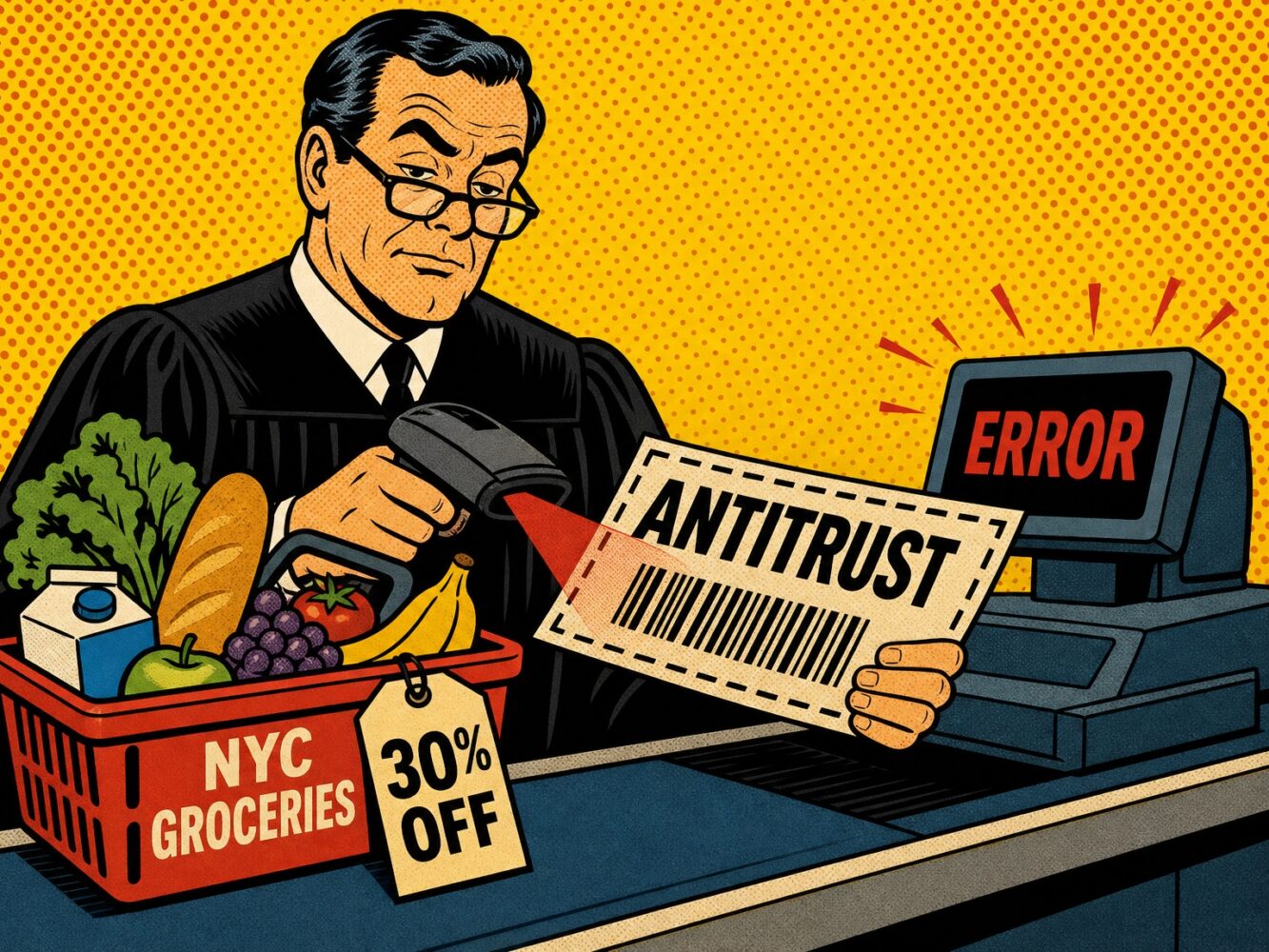
I’ve criticized plenty of private antitrust cases. This may be the first in which the plaintiffs sued to stop a genuinely bad idea—and I still think they should lose. That is the odd posture of the antitrust challenge to Mayor Zohran Mamdani’s plan for subsidized grocery stores in New York City.
On Sept. 9, the National Supermarket Association and two New York supermarkets filed suit in the U.S. District Court for the Southern District of New York. They allege that New York City and the New York City Economic Development Corp. are attempting to monopolize “retail sales of weekly-stock-up groceries at full-service stores” in certain New York City markets through the Mamdani plan for discounted city-run grocery stores (here, here, and here).
The gravamen of the complaint is that the planned discounts would amount to predatory pricing. That’s a tough row to hoe for several reasons, but the demanding predatory-pricing standard is hardly the plaintiffs’ only obstacle. The case raises some interesting issues, but I think it’s a loser. I’ll get to that.
What’s Actually in Store?
There has been no shortage of press coverage of Mayor Mamdani’s much-lauded and much-lambasted plan for discount grocery stores. Here’s a selection from the New York Times, the Wall Street Journal, and the Washington Post, each of which has had more to say on both its news and editorial pages. You’ve neither heard nor read it here first.
Still, it’s worth reviewing the plan’s basic features so that we’re all on the same page. The Mayor’s Office and the New York City Economic Development Corp.—the two defendants in the suit—jointly issued a 17-page “report” titled “N.Y.C. Groceries: A Recipe for Affordability.” (See what they did there?) Or perhaps it’s an online pamphlet, given that those 17 pages include many large pictures.
The plan doesn’t exactly call for municipally run grocery stores. But the city will heavily regulate and subsidize the stores, and it may own some of the properties where they operate. According to the report:
The City will provide the foundation and deliver grocery-ready sites, cover rent and property taxes, fund initial buildout, and establish a single public brand for all N.Y.C. Groceries locations. The City will also set clear requirements for affordability, job quality, transparency, and performance. The City will:
-
Provide low- or no-cost access to real estate, including public sites.
-
Offer subsidies that will lower grocery prices within the core basket.
-
Set clear standards for stocking, job quality, and pricing transparency.
-
Oversee performance to ensure accountability.
Private grocery operators will, for their part:
-
Manage day-to-day store operations, including staffing, stocking, and merchandising
-
Bring expertise in grocery retail, supply chains, and customer experience
-
Meet affordability and operational standards defined by the City
-
Pass on the savings from the City’s subsidy directly to consumers in the form of lower-priced groceries
There is more detail. Each store will offer a substantially discounted “core basket of goods” that includes “all fresh produce, meats, and seafood, in addition to select dairy, shelf-stable grocery, and frozen items.” Core-basket items “will be priced on average” 30% below market prices.
The report also outlines several operating requirements. Each store “will stock selections that are culturally responsive to the diversity of New York and to the specific neighborhood the store is located within [sic].” The stores will face “clear” performance standards, although neither the standards nor the metrics are specified. They will also face job-quality standards, “including access to benefits, safe working conditions, and respect for workers’ right to organize,” along with standards for “clear reliable pricing on the shelf.”
Oh, to be a fly on the wall as they design and enforce the requirement, store-by-store, that the grocery skus are “culturally responsive,” both to “the diversity of New York to the specific neighborhood” in which each store is located.
The requests for proposals (RFPs) provide still further details. Public financial support will cover real estate, taxes, rent, buildout, brand development, and marketing. For core-basket goods, the city will cover losses imposed by the discount-pricing requirement. Those losses could be compounded by the requirement that prices remain “stable,” with adjustments permitted only once a month, regardless of wholesale-price volatility. From soup to nuts, the “Mayor has allocated $70 million in the capital budget.”
One interesting wrinkle is that the stores—and the discounted goods in their core baskets—will be open “to all regardless of income.” Like public parks, but with groceries.
For all that—and there is not all that much to the “all”—the plan remains largely abstract. It calls for five stores, one in each borough, operated by private grocers. The city has issued an RFP for grocers to operate the stores and another for a firm to design their brand identity. No operators have been selected, and there is no site-specific plan for a particular grocer to run a particular store in any of the five boroughs.
Still, the Mayor’s Office has announced that the first store “will open by the end of 2027 at Hunts Point in the Bronx.” A second will open in Harlem, and the other three will “open by the end of the Mayor’s first term” in 2030.
The Incredible Shrinking Grocery Bill
I don’t doubt the city’s ability to open the first store, and I suppose it could get all five up and running by 2030, as promised. But whether this bird flies, limps along, or crashes will depend on quite a few contingencies. Not least among them is how much money the city will be willing to burn subsidizing groceries and the particular heavily regulated retail model through which they will be sold.
Is it a good idea? I don’t think so, quite apart from how much any given nation, state or province, or municipality wishes to subsidize food for low-income consumers. If augmenting the social safety net is the goal, this is likely to be a terribly inefficient way to do it.
I also doubt the plan will achieve the grand ambitions under which it has been sold to the public. The Mayor’s Office projects that it will “cut New Yorkers’ average grocery bill by 15 percent, about $90 a month, or roughly $1,000 a year.”
We could toil away at our own projections, but let’s start with some simple numbers. The city plans to open five stores. True, officials have expressed enthusiasm for expanding the program eventually. For now, though, the plan is to open five stores by 2030.
And these will be five small stores. The site-selection criteria contemplate locations of about 10,000 square feet. That may be typical of New York City supermarkets, but it is roughly 25% of the size of a typical American supermarket.
The last time I checked—about 30 seconds ago, on the Census Bureau’s website—more than 8.5 million residents lived in New York City’s five boroughs. That does not include temporary visitors who reside elsewhere. The same source puts those residents in about 3.34 million households.
Those 8.5 million residents—plus visitors and other nonresidents—now shop at thousands of grocery vendors. One academic estimate counts about 1,000 supermarkets, “25,000 independent stores, thousands of mobile produce vendors, and nearly 140 farmers markets.”
According to the New York state comptroller, annual food spending reached $11,288 per household by 2023, including $6,817 for groceries, or “food at home.” Let’s keep this simple and generous by ignoring the nontrivial price increases of the past three years. Dusting off some first-grade arithmetic, we can multiply average household grocery spending by the number of households. The result approaches $23 billion a year.
And 15% of $23 billion is about $3.45 billion. That is not far from what we would get using the mayor’s estimate of $1,000 per household multiplied by 3.34 million households.
So . . . hmmm . . . how many of those 8.5 million-plus New Yorkers—or representatives of those 3.34 million households—will shop at five little stores, when more than 25,000 grocery vendors already serve them? And what portion of their purchases will fall within the heavily discounted core basket?
To be sure, some grocers near the five city stores might respond to the subsidized discounts by lowering some prices on some products. Supermarket margins are famously low (see here and here), but they vary across product categories. Even low markups may leave some room for marginal price reductions on some products.
Then again, margins are low. “We lose money on every sale but we make it up on volume” is a fine old joke, but it’s just a joke, and it’s the illogic of it that makes it funny. A heavily subsidized discount on a select basket of goods at five locations in a city of 8.5 million is not a competitive bellwether. There is no reasonable basis to expect lower prices to permeate New York’s grocery markets.
Breaking out the crystal ball, or my hope for a plan for a crystal ball, and putting this in the nicest possible terms: There is no . . . [expletive deleted] way that the five NYC Groceries, even when running at full steam, will supply 2% of the city’s groceries. And there is no . . . [expletive deleted] way they will lower the average household grocery bill citywide by $1,000 a year.
While we’re at it, how long will that $70 million last? The city plans to subsidize real estate, rent, buildout, and taxes, along with losses on every product in the core basket and any other losses caused by the “stable” pricing requirements.
The mismatch between the program’s marketing and its likely effect appears staggering. And that assumes the program works at all and that a meaningful stream of consumers finds its way to the discounted goods on the shelves.
To be clear, some consumers will save some money if the city opens even one store, and many of them will likely be low-income consumers. I’m not opposed to feeding the hungry. Nor am I opposed to democratically accountable legislators in New York choosing different programs and spending levels from those chosen where I happen to live—Arlington County, in the Commonwealth of Virginia—as they pursue their policy priorities.
I’m just opposed to bad government and burning public money. And to BS populist demagoguery. And to burning public money in service of such.
A Bad Idea Is Not an Antitrust Violation
So, Dan, you may ask, if the plan is such a bad idea, why do you doubt the merits of the antitrust suit against it? Surely a 30% discount on a substantial basket of goods could have competitive effects in an industry with relatively low markups.
Well, not so fast. To quote nearly everyone I’ve worked for or with, antitrust is no Swiss Army knife—not even one designed specifically for competition problems.
I don’t think the plaintiffs will succeed. Remember, the National Supermarket Association and two New York supermarkets allege that the city’s planned discounts constitute predatory pricing and thus attempted monopolization in violation of Section 2 of the Sherman Act.
An Immunity Coupon That Won’t Scan
It’s possible that we will never reach the merits of the antitrust claim, and not merely for the usual reasons. New York City might, for instance, claim immunity from antitrust scrutiny under the state-action doctrine.
In Parker v. Brown, the Supreme Court held that federal antitrust laws do not reach anticompetitive conduct by a state acting “as sovereign.” The Court rooted that limitation in the Sherman Act itself and in principles of federalism.
The clearest example is legislation duly enacted by a state legislature. The doctrine also covers a state supreme court acting in its “legislative capacity” (never mind). But in a line of cases from California Retail Liquor Dealers Association v. Midcal Aluminum Inc. through FTC v. Phoebe Putney Health System Inc.—a solid FTC case and a unanimous decision, that one—the Supreme Court has both extended and limited the doctrine’s application to “lesser state actors,” which act under the mantle of delegated state authority but are not themselves sovereign. Those actors include municipalities, as in City of Columbia v. Omni Outdoor Advertising Inc. and Town of Hallie v. City of Eau Claire, and even essentially private parties acting under delegated state authority.
Under Midcal, the doctrine shields a private (or more-or-less private) entity exercising delegated state authority from federal antitrust liability only if two conditions are met. First, the state must have “clearly articulated” the delegated authority to engage in the challenged anticompetitive conduct. Second, the sovereign must “actively supervise” that conduct.
Such privately operated—if heavily regulated and subsidized—grocery stores would likely be treated as private entities acting under delegated municipal authority. A private party must satisfy both Midcal prongs, while a “lesser state actor,” such as a state executive agency or municipality, need establish only that the state’s authorization of the challenged conduct was “clearly articulated and affirmatively expressed.” There is also an active-market-participant exception—an exception to the lesser state actor exception—but let’s leave that aside.
I don’t think the distinction matters here because I don’t see how even the city itself—with or without the Economic Development Corp.—could satisfy the first prong.
Phoebe Putney is instructive on this point. There, a unanimous Court ruled that an anticompetitive merger by a “hospital authority” was not protected by the state-action doctrine because the Georgia Legislature had not clearly articulated and affirmatively expressed an intent to permit hospital authorities to make anticompetitive acquisitions.
Notably, the legislature had expressly authorized political subdivisions to form hospital authorities to provide or foster local health-care services. It also authorized those hospital authorities to “acquire by purchase, lease, or otherwise and to operate projects . . . which are defined to include hospitals and other health facilities.” Even so, the Court reasoned, Georgia had “not clearly articulated and affirmatively expressed a policy to allow hospital authorities to make acquisitions that substantially lessen competition.”
In short, the national policy favoring competition requires courts to disfavor antitrust immunity and sets a high bar for clear articulation and affirmative expression. Express statutory authority to form local hospital authorities, coupled with express authority for those entities to build, purchase, or lease hospitals, was not enough to permit one hospital to acquire its only competitor.
I am aware of nothing in New York state law that would help New York City clear that bar. So much the worse for a privately operated city store.
Predatory Pricing Without the Payoff
The plaintiffs allege attempted monopolization through predatory pricing. I think they will find tough sledding on both tracks.
For the basic contours of attempted monopolization, we can look to the Supreme Court’s 1993 decision in Spectrum Sports Inc. v. McQuillan. A unanimous Court articulated a two-part test:
[P]etitioners may not be liable for attempted monopolization under § 2 of the Sherman Act absent proof of a dangerous probability that they would monopolize a particular market and specific intent to monopolize.
For predatory pricing, we can look to Brooke Group Ltd. v. Brown & Williamson Tobacco Corp.—a Robinson-Patman Act case (boo) but one that sensibly adopted a standard consistent with Section 2 of the Sherman Act—as well as cases like Matsushita Electric Industrial Co. v. Zenith Radio Corp. and Cargill Inc. v. Monfort of Colorado Inc..
The two-part standard articulated in Brooke Group is clear:
[W]hether the claim alleges predatory pricing under § 2 of the Sherman Act or primary-line price discrimination under the Robinson-Patman Act, two prerequisites to recovery remain the same. First, a plaintiff seeking to establish competitive injury resulting from a rival’s low prices must prove that the prices complained of are below an appropriate measure of its rival’s costs.
And second:
[A] demonstration that the competitor had a reasonable prospect, or, under § 2 of the Sherman Act, a dangerous probability, of recouping its investment in below-cost prices.
Start with attempted monopolization. The city has a plan—not yet any stores—to open five small, heavily subsidized and heavily regulated supermarkets, one in each borough. New York City has more than 8.5 million residents and thousands of grocery outlets. Is there a dangerous probability that this plan, even if fully implemented, will monopolize a particular grocery market? That seems like a stretch.
It’s not impossible. A relevant product market might be narrower than all retail groceries, and a geographic market might be relatively local. Shoppers in the suburbs might drive 10 miles to a Walmart Supercenter or Wegmans. Many Manhattan or Brooklyn residents do not own cars and may be unwilling to travel the same distance by subway, bus, or foot for routine grocery shopping. Even so, the plaintiffs may need to be both creative and lucky to convince a court that there is a dangerous probability of monopolization.
As for specific intent, the mayor—a self-described socialist—might dream of citywide control over grocery sales and more. But it is difficult to read that intent from the published plans. And it’s impossible to read it off the Mayor’s $70 million allocation.
The potential for harm to certain competitors is real. The plaintiff grocers operate stores near the announced Bronx and Harlem sites. Those businesses could lose sales when the nearby NYC Groceries begin selling a substantially overlapping bundle of goods at discounted prices, and lost sales might not be confined to the core basket of goods. But as the Supreme Court famously said—initially in the lamentable Brown Shoe Co. v. United States—the antitrust laws protect competition, not competitors.
Predatory pricing might present a closer question. Proving below-cost pricing is itself difficult in many cases. Perhaps it will not be here. The plan expressly contemplates steep, heavily subsidized discounts on a substantial bundle of core goods, along with a mechanism to reimburse store operators for losses caused by the city’s pricing policy. Given common industry markups, below-cost pricing on some goods is foreseeable.
Recoupment is trickier. The requirement reflects a straightforward principle. Firms generally do not sell below cost to destroy their competitors simply for the pleasure of destroying them, although business rivalries do sometimes get personal. They might accept short-term losses if they expect to recover those losses—and then some—through supracompetitive prices after driving their rivals from the market.
As the plaintiffs point out, a government—even a city government—may be ideally positioned to sustain losses indefinitely, or at least for however long it takes to drive competitors out of business. The plan does not contemplate operating forever, but it is a multiyear project to which the city has committed tens of millions of dollars. It also aspires, as the plaintiffs emphasize, to become “a model for future programs.”
But is there a plan to recoup the losses? Not obviously. In fact, the plan appears to disavow recoupment. Its stated purpose is to maintain low prices via public subsidies, at least for certain products. The financial projections may be unrealistic—perhaps wildly so—but they do not contemplate a future in which the core basket will carry above-cost prices or even prices at cost. And the plaintiffs are suing based on the plan.
Recoupment is not an impossible outcome. The program might become a regulatory, managerial, or financial albatross for the city. It might become all three. If that happens, and if competition—not merely a competitor—is harmed in some relevant market, the city might walk away and leave the surviving stores to fend for themselves. One or more of those stores might then exploit diminished competition by raising prices.
But now we’re really piling up the “ifs.” The string of contingencies does not seem very likely. And any supracompetitive prices would also invite entry in an industry without tremendous entry barriers. Predatory-pricing allegations are notoriously difficult to prove in any event. See Herb Hovenkamp here and here. There’s not just the question of below-cost pricing (and of why rivals’ costs may be higher, absent any anticompetitive conduct), there’s the simple fact that antitrust tends to favor higher output and lower prices. Not always–hence predatory pricing–but it’s understandable that the law sets a high bar for finding consumer benefits to be an antitrust problem.
The dangerous-probability-of-recoupment requirement is not arbitrary. Nor is it merely an extension of attempted monopolization’s intent requirement. It reflects antitrust law’s basic concern with conduct likely to harm competition, typically seen in reduced output, higher prices, or sometimes higher quality-adjusted prices. Recouping substantial losses through sustained supracompetitive pricing—likely accompanied by reduced output—signals competitive harm. It’s an imperfect signal, but a signal nonetheless. And with this plan, the risk of durable anticompetitive effects appears low.
Could the plaintiffs survive a motion to dismiss or summary judgment? Maybe. District courts sometimes do the darndest things, and this case presents a few interesting wrinkles. Still, it looks unlikely as a Section 2 case.
After staring deeply into my plan to design and implement a crystal ball—which, like the city’s grocery stores, does not yet exist—I expect the city will be allowed to proceed. Bad policy is not an antitrust violation.
Meanwhile, Back at the FTC
This has nothing to do with New York City groceries. It is instead a brief exercise in giving my old employer its due: The Federal Trade Commission (FTC) got the Zillow case right.
From time to time, I’ve been a tad critical of the FTC. Perhaps I’ve occasionally indulged in rhetorical excess, even while raising perfectly good competition concerns. If so, my bad. In the spirit of the holiday, s’lach lanu.
Turnabout is fair play. So props to the FTC for two things: bringing the Zillow case and settling it. Here is the complaint, and here is the settlement.
On the alleged facts—and some that were independently reported—this one really did take the cake. The FTC alleged that Zillow and Redfin agreed to have Redfin exit the internet listing service (ILS) advertising market for “multifamily” properties, meaning apartment buildings with 25 or more units. Redfin would effectively stop competing in that market and help Zillow take over that part of its business. What would Redfin get in return? At least $100 million, among other things.
The FTC alleged three violations: an unlawful agreement under Section 1 of the Sherman Act and Section 5 of the FTC Act, an unlawful acquisition under Section 7 of the Clayton Act, and an unfair method of competition under Section 5 of the FTC Act.
Again, on the alleged facts, the agreement sure looked like a Section 1 violation. It was a pay-to-not-play-anymore agreement and, not incidentally, a horizontal market-allocation agreement. The FTC appeared to have a strong case even under the rule of reason. The claimed countervailing efficiencies looked weak, if not pretextual.
The Clayton Act count? Maybe. The Section 5 counts? Sure, at least insofar as a Sherman Act violation also constitutes an unfair method of competition. But the Section 1 claim looked especially strong. The agreement appeared anticompetitive.
Might complexities have emerged at trial? Maybe. Anything is possible. But this looked bad for the defendants. As in, did anyone run this deal by antitrust counsel and get a thumbs-up? Even a maybe?
So good on the FTC and its Bureau of Competition for bringing the case. And good on them for reaching a settlement designed to terminate the agreement and unwind the transaction. Whether the stipulated order will accomplish everything it is supposed to accomplish remains to be seen, but much of it looks like a workable response to an anticompetitive deal.
