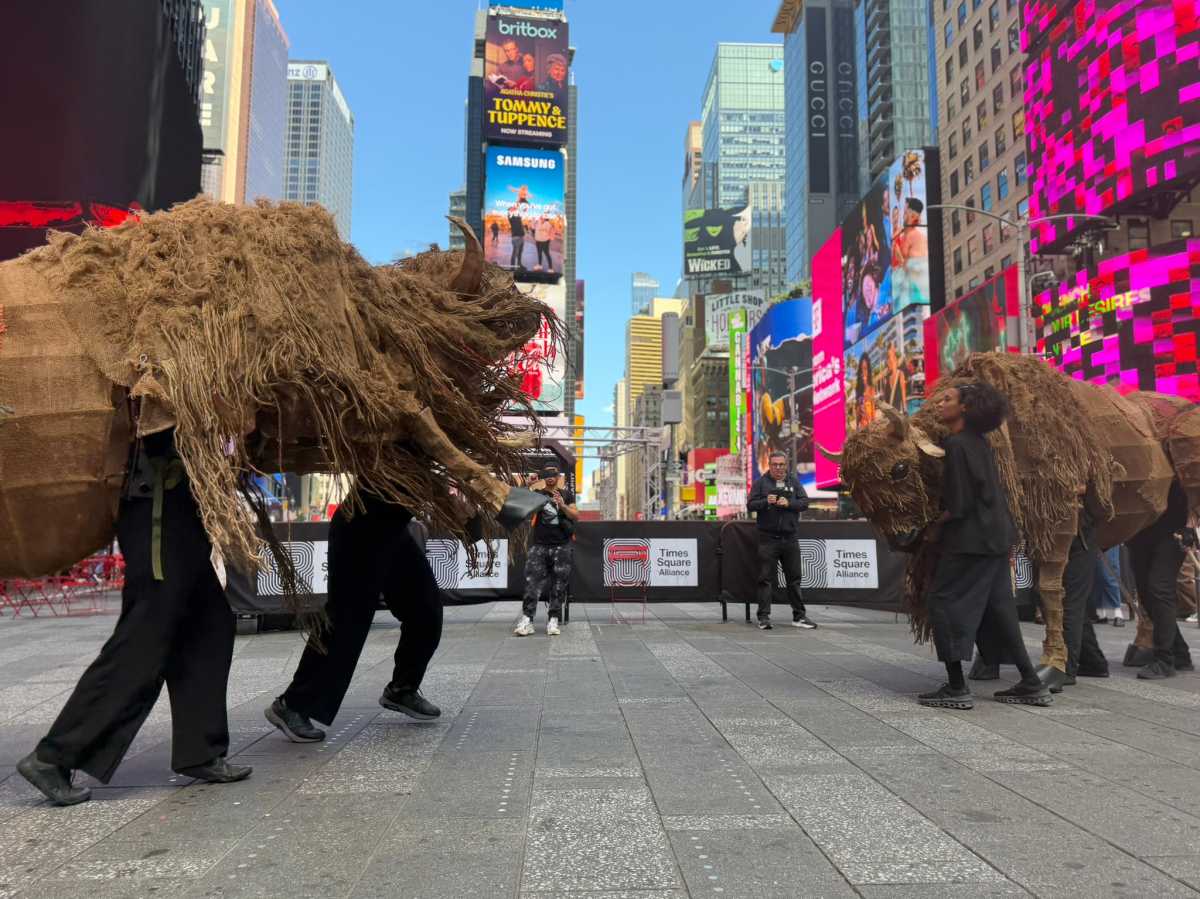
“Return of the Buffalo: Tatanka Owe Akupi” is taking over the streets of New York City this weekend as St. Ann’s Warehouse brings 40 life-sized buffalo puppets to the streets of Lower Manhattan and Downtown Brooklyn.
The American bison, referred to as the buffalo by many Indigenous tribes, serves as a symbol of renewal and hope through the performance, reminding viewers that American history long predates 1776.
Susan Sarandon and Rosario Dawson are slated to appear at Friday’s performance alongside more than 100 artists and First Nations tribe members including Jason Baldes, John Thomas, Eric and Aubree Wensman, Tokala Two Elk, Sonnie Allen and Evelyn Kionute.
“Return of the Buffalo” was created by Amir Nizar Zuabi in partnership with Elders from Lenape and Lakota Tribes. It is produced by St. Ann’s, the Walk Productions and KBH Arts in collaboration with the Times Square Alliance.
The National Park Service estimates anywhere between 30-60 million bison roamed the grasslands spanning the North American continent in the early 1800s. European colonization nearly led to their extinction, however, following the slaughter of both bison and the Indigenous peoples. By 1900, fewer than 1,000 bison remained.
Recent conservation efforts have drastically increased the number of bison, with recent estimates showing there are approximately 500,000 left. That’s still a small fraction of the NPS’ estimated bison population more than 200 years ago.
The buffalo puppets, which acknowledge this harrowing history, were designed by Cape Town collective Ukwanda Puppets, which is led by world-renowned puppetry director Craig Leo. The lifelike buffalo are made of recycled and recyclable materials, including plywood, metal and burlap.
Fabricated locally and assembled at St. Ann’s in Brooklyn Bridge Park, more than 100 volunteer puppeteers from all over the world were trained to mimic the movements and walking of real life-sized buffalo.
Leo, the director of puppetry for Return of the Buffalo, spoke in detail about the logistics of the puppet’s design and operation, aiming to accurately represent the buffalo’s movement and expression.
Ukwanda Puppets, which already had experience designing similar puppets for a prior production of “War Horse,” made a prototype in Cape Town, South Africa, and digitized the plans for laser cutting, welding and fabricating.
Three puppeteers operate the puppet — one in the rear who controls the back legs, one in the front who moves the head, and another who supports the head from the outside and helps pass down information to the puppeteers inside who can’t see very well.
Leo said the head of the buffalo weighs more than 40 pounds, meaning the puppeteers must have a lot of stamina and arm strength.
He explained that he calls the head puppeteer the “heart” of the puppet because those performers are largely responsible for the emotional expression of the buffalo.
“Buffalos are wild animals — they’re not pets,” Leo said. “They’re frightened in the city, they feel threatened. That’s one of the biggest emotional states we’re working with. There’s a high level of tension.”
However, Leo explained that when the buffalo encounter the Lakota Tribe, they respond with a strong sense of connection.
“[The Lakota] see the buffalo as kin,” Leo continued. “We can play with the buffalo, picking up on that connection and finding calmness through them.”

Karen Brooks Hopkins, founder and producer at KBH Arts, as well as president emeritus of Brooklyn Academy of Music, said she’s worked with St. Ann’s on many visionary projects like Return of the Buffalo that she believes benefit the city.
“This is going to be the largest public art spectacle in America,” she said. “We have decided to do this not only for the story of the buffalo, but what it’s a metaphor for. The buffalo were rendered extinct; millions were slaughtered. In many ways, we feel like our democracy has been threatened. But the buffalo is a symbol of renewal in the face of extinction.”
Conservationists have been working not only to restore the American bison to their natural habitat, but to reconnect them with Indigenous communities that share a sacred respect for the animal that once roamed free from coast-to-coast.
Hopkins said that while all eyes are on New York City following an exciting roster of sporting events and America 250 celebrations, this moment was a perfect opportunity for the artists to invite residents and tourists to take part in a large-scale, inclusive public art spectacle that exposes viewers to different sides of American history.
“We are making a statement about the larger story of America,” Hopkins explained. “We feel this will capture people’s hearts and minds to understand the story of the buffalo and our democracy as it faces difficult moments.”
It was important to the team, she continued, that Indigenous tribes be actively involved in the entire planning process, noting that many of them will be delivering teachings throughout the performance. She said the tribes informed the team every step of the way, bringing their experience and history so producers could better understand what they were creating.

John Thomas, a Lenape Elder of the Delaware Tribe of Indians, and his grandson, Xavier Michael Young, a Lenape descendant of the Seminole Tribe of Florida, said much of their work for the performance centered around ensuring indigenous language and protocols are properly incorporated into the program. They emphasized respect, accountability and reciprocity.
Thomas said the producers picked the perfect symbol of the Indigenous people, explaining that the history of the buffalo goes hand-in-hand with the history of Native American tribes. “You kill a buffalo, you kill an Indian,” he said.
Indigenous tribes depended on the buffalo for their livelihood, Thomas continued. He said the massacre of the buffalo, as well as the failure of the United States to address the environmental impacts of their extinction, had devastating impacts on Native Americans.
Today, they are relegated to reservations, where they remain the poorest demographic in the country. While they are treated as independent entities, they rely on the United States government to provide resources that are often underserved due to chronic underfunding.
Young, who also serves as finance director of the Wind River Tribal Buffalo Initiative, emphasized that this massacre of the buffalo is a significant part of American history. One of the reasons why it’s important to bring cultural awareness to it, he continued, is because it impacts the environment across the globe.
According to the World Wildlife Fund, the extinction of bison has greatly contributed to climate change. Once their natural habitats were plowed for agricultural purposes, it released millions of tons of carbon into the atmosphere.
The environmental impact of bison, however, helps reduce the ability of grasslands to store carbon, supplies nutrients to the soil and increases biodiversity.
“It’s important to bring the buffalo back because of their keystone role in the ecosystem,” Young said. “It’s imperative we involve not only American Indian partners and tribal nations, but also involve the buffalo as we reconcile with our traumatic history.”
Susan Feldman, founder and artistic director of St. Ann’s, said the intention of this performance is to bring cultural programming to audiences that otherwise would not be exposed to it, tying the event into the warehouse’s founding mission.
Feldman and 20 full-time staffers work to commission artists all around the world, bringing in choreographers and visual artists to bring their vision to life. The team began planning Return of the Buffalo in February, working to put the pieces together in just seven months.
“It’s very carefully curated,” Feldman said. “There’s a whole group of Elders of Indigenous tribes that are represented, as well as a story told about the extinction of bison and bringing them back as a species. There’s this whole sense of renewal.”

Feldman said the performance is meant to express Indigenous peoples’ plight both culturally and artistically.
“I hope it communicates that there were people here before America was settled,” Feldman stressed. “Democracy is important, and so is diversity of opinions. People working together, artistic expression, peaceful interaction, beauty and art have a very important role in our society.”
Young said when it comes to discourse about Indigenous peoples, it’s important to include discussions about natural resources and climate change, challenging peoples’ perspectives about the land they live on.
“There’s so many people involved in this buffalo story, especially American Indians,” he said. “When we talk about this animal, it’s really about respect and stewardship that have helped keep this animal alive.”
“We’ll be having a lot more presentations pertaining to this effort,” Thomas added. “We’d like for everybody to come out and join in.”
For more information about the performance, visit StAnnsWarehouse.org.

