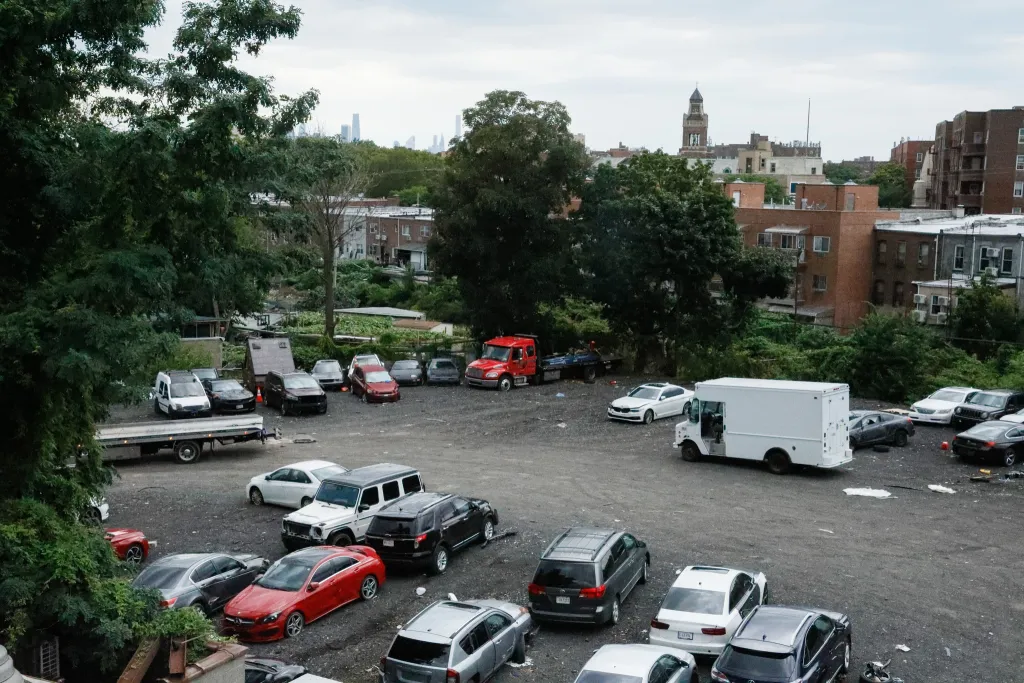
The Queens property where the owner put up a parking lot on an 18th century burial site for free Blacks is now in foreclosure and up for sale — a transaction that could be complicated by strict state rules meant to preserve the human remains interred in unmarked graves.
Three weeks ago the attorney appointed as referee in foreclosure litigation over the site filed a report declaring his intent to sell the lot at 47-11 90th St. in Elmhurst to recover what’s owed to a New Jersey bank.
Last year the owner, aware that the site was sacred ground, paved over the entire property and began renting it out as a parking lot. Included in the dozens of vehicles deposited there were some brought by a towing firm hired by the NYPD to drag abandoned vehicles off city streets.
The owner, a limited liability corporation called 90 Queens LLC, originally purchased the property in 2009 with the intent of putting up condos, but when construction began two years later, laborers working a backhoe struck what turned out to be an iron coffin containing the remains of a freed slave who’d died of smallpox in approximately 1850.

Across New York, the burial sites of enslaved and free Blacks are owned and managed by a variety of public and non-profit entities, including the African Burial Ground National Monument in Lower Manhattan, managed by the National Parks Service; the Enslaved African Burial Ground at Van Cortland Park in The Bronx, controlled by the city Parks Department; and the Harlem African Burial Ground, located on East 126th Street on the site of a former MTA bus depot, which is being developed into a memorial by a local community group and the city Economic Development Corporation.
The city Landmarks Preservation Commission in 2005 flagged the troubled Elmhurst site as potentially an abandoned cemetery affiliated with St. Mark African Methodist Episcopal Church. The church — now in its 198th year — was located there from the 1820s until the 1930s when it moved a mile away to Jackson Heights.
After the iron coffin was discovered in 2011, 90 Queens LLC worked out an agreement with St. Mark that would allow the developer to dig on the condition that he created a special memorial to the burial ground in the planned condo building. The owner then hired a Brooklyn-based firm, Chrysalis Archaeological Consultants, to investigate the site to determine how many human remains were buried there.
Litigation revealed that the remains of more than one person were removed from the lot during early excavation.
MORE: They Paved a Historic NYC Black Burial Ground. Now It’s a Lot for Abandoned Cars.
In court filings, Chrysalis’ president, Alyssa Loorya, said that at least one other body has been removed from the site and that there are more remains still buried under the asphalt there.
Loorya said her firm “is in actual possession of human remains that belong to the next of kin” and that “additional remains exist at the property and have not been excavated.” Loorya did not immediately return calls seeking comment.
Despite the complications the burial site brought to the condo project, in 2019 a New Jersey-based bank gave 90 Queens LLC a two-year, $6.5 million loan that was later extended to January 2022. By then the owner had abandoned the project and last year paved over the property and began using it as a parking lot.
Last spring the Buildings Department declared the lot was illegal and dangerous and ordered it shut down. For months the owner ignored the DOB’s order, racking up violations totaling more than $20,000. The NYPD stopped using the vendor who brought cars there in April after the firm’s tow truck license expired.
“While the law does not explicitly prohibit the use of the property, any activity that disturbs a grave would violate the law.”
Jaclyn Keegan, STATE eDUCATION DEPARTMENT
Last week DOB announced they’d reached a settlement in which 90 Queens LLC finally agreed to shut down the parking lot by Nov. 30.
Meanwhile, the bank behind 90 Queens LLC’s mortgage filed a lawsuit in Queens declaring that the owner had made no payments on it and seeking to foreclose on the property. Court records state that the owners ultimately defaulted by not responding to the suit, and the court appointed an attorney, Everett Hopkins, as referee to determine how to dispose of the property.
Two weeks ago on Aug. 4th, Hopkins filed his first report, saying he’d examined the property and decided the “mortgaged premises should be sold in one parcel.” (Hopkins did not immediately return a call seeking comment).
That’s easier said than done. The site is subject to a New York State law called the Unknown Burial Site Protection Act, which says that anyone other than an archaeologist who “intentionally removes human remains or funerary objects from a burial site” faces a potential misdemeanor charge.

“While the law does not explicitly prohibit the use of the property, any activity that disturbs a grave would violate the law,” said Jaclyn Keegan, spokesperson for the state Education Department, which oversees compliance with the burial site law.
The law requires the property owner to hire their own archaeologist or the state archaeologist at their own expense to supervise the removal of remains. And any “culturally affiliated group” connected to the site — in this case, St. Mark AME Church — can bring in their own “cultural monitor” to oversee this process.
Nearly 100 years ago, a city registrar, citing a legal dispute over the sale of the property, stymied an attempt by the church to relocate the burial site’s remains — now estimated at 290 interred people — two miles away to Mt. Olivet Cemetery in Maspeth, the Amsterdam News reported in 1928, helping to set the stage for the ongoing conflict.
The property was eventually purchased by a company called AMF Machine, which built a factory there in the 1950s before selling it to 90 Queens LLC.
St. Mark’s position as to what will happen to the site remains unclear. The Rev. Kimberly Detherage has not returned calls seeking comment.
Our nonprofit newsroom relies on donations from readers to sustain our local reporting and keep it free for all New Yorkers. Donate to THE CITY today.
The post Paved-Over Historic Black Cemetery Is Now Up For Sale, Lawyer Says appeared first on The City Reporter.
