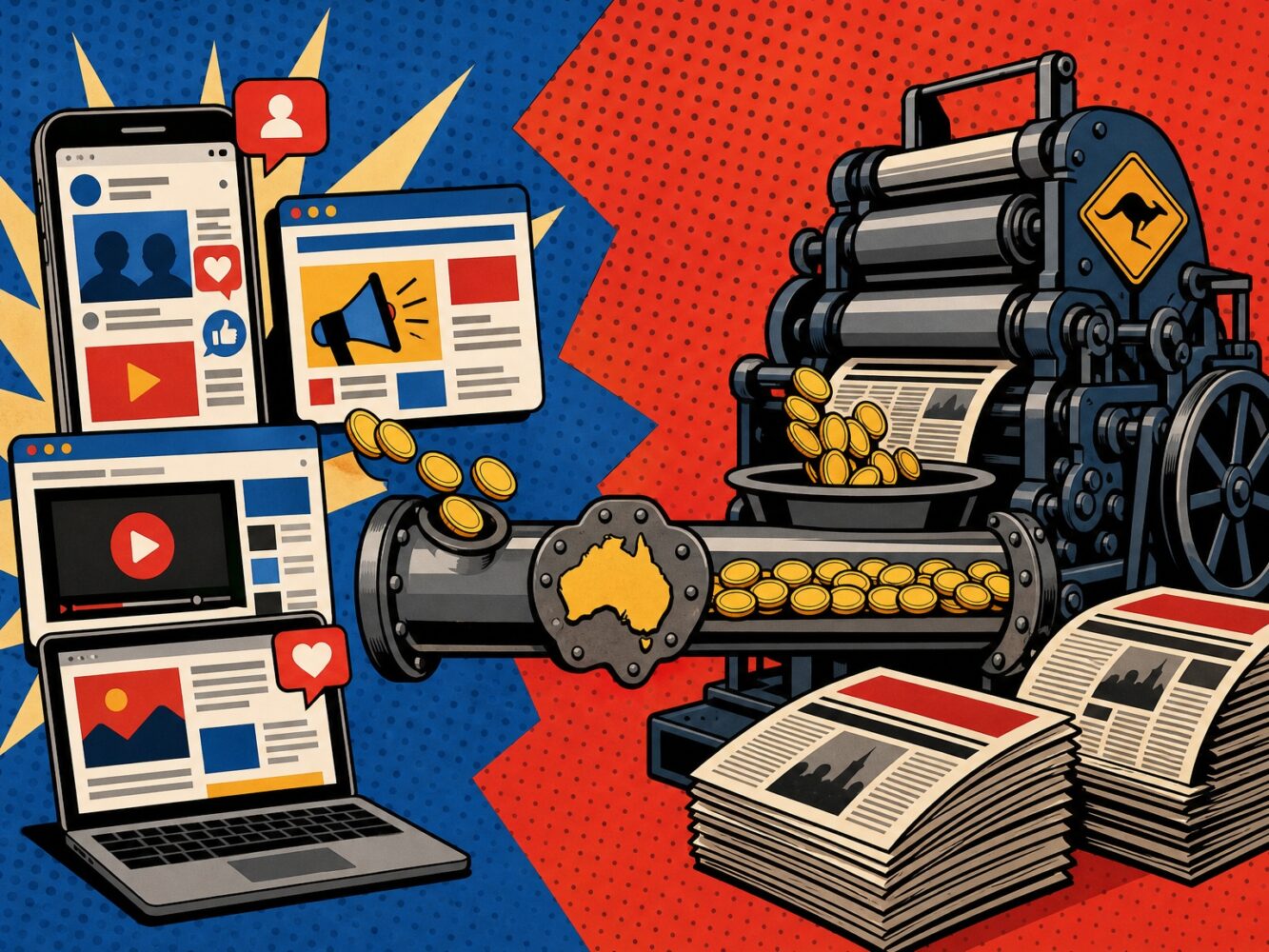
Australia’s latest plan to make digital platforms pay for journalism has an unusual feature. A platform can owe money even if it carries no journalism at all. The government calls this an “incentive.”
On Aug. 3, the Australian government finalized legislation establishing the News Bargaining Incentive (NBI). The government first proposed the NBI in December 2024, then put it on hold after calling a general election a few weeks later.
The NBI seeks to encourage digital platforms to enter into commercial agreements supporting Australian journalism. Large platforms that decline to enter into or renew qualifying agreements must pay a charge based on advertising revenue attributable to the Australian market. Platforms with qualifying agreements may reduce their liability through a nonrefundable offset.
The NBI’s unusual reach is deliberate. It applies to large platforms that provide significant social-media or search services, regardless of whether they carry news content. According to the government, this approach closes a major gap in Australia’s existing bargaining code, which allows platforms to avoid payment obligations by removing news.
The government has openly expressed frustration that the code has failed to secure the desired transfer of revenue from large platforms to news publishers, despite its mandatory bargaining process and binding final-offer arbitration. The NBI responds by compelling payment even when a platform makes no use of news content.
This latest change to Australia’s legal framework warrants attention for two main reasons.
The ‘Success’ That Needed a Sequel
First, Australia’s model has become influential in the long-running dispute between digital platforms and publishers over the online use of news content. That dispute has driven policy interventions in several jurisdictions in recent years, and other governments have looked to Australia for a possible solution.
Australia’s bargaining code grew from an acknowledgment of the limits of Europe’s copyright-based approach. Digital platforms’ use of article headlines and short excerpts, known as snippets, was unlikely to infringe copyright. Even if copyright protected that material, fair-dealing exceptions might permit its use. The Australian Competition and Consumer Commission (ACCC) therefore recommended a code of conduct that would encourage negotiations and allow the ACCC to address potential imbalances in bargaining power.
The ACCC initially designed the code as a form of industry self-regulation. Digital platforms would have nine months to develop it. If they failed to submit an acceptable code to the Australian Communications and Media Authority (ACMA), ACMA could impose a mandatory standard.
The ACCC then began working with Facebook, Google, and news-media businesses on voluntary codes. It soon advised the government that this process was highly unlikely to resolve the central dispute over payment for content. The government responded by directing the ACCC to develop a mandatory code, prompting intense debate.
The code’s central feature is binding final-offer arbitration. It requires the parties to negotiate in good faith. If they cannot agree, an arbitration panel resolves the dispute. Each party submits its final proposal for the amount the platform should pay, and the panel must choose one. If both proposals conflict with the public interest, the panel may amend the more reasonable offer. This process serves as a backstop to voluntary negotiations. It seeks to produce faster decisions, deter inflated demands, and encourage both parties to make reasonable offers.
After the code’s first year, the Australian government’s 2022 review declared it a success. The government reported that digital platforms had reached more than 30 commercial agreements with a broad cross section of Australian news businesses. In its view, the parties would have been highly unlikely to reach those agreements without the code.
The review also identified serious concerns. Smaller news businesses struggled to secure agreements, while the secrecy surrounding completed deals made it difficult to assess whether the code had achieved its objectives.
Platforms also pursued sharply different strategies. Meta showed little interest in negotiating, consistent with its public claim that news plays a minor role in its business model. Google engaged more readily, though it directed most agreements toward its own strategic content initiatives.
The government’s decision to revisit even the mandatory code suggests that its 2022 declaration of success came too soon.
Free Riding Without the Ride
Second, the Australian NBI exposes a deeper problem with the free-riding narrative that has shaped the debate over publishers and digital platforms. As I argued in a recent paper, the rationale for the NBI conflicts with that narrative.
Despite differences in legal design and institutional context, laws governing the online use of news tend to follow a common script. Policymakers first acknowledge that publishers and online intermediaries, such as search engines and social-media platforms, benefit from one another. They also recognize that these platforms have become major gateways to news and that publishers rely heavily on the traffic they provide.
But these laws generally omit a crucial comparison. They do not determine whether the benefits of referral traffic offset the losses from fewer direct visits to publishers’ websites. Policymakers proceed from the premise that platforms free ride on publishers’ investments in producing news and have helped cause the publishing industry’s structural decline. That premise persists despite empirical evidence casting doubt on it. Policymakers treat free riding as an accepted fact without first demonstrating it.
The debate then turns to bargaining power. Publishers depend on certain platforms, which policymakers portray as unavoidable trading partners. Yet the relevant economic effects remain uncertain. Referral traffic may expand publishers’ audiences, while headlines and snippets may reduce direct visits by giving users enough information without requiring a click. Policymakers generally presume that the second effect outweighs the first.
Publishers may rely heavily on platforms to reach new readers. Platforms may have little reciprocal dependence because news content plays only a minor role in their core businesses. That reasoning weakens the free-riding claim by acknowledging that platforms do not need news content. Publishers could also gain more from referral traffic than they lose through competition with platforms, regardless of any difference in bargaining power. If so, their claim to compensation becomes difficult to sustain.
Policymakers nevertheless infer harm from a commercial relationship they regard as unfair. They then require large platforms to negotiate over the use of press publications and pay publishers “fair remuneration,” departing from their initial acknowledgment that both sides benefit.
The free-riding narrative has therefore served as a rhetorical justification for a mandated transfer of revenue. Policymakers continue to pursue that transfer without clear evidence that platform business models have caused publishers economic harm. Michael Geist calls Australian-style mandatory negotiation systems a “shakedown subsidy model” because they require platforms to compensate publishers without a clearly established basis for payment.
The NBI weakens the free-riding claim further by requiring platforms to pay even when they use no news content—when, in other words, there is nothing to free ride on.
Another Chance to Learn the Same Lesson
For at least two decades, policymakers around the world have called for journalism to reinvent itself. The industry has struggled to do so. Revenue-transfer schemes have failed to help publishers develop sustainable commercial models, while protection from competition and continued subsidies leave the structural causes of the industry’s decline intact. Without substantial changes to publishers’ businesses, the next decade will bring more of the same unresolved debates over the fate of traditional media.
Technological change is already overtaking those debates. While policymakers continue searching for ways to make digital platforms pay for snippets, artificial intelligence (AI) has changed how users find information online. Features such as AI Overviews provide synthesized answers within search results, accompanied by links to the underlying sources.
Publishers fear that these summaries will reduce website visits and the advertising or subscription revenue those visits generate. AI Overviews have therefore become the latest perceived threat to publishers’ business models and the industry’s financial sustainability.
Policymakers have had two decades to learn the lesson. Their next response will show whether they finally have.
