Marina Abramović has spent more than five decades forcing art to admit what the body already knows: endurance, fear, desire, pain and presence are not merely themes. They are materials.
Through stillness, exposure and a nearly aristocratic command of duration, she has repeatedly dismantled the safer distance between artist and observer. Looking becomes participation. Time becomes pressure. The audience, often without quite realizing it, becomes part of the evidence.
New York will reencounter her work more than once this year. I am dying in anticipation, and you should be, too.
The first meeting arrives this August, when Balloon Museum opens its permanent location inside the historic Tin Building with DAYDREAM: AIR BECOMES ART. The 54,000-square-foot exhibition will gather monumental interactive environments devoted to air as sculpture, architecture, motion and emotional force. At its center, Abramović will unveil Snowy/Windy/Spring on Planet Z, her first inflatable installation: an extraterrestrial meadow of towering grass, artificial snow and shifting atmospheric currents.
That premise alone carries a peculiar thrill. Abramović, long associated with knives, hunger, exhaustion, nakedness and the moral suspense of endurance, has created an inflatable dream.
The apparent softness, however, should not be mistaken for retreat. Air remains invisible until pressure gives it shape. Snow may arrive as delicacy, erasure or threat. A meadow usually suggests pastoral ease, yet this one belongs to another planet. As visitors enter, their own anatomy completes the piece. Lungs draw breath, skin registers motion, balance recalibrates and the mind searches for order within a climate that feels playful, beautiful and faintly untrustworthy.
Other works deepen that buoyant delirium. Martin Creed’s Half the Air in a Given Space fills a transparent room with blue balloons. Alex Schweder’s mirrored Her Joy rises and deflates, while Karina Smigla-Bobinski’s charcoal-spiked ADA drifts through the gallery, recording each collision upon surrounding surfaces. The museum promises something more seductive than a conventional exhibition: a collective hallucination in which delight and disorientation breathe the same oxygen.
Several months later, the dream turns feral.
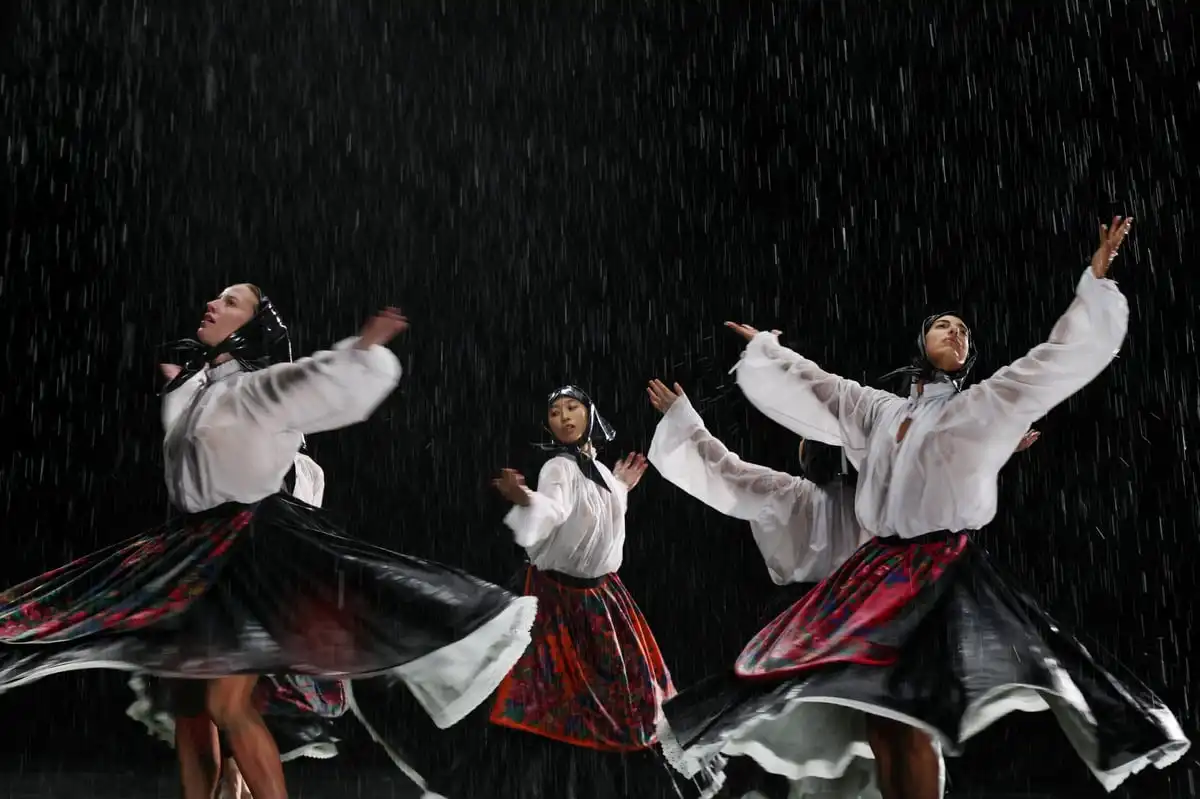
From December 8 through 20, Park Avenue Armory will present the North American premiere of Balkan Erotic Epic, Abramović’s largest-scale performance work to date. The four-hour production unfolds through 13 scenes across the Wade Thompson Drill Hall, animated by nearly 50 dancers, musicians and singers. Rather than remaining fixed before a stage, audiences will move freely through film, sculpture, song, ceremony and bodily confrontation.
The scale feels intoxicating even in description. Black grass, Brutalist architecture, immense projections and ritualistic encounters will transform the Drill Hall into an ancestral fever dream. Fertility rites, funeral laments, storm-banishing gestures, milk baths, knife dances and a ceremonial black wedding will occur around the audience, while regional brass, throat singing and electronic composition collide overhead.
One can almost feel the Armory beginning to breathe.
Eroticism, in Abramović’s hands, is never decorative provocation or inexpensive scandal. Here, it returns to an older, more combustible register, bound to birth, death, harvest, grief, desperation and tenderness. The work rejects the modern reduction of eroticism to pornography, commodity or shame, restoring the body as a site of spiritual force, mystery and transformation.
Performance art existed long before Abramović, of course. Futurist actions, Dada, Happenings and Fluxus had already destabilized the border between object and event. Her intervention was more ethically severe. She made vulnerability impossible to observe innocently.
In Rhythm 0 in 1974, Abramović placed 72 objects before the public and allowed strangers to use them upon her passive body. Tenderness gradually surrendered to aggression. Decades later, The Artist Is Present converted confrontation into silence as she faced visitors throughout her 2010 MoMA retrospective. The weapon changed, although complicity remained central.
That history makes these forthcoming encounters feel especially alive. Balloon Museum expands her language into buoyancy, weather and speculative landscape. Park Avenue Armory returns her to flesh, ancestry and collective ceremony on an almost operatic scale. One may seduce the senses before quietly destabilizing them. The other promises to seize the nervous system outright.
Many artists eventually become custodians of their own mythology. The radical gesture hardens into a signature, while institutional reverence slowly domesticates what once threatened it. Abramović appears unwilling to accept that elegant embalming.
Approaching her 80th birthday, she is not polishing the legend. She is detonating it in opposite directions.
First comes air: alien, buoyant and deceptively tender. Then comes the reckoning—four hours of bodies, song, burial, fertility, ecstasy and ancestral darkness inside one of New York’s most overwhelming spaces. The Armory describes the work as a free-roaming encounter with intimate performances, feverish dances and haunting songs, reclaiming the erotic as a vital life force rather than a modern taboo.
Marina Abramović has never asked us merely to admire her. This year, she invites us to breathe inside her imagination, then walk directly into its fire.
Baloonmuseum.world
armoryonpark.com
