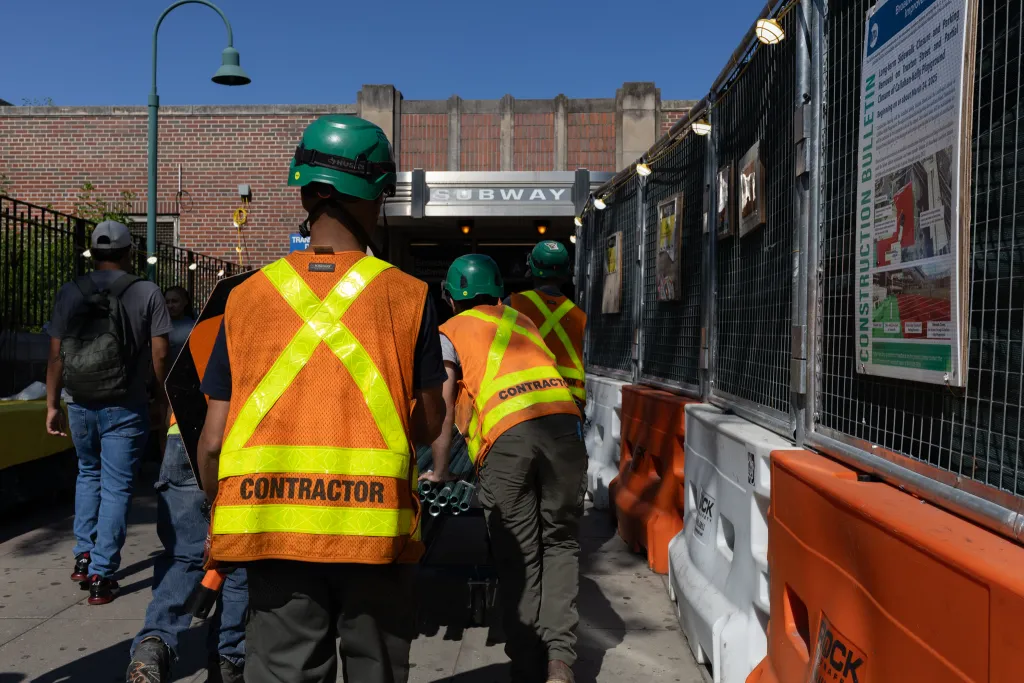
A $400 million renovation of a major Brooklyn transit hub has yielded little for locals looking for jobs, critics charged Thursday, saying that less than 8% of the 170 hires for the project so far have come from surrounding neighborhoods.
The multi-year makeover of Broadway Junction — a sprawling complex that last year served more than 1.8 million riders on the A, C, J, L and Z lines — will equip the station’s multiple levels with seven new elevators, rebuild three escalators and add a new street-level pedestrian bridge by the end of 2027.
Several elected officials and community leaders contend the MTA is falling short of its stated goal to hire at least 20% of the workforce from neighboring communities as part of a local hiring pilot program.
Those neighborhoods include East New York, Brownsville and Bushwick.
“The problem we are having is that for $400 million, we are not seeing those dollars hit the ground, we are not seeing it go into the pockets of our local workforce, we are not seeing it go into our local economy,” said City Councilmember Sandy Nurse (D-Brooklyn), who represents the area. “And that’s a shame.”

Nurse said that 13 of the 170 workers now on the job — or not quite 8% — come from the eight ZIP codes nearest to Broadway Junction, with the numbers coming from meetings with MTA officials.
“That was from them finally giving us the numbers, after kicking and screaming about it, quite frankly,” she said. “I mean, we want to see more than 13 out of 170.”
The MTA countered that the transportation authority is meeting its commitment.
“MTA contracts are consistent with state and federal law,” said authority spokesperson Joana Flores. “The MTA’s $400 million investment in Broadway Junction will modernize and make this station fully accessible, improving quality of life for riders while improving the neighborhood’s economic growth and revitalization.”
But elected officials charged the transit authority is relying on a broader definition of local hiring to meet the 20% mark, counting people from “economically disadvantaged” neighborhoods. Contractors hire workers for the union jobs.
“When we said local hiring, we meant local from the community — not from miles and miles away,” said state Sen. Jabari Brisport (D-Brooklyn). “Don’t redefine it to meet your goals when you’re actually subverting and undermining what we need, which are investments in our community.”
The overhaul and accessibility upgrades within the towering transit complex is seen as essential to a series of projects aimed at turning the surrounding area into more of a jobs hub over the course of several years, with construction planned for a gateway to the main entrance to Broadway Junction.
“There’s going to be a lot of money coming into this district, probably easily over a billion dollars,” Nurse said. “But how many of those dollars are going to go into our community, into the pockets of our families and how much of this money is going to lift up our local economy?”

A 400,000-square foot commercial building known as 2440 Fulton Street — which is billed as the largest in the area — opened across from the station last year, with room for multiple agencies and city-administered programs.
At a rally Thursday outside of Broadway Junction, leaders from several community organizations said jobs are essential for creating opportunities within a section of the city whose poverty rate of 21.4% topped the citywide total of 18%, according to a 2024 study from NYU Furman Center. Black unemployment, especially for young people, is also stubbornly high in the city, The City Reporter recently detailed.
“Jobs for the junction? Hire East New York!” the crowd chanted. “Jobs for the junction? Hire Brownsville!”
“This project is more than construction or rehabilitating a train station,” said Bill Wilkins, executive director of the Local Development Corporation of East New York. “It’s an opportunity to strengthen neighborhoods.”
“We want to see the people getting jobs from within the community,” said Robert Camacho, chairperson of Brooklyn Community Board 4, which includes Bushwick. “Investment comes with the community, no?”
As Dria Forbes carried an empty baby stroller down the stairs to the station’s A and C line platform — where elevators are being installed — the 35-year-old mother said she welcomes the MTA’s investment in the station.
“When I have the child, he has to come out of the stroller when there is no one to help me,” Forbes said. “It will make a big difference because I got to be up and down on these steps.”
Close to 34% of all stations in the transit system are presently compliant with the federal American with Disabilities Act and the MTA has made more than 60 stations fully accessible since 2020. The authority faces a federal court mandate to make 95% of its nearly 500 subway and Staten Island Railway stations ADA-compliant by 2055.
Our nonprofit newsroom relies on donations from readers to sustain our local reporting and keep it free for all New Yorkers. Donate to THE CITY today.
The post Not Enough Jobs For Locals at Broadway Junction Revamp, Local Pols Charge appeared first on The City Reporter.
