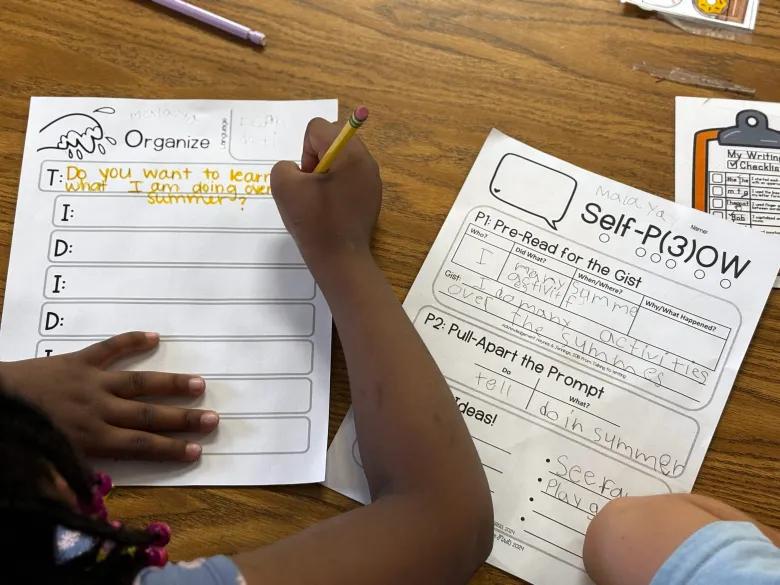

HIGHLANDS RANCH, Colo. — It was the middle of a writing lesson in Gabrielle Grace’s first grade class at Sand Creek Elementary in suburban Denver, and students were furiously jotting down details about their summer plans, the first step in composing a paragraph on the topic.
Except for 6-year-old Dean, who was already done.
“This stuff was just too easy for me,” he said. He pointed to his worksheet, fully filled out with a topic sentence (“I do many things over the summer”) and a list of his summer activities (“park, ipad and vacation”).
“I wrote this, like, before the bell rang,” he said nonchalantly.
At the beginning of the year, many of Grace’s students couldn’t write a sentence. “Now, they do this on their own,” she said. “Their writing is very organized. They write in complete sentences. It’s just like clockwork.”
Dean’s writing prowess — and confidence — is what many elementary school teachers dream of. For years, teachers have bemoaned the state of student writing — and have struggled to manage students’ complex, largely negative feelings about it. Across grade levels, educators say children struggle to write basic sentences, let alone use proper spelling and punctuation. In upper elementary grades, when students should be writing paragraphs and short essays, teachers are finding many students still lack fundamental skills and struggle to write at length.
In recent years, concerned by low writing scores on state exams, some districts have started to rethink how they’re teaching writing. For example, in the 61,000-student Douglas County district, administrators have added more professional development for teachers in evidence-based writing approaches and are prioritizing explicitly teaching writing to students. Similar efforts are underway in Tennessee, Pennsylvania, California and Rhode Island.
Many school leaders say they’re seeing promising results, indicating that America’s children can write better — if they have the right instruction.
“Writing is the last bastion of education,” said Randy Barth, CEO of SRSD Online, which trains teachers in the “science of writing,” encompassing a growing body of research on effective writing instruction. “Writing, I would say, is the last thing that the education system is putting money towards.”
Related: Scientific evidence on how to teach writing is slim
For years, while America has been focused on math and reading — and in recent years, the science of reading — writing has largely been ignored.
Unlike for reading and math, national data on writing proficiency for elementary-age students is sparse. America has not released nationwide standardized writing scores from elementary school grades since 2002, when 27 percent of fourth graders scored proficient or higher.
Nationwide, there’s no good way to know how elementary students are doing when it comes to writing, said Vicki McQuitty, a professor in Towson University’s elementary education program and director of the Maryland Writing Project, an initiative aimed at improving writing instruction. “But the word on the street is that kids can’t write.”
An analysis of recent state test results seems to confirm this. In 2025, more than half of Texas’ 360,000 third graders received no credit for their responses on an essay prompt in the state’s annual English language arts test that asked them to compare and contrast two texts. In California the same year, only 17 percent of third graders met the standard for well-organized writing on an essay asking them to demonstrate research skills when responding to a prompt. And in Florida, students on average scored 6 out of 12 possible points on the state’s writing test.
The results aren’t much better as students age. For years, employers, college professors and high school teachers have complained that students struggle to write coherent, multi-paragraph essays when they arrive in their classrooms or apply for jobs.
Elementary teachers, responsible for the heavy lift of early writing instruction, say they’re up against a host of challenges. Writing is a demanding task for students, requiring a certain amount of background knowledge to understand the material, fine motor skills and vocabulary, among other skills.
“I think writing is the hardest thing to teach,” said Chrissy Everett, a fourth grade teacher at Prairie Crossing Elementary in the Douglas County district and an educator of 23 years, because it involves executive function skills and knowing “how to piece it all together and what steps to do next.”

Related: Young children have unique needs and providing the right care can be a challenge. Our free early childhood education newsletter tracks the issues.
While the “science of writing” isn’t as deeply researched as the science of how children learn to read, experts generally agree on practices that are key to teaching students how to write. For example, students should be given time each day to write and taught different genres and purposes of writing. Educators should also explicitly instruct students in individual components of writing, starting with handwriting, spelling and vocabulary.
Adrea Truckenmiller, an associate professor at Michigan State University’s college of education, whose research has focused on writing, said students need to learn that a complete sentence includes a subject and a verb, not just a capital letter at the beginning and a period at the end. Later, they must be taught how to connect ideas by expanding and combining sentences. Finally, they can tackle essays, using worksheets and charts to plan their writing.
But research shows teacher preparation programs vary in how much and what they teach aspiring educators about writing instruction. Many lack standalone writing instruction courses. “Even teacher educators do not always feel comfortable teaching preservice teachers about writing,” said McQuitty, from Towson. “It’s always pushed to the back.”
Once in the classroom, teachers are under pressure to prepare students for standardized tests that emphasize reading and math, experts say, often to the detriment of other subjects.
“I just assumed writing instruction was happening, but every time I walk into a classroom my assumption is proven wrong,” said Truckenmiller.
Adding to the challenge is that after spending their early years scrolling iPads and pecking at keyboards, some kids struggle to even hold a pencil. Christina Bretz, an occupational therapist with Learning Without Tears, a company that sells early reading and writing curriculum and materials, said she recently met a kindergartener who had never seen crayons and only knew how to color by using his finger on an iPad.
“As we’re seeing more children use devices, we start to see less of them manipulating objects with their hands,” said Bretz.
Related: Why are children still struggling in school four years after the pandemic?
In 2023, district leaders in Douglas County noticed scores on the elementary writing portions of state tests were far lower than on the reading portions. As they dug into the district’s approach, “we found that teachers didn’t know how to teach writing,” said Janet Merrill, literacy coordinator for the school system.
District officials realized teachers had largely been left on their own to teach writing and were using a hodgepodge of methods. “In the past, really just whatever a teacher could find from Teachers Pay Teachers or something online was where we were,” Merrill said.
Without districtwide common strategies, writing instruction varied greatly from class to class, and teachers often felt like they were starting each year from square one, Merrill said. Teachers largely focused on creative writing, asking students to write about a favorite vacation or birthday, Merrill said.
“We did ‘Describe your shoe’ for like a month. And then you described your backpack,” she added. “It’s just this random writing.”

Merrill started researching science-backed ways to teach writing and learned about an approach that disability advocates in the district were championing, called Self-Regulated Strategy Development. Rather than focusing on creative writing, SRSD is prescriptive, encouraging students to respond to texts using evidence and giving them specific strategies for planning and organizing writing.
With help from a group called Releasing Writers, the district rolled out a new approach to writing with 100 instructional coaches and teachers across its more than 70 elementary schools. Three years later, every elementary teacher in the district is following the same process: reading and analyzing examples of writing with their class; using a routine for analyzing and responding to a prompt; and relying largely on writing responses to texts, rather than creative freewrites. Teachers model the strategies and their easy-to-remember acronyms, like “TIDE,” which stands for “topic, important details, and ending.” Students at every grade level repeat the same process, with slight variations for younger students.
The district’s new approach also teaches students to be resilient as they write. They start their drafting process by writing a positive phrase to themselves, which they can read when they’re feeling frustrated or stuck.
Around the corner from Grace’s classroom, students in Kristin Allen’s kindergarten class had just finished reading a story about a group of animals who made a gift for a turtle.
Now, Allen was working with small groups of students to help them retell that story in writing. Before the four students sitting with her got started, Allen asked them what they should write at the top of their papers.
The children thought for a moment and started scribbling down affirmations on their pages. Allen asked them to share.
“I can do this,” said one child.
“I am smart,” said another.
Then Allen asked them to write a topic sentence about the story, followed by three details from it.
“The anumls make a gift for turtle,” one girl wrote.
Allen was quick to correct spelling and punctuation. She paid close attention to how students held their pencils. She encouraged them to leave spaces between words.
This was Allen’s first year back in the classroom after taking several years off to spend with her own children. Prior to that, she taught kindergarten in New Jersey for 10 years. When she first started teaching, “I did not see anything like this,” Allen said, motioning to papers covered with her students’ writing, which in some cases included full paragraphs. “Some people have the attitude that ‘Oh, they’re kindergarten, they’re five and six, they can’t’.’ They can.”
Allen was eager to learn the SRSD method. But not all teachers are. Merrill said some veteran teachers were reluctant, worrying that kids wouldn’t love writing with such a prescribed process — but she’s not sure students enjoyed the old process as much as their teachers believed.
“They saw this blank page and they just were like, ‘I don’t even know where to start.’” Merrill said. “Now, students love writing because they have the skill to actually write.”
What helped convince teachers was seeing near-immediate effects from the early adopters who piloted the approach. After the first year, educators in higher grades noticed kids who had been taught via SRSD were entering middle school with better writing skills, and they started asking their colleagues what had changed in elementary classrooms.
Related: America’s reading problem: Scores were dropping even before the pandemic
Federal research has found the SRSD approach improved writing quality across different genres, grades and assignments, and can be an effective intervention for students with learning disabilities. But despite the evidence behind SRSD and similar approaches based on the science of writing, they haven’t made it into mainstream curricula and classrooms in part because there’s still not widespread awareness of them among educators, experts say.
“We have this knowledge base concentrated in a really small number of people that hasn’t been scaled yet,” said Truckenmiller, from Michigan State University. In addition, schools have competing priorities, she said, often thinking they need to get reading instruction right first before focusing on writing.
But in Douglas County, officials say focusing on writing is key to improving reading. And they’ve already noticed a difference in test scores: After a year of rolling out the strategy in a handful of schools, the district said it saw state writing scores increase by 3 percentage points. Math scores increased too, which district officials attribute to students having the skills to better analyze questions and problems. This summer, at the request of educators in the district, Merrill and her colleagues will begin training all their middle school teachers in SRSD.
Students have noticed the difference as well.
Last year, “you just had to sit down and write,” said Connor Miles, a fourth grader in Everett’s class at Prairie Crossing Elementary. How did that make him feel? “Completely lost,” he said.
One of Connor’s classmates, 10-year-old Arya Melancon, said this year, teachers are better able to explain the process of writing. They are providing her and her peers with strategies and systems, and she likes sorting through evidence from texts and “building” paragraphs and responses.
“We’ve definitely improved this year. We have a better understanding,” she said. The difference was most glaring to her and her classmates when they sat down to take their end of grade state test in the spring, she added.
“Last year we were all scared of writing prompts,” Arya said. “This year, we felt like we were ready.”
Contact staff writer Jackie Mader at 212-678-3562 or mader@hechingerreport.org.
This story about writing skills was produced by The Hechinger Report, a nonprofit, independent news organization focused on inequality and innovation in education. Sign up for the Hechinger newsletter.
The post The next literacy challenge: Teaching students how to write appeared first on The Hechinger Report.