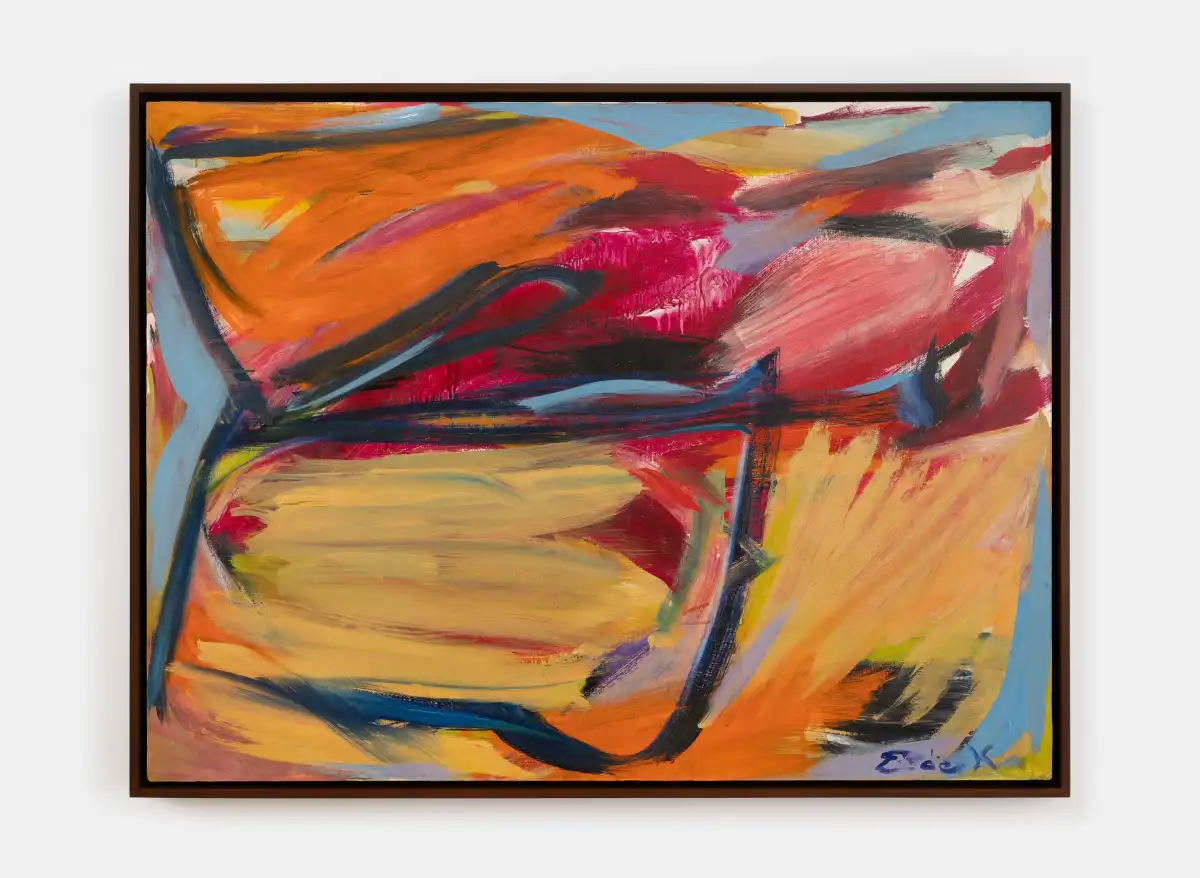
Before the Hamptons perfected the choreography of linen, rosé and strategic nonchalance, the East End smelled of salt, turpentine, wet earth and artistic mutiny. Certainly, the light was ravishing. Yet painters came for something more dangerous: distance from Manhattan, permission to fail extravagantly and the possibility that American painting might finally grow vast enough to tear open the beautiful, terrified interior of its age.
In many ways, the moment was almost violently precise. By 1945, Europe had been ravaged by war, while New York was becoming modern culture’s gravitational center. The old pictorial languages seemed indecently composed beside the Holocaust, the atomic bomb and a muscular United States. No polite landscape could contain such psychic wreckage. Canvas became arena, confession, fistfight and revelation. As the idiom gained prestige, its surfaces traveled abroad as symbols of democratic freedom—a magnificent irony for a nation still rationing it at home.
That year, rather fatefully, Jackson Pollock and Lee Krasner settled in Springs. The standard account rushes toward him—the barn floor, flung enamel, brooding masculine genius—yet Krasner was hardly a supporting character in someone else’s revolution. She was a rigorous painter, intellectual engine and catalyst whose instincts shaped the community around them. The pair encouraged Elaine and Willem de Kooning to visit in 1948; James Brooks and Charlotte Park followed in 1949. Soon enough, rivalry, friendship, alcohol, ambition and gossip circulated almost as vigorously as pigment. Essentially, an insurrection acquired an address.

Quite fittingly, the Parrish Art Museum now returns to this volatile history with Abstract Expressionism: The East End, 1940 to Today, opening September 27 in Water Mill. Organized by Kaitlin Halloran as part of PARRISH USA250: Life, Liberty, and the Pursuit of Happiness, the exhibition takes “liberty” as its animating principle. The pictures, however, refuse to make that idea tidy.
After all, expressive freedom has never been distributed evenly. This is Shinnecock land, freighted with histories older than the studios that later made the region famous. Likewise, Abstract Expressionism proclaimed radical individuality while its legend hardened around heroic men, cigarettes and exquisitely marketed anguish. Women were present in ateliers, salons, galleries and arguments from the beginning; recognition, mysteriously, kept losing their addresses.
Here, thankfully, those painters reemerge with authority. Mary Abbott, Elaine de Kooning, Perle Fine, Gertrude Greene, Helen Frankenthaler and Lee Krasner appear not as corrective footnotes but as architects of the upheaval. More revealingly, their canvases prove that gesture was never inherently male, scale required no testosterone and emotional power had no obligation to arrive wearing work boots.

Betty Parsons offers, perhaps, the most delicious complication. History remembers the dealer who championed Pollock, Rothko and Newman, even as she painted with equal conviction. By placing Parsons’s own canvases alongside later pieces by Joanna Pousette-Dart, the survey restores the woman behind the market to the intimate life of form, color and risk. Apparently, building the canon did not satisfy her; she had to create beyond it as well.
Pousette-Dart’s two-panel Untitled (From the Beatus Group) carries abstraction into another register. Its layered structure and calligraphic energy suggest a manuscript coming loose from chronology, poised between symbol, terrain and thought. Instead of rehearsing the grand gestures of the 1950s, the composition distills their permission into a more elusive intelligence.
Still, that evolution matters. The story does not end when the first generation becomes expensive enough for textbooks. Works from the 1970s and 1980s reveal a language shedding its original swagger, while Marina Adams, Suzanne McClelland, Pat Steir, Stanley Whitney and Frank Wimberley demonstrate how chromatic rhythm, physical improvisation and spatial tension mutate. In their hands, inheritance becomes provocation, never etiquette.

Meanwhile, photographs by Hans Namuth, Fred W. McDarrah and Laurie Lambrecht restore bodies to the mythology. A finished canvas may appear inevitable; the studio tells the dirtier truth through revisions, ruined passages, exhausted materials and the private terror of not knowing whether anything will cohere. Creation, inconveniently, is less thunderbolt than sustained nerve.
Arguably, that is why this presentation matters during the nation’s 250th anniversary. That promise is easy to engrave on monuments and considerably harder to practice across institutions, histories and human lives. Abstract Expressionism embodied both the beauty of self-determination and the exclusions concealed inside American grandeur. By widening the frame, the Parrish makes that achievement more honest, unruly and alive.
Ultimately, the East End did not merely shelter an avant-garde. It gave rebellion acreage, weather, solitude and witnesses. Abstract Expressionism: The East End, 1940 to Today is on view at the Parrish Art Museum, 279 Montauk Highway in Water Mill, from September 27, 2026, through February 14, 2027. Go prepared to be seduced, implicated and splattered—emotionally, one hopes. The dry cleaning situation should remain manageable. Visit parrishart.org.

