Some art asks to be understood. Tyvette Symone’s work, perhaps more urgently, asks whether understanding was ever enough.
Encountered within The Now After: What We’re Left With, on view at Pen + Brush through September 12, Symone’s assemblages appear almost mid-metamorphosis—part reliquary, part psychological landscape, part evidence recovered from an interior catastrophe. Wings spread as crystals glint and paper frays, while soil, bark, moss, mirror and feathers carry their own private histories. Nothing feels passive, and certainly nothing is merely pretty; instead, the materials seem to twitch with symbolism, as though nature itself had been asked to describe what happens when the mind becomes both sanctuary and threat.
Perhaps this recognition strikes me so deeply because I first encountered Symone’s work nearly a year ago, and it has remained lodged in my mind ever since. Rather unusually for me, language failed to give it the light it deserved. For months, I quietly revered it in person, marveling at its dimension, vulnerability, force, complexity and severity. Then, as kismet would have it, one of this great city’s leading cultural institutions also discovered the power I had struggled to articulate.
Drawing upon her experience of Bipolar I disorder, the Brooklyn-based, self-taught artist translates mania, depression, hallucination, paranoia, psychosis and recovery into a steady explosion of human emotion. Rather than illustrating mental illness from a safe distance, her practice enters the storm and arranges what survives into a form we can bear to confront.
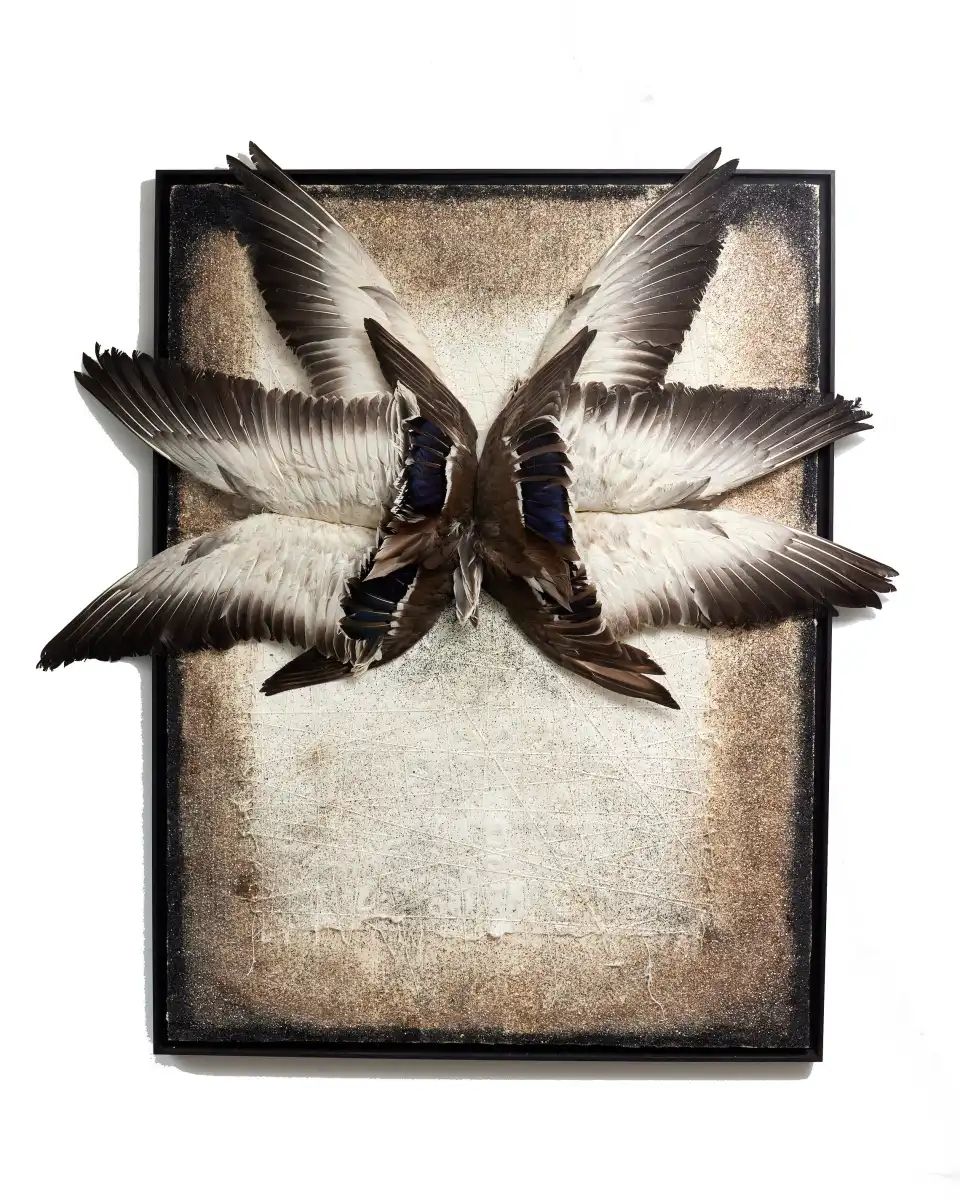
At its emotional center, Delusions of Grandeur: The Death of Symone Seraphim brings together black tourmaline, mica, paper, string and literal wings. Standing before it, grief arrived before understanding, and my body recoiled even as I leaned closer. Its plumage promised escape while announcing the death of flight; mica flashed like an exposed nerve, while tourmaline seemed to hold darkness without relieving it. Rather than ask for my attention, the piece entered me—sacred, feral and almost unbearable.
Crucially, Symone Seraphim was not a fictional alter ego. During psychosis, she experienced a delusion of grandeur, identifying with the seraphim, six-winged beings imagined near the throne of God. Their pinions signify reverence, passage and humility, while the name descends from a Hebrew root associated with burning. Symone even wore wings publicly, turning an interior reality outward. Although that disclosure could have been sensationalized, in her hands it becomes testimony. The “death” in the title reads less like an ending than the brutal exorcism of a self once believed divine in order to return to life.

If Delusions of Grandeur mourns a consecrated identity, Mania, from 2023, seduces before it wounds. Gold, moss, glass, mica and feathers create an irresistible radiance, and, in its presence, my pulse quickened before my intellect could catch up. I wanted the brightness even as I distrusted that desire. Perhaps this is the work’s most unnerving achievement: it understands that mania may first resemble revelation—propulsion, confidence, inexhaustible possibility—before consequences surface. Its presence dazzles and destabilizes, leaving behind one merciless truth: ecstasy can cut.
Psychosis, by contrast, is quieter, though no less devastating. Constructed from wings, moss, mica, antiqued mirror and unryu paper, it places reflection at the center of its cruelty. Gazing into the aged glass, I did not meet my image so much as its erosion; my face became a rumor. That sensation was brutal precisely because it felt recognizable, suggesting the boundary between certainty and distortion may be thinner than anyone would like to admit.
From there, the promise of ascent appears suspended. Vegetation encroaches like time reclaiming an abandoned structure, while fibrous, skin-like paper holds fragility against a harder mineral gleam. Rather than imitate the loss of shared reality, the composition unsettles our confidence in perception itself until, for one terrifying moment, certainty is no longer guaranteed.
Seen through art history, Symone’s imagery becomes charged. Nike races forward; angels descend through Renaissance altarpieces; Icarus falls because desire cannot resist the sun. Her forms, however, occupy a more unstable threshold, offering escape and entrapment, divinity and delusion. Flight, after all, is never only about leaving the ground; sometimes it is the fantasy that the self can outrun itself.
Within the broader reckoning of The Now After, Symone’s contribution remains intensely intimate. The exhibition considers what endures after environmental, political, historical and psychological rupture. Her answer, somewhat devastatingly, is matter: the body, the memory of what it withstood and the responsibility of deciding what to make from the wreckage.
That proposition also carries through her earlier Reflections of the Human Condition, where clinical categories opened into sensation. In many ways, the collection restored texture, contradiction and personhood to experiences too often reduced to symptoms. After all, a diagnosis may name a condition, yet it cannot contain a soul; Symone’s vulnerability is not weakness displayed for applause, but authority earned through survival.
Even so, the final sensation is not despair. An impulse continues reaching upward—perhaps the wing, a crystal catching light or simply the instinct to take what nearly destroyed us and fashion from it an object that might keep someone else alive.
Ultimately, Tyvette Symone creates from the now after: that strange silence following impact, when the world has changed and one must decide whether to remain among it. Her answer is raw, imperfect and fiercely inspiring.
The feathers may come from death. Still, they remember flight.
Visit penandbrush.org for more.
