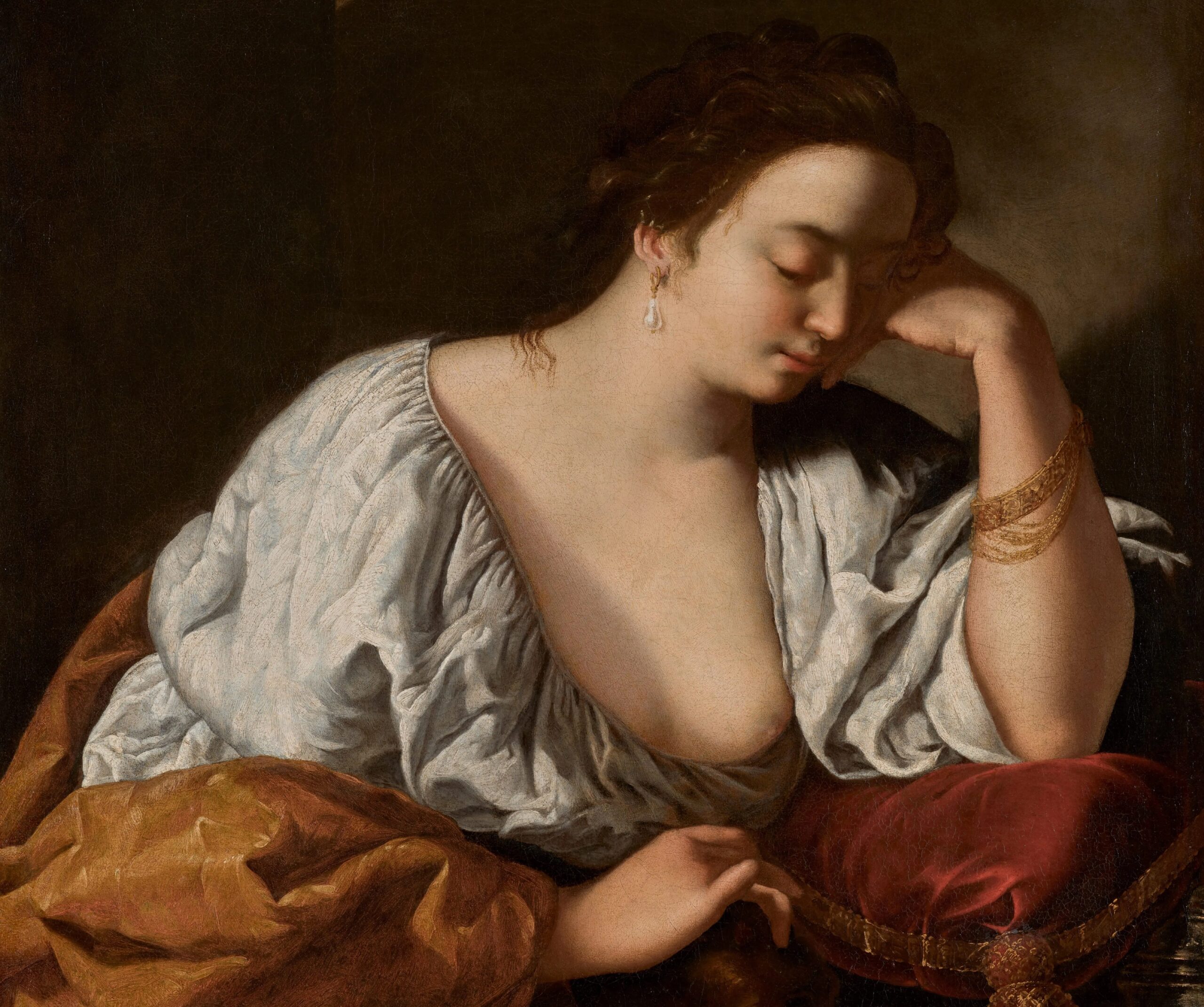


Füssli’s Solitude Twilight at Didier Aaron & Cie

The rising fascination with the surreal and the extra mystical or non secular dimensions of artwork is resulting in renewed consideration and appreciation for singular creative visionaries who, throughout moments of historic fracture and seismic change, created luminous or ominous photos grappling with timeless archetypes and profound reflections on the human situation lengthy earlier than the Surrealist motion. Swiss-born 18th-century painter Henry Füssli is one in every of these figures. His nightmarish and fantastical imagery explores desires, the supernatural and psychological states, occupying a vivid and distinctive house between Romanticism and early Symbolism. Parisian gallery Didier Aaron is presenting an excellent instance of his work depicting a reclining determine in a deep dreamlike state draped in darkish clothes as she rests towards a shadowy kind. The daring contrasts of sunshine and shadow seize the extreme emotion and psychological depth typical of Fuseli’s work. This can be very uncommon to see a portray of this dimension and high quality come to market since Fuseli produced a restricted variety of canvases, a lot of which now reside in museum collections. Coming from a non-public assortment in Switzerland, the portray is priced within the excessive six-figure vary.

The Rembrandt self-portrait etchings at Kunsthandlung Helmut H. Rumbler

Rembrandt is among the most profound and relentless explorers of the self-portrait style, delving deeply into the psychological complexity of the human situation. His self-portraits usually are not merely depictions of his outward look however intimate and sometimes uncooked reflections of his interior world. By means of these works, created at completely different moments in his life, Rembrandt captured the growing old course of, his emotional states and his evolving identification with an depth few artists have matched. Kunsthandlung Helmut H. Rumbler is presenting 4 etched self-portraits from 1630, and regardless of their intimate scale, every carries the identical depth. The etched traces agitate and accumulate throughout the floor, capturing delicate microexpressions whereas sharp contrasts of sunshine and shadow heighten the dramatic sense of vexation. The result’s a sequence of outstanding works combining psychological depth with extraordinary technical mastery.
Forma Fantasma at Fridman Benda

One of many first prints of Goya’s Los Caprichos dated 1799, at Emanuel von Baeyer

Within the dystopian and unsettling panorama of right now’s fixed barrage of unhealthy information, works like Goya’s Los Caprichos really feel terribly well timed. In its masterful mix of darkish humor, social commentary and fantastical imagery, Goya’s well-known sequence of 80 aquatint etchings affords a pointy satirical critique of the social, political and cultural atmosphere of late 18th-century Spain—one which resonates deeply in an age when societal contradictions and political strife appear ever extra current. London supplier Emanuel von Baeyer is presenting one of many first impressions of this iconic sequence at TEFAF.
In February 1799, Los Caprichos, a group of 80 prints on “whimsical issues, invented and etched by D. Francisco Goya,” was placed on sale in Madrid for 320 reales. Shortly after its publication, nonetheless, fearing the wrath of the Inquisition, Goya withdrew all obtainable copies and surrendered them to the Spanish Crown. Solely 27 had been offered, and it stays unknown what number of of these survive right now. The copy right here, priced at £1.5 million, is a type of uncommon 27: an entire set of 80 etchings in its authentic binding. Most remarkably, this explicit instance carries a distinguished provenance, having been bought throughout that temporary window of availability by the famend engraver and modern of Goya, Blas Amettler y Rotlan (1768-1841).
Extra in Artwork Gala’s, Biennials and Triennials
