This story was produced as part of a collaboration between The City Reporter and MindSite News, the nation’s only nonprofit news outlet focused on mental health. Sign up for the MindSite News Daily newsletter here.
Genaro watched as four police officers crowded out of the elevator, their boots thudding through the narrow hallway of the apartment building where he lives with his parents and brother, in Flushing, Queens. The officer in front carried a shield that blocked her from head to knees, as if she were facing down a riot, though Genaro was alone.
He tried to explain that this wasn’t what his family needed. He’d called 911 to ask for an ambulance for his older brother Steven, who is diagnosed with schizophrenia. Steven had been agitated and moody for weeks, not sleeping and smoking too much marijuana. Earlier that evening, he’d started an argument with their father, yelling and pounding on a kitchen cabinet.
When things like this had happened before, Genaro, who was 20 years old when the police came, tried to lay low in his room and focus on his homework. But that night, in October 2024, he felt fed up. He walked into the kitchen and told Steven not to disrespect their father. Steven got angrier and knocked over the family’s TV, which shattered on the floor. Genaro’s temper snapped, and he punched Steven in the face.
Their mother, Gloria, who barely comes to Steven’s shoulder, stepped between her sons and told Genaro to do what doctors and social workers had always instructed if Steven was in a crisis: Call 911 and ask for an ambulance to take him to the hospital. (Gloria asked to be identified by her first name to protect the family’s privacy. Genaro and Steven are middle names.)
By the time Genaro led the police into the apartment, Steven was sitting on the sofa, sobbing like a child. His parents assumed that soon, someone would lead him downstairs to an ambulance.
But that’s not what happened. Instead, a police supervisor from the 109th Precinct showed up and started asking questions — not about whether Steven was okay, but who had done what to whom; who had broken what. “He had like a really bad attitude. Everything just got escalated,” Genaro said.

The supervisor told his officers to put Genaro and Steven in handcuffs. They were both under arrest — Genaro for assault; Steven because of the broken TV. Genaro remembers the officer nearest him asking if they could do the handcuffing outside, where Gloria wouldn’t have to watch. The supervisor said no. Gloria started to scream and bang on the table, “like her heart was breaking,” Genaro said.
Gloria, who doesn’t speak fluent English, remembers pleading with a Spanish-speaking officer. Genaro was such a good kid; he’d never been in trouble. And Steven, her vulnerable, unpredictable son — what would happen to him in jail?
“How is it possible that this is happening right now?” she asked. “We were asking for help. We were not asking for the police to come.”
Broken Promises
The New York Police Department responds to upwards of 149,000 mental health emergency calls each year.
In the worst-case scenarios — the ones that make news — the person in crisis ends up dead, as has happened at least 24 times since 2015.
But even when everything goes according to plan, police encounters can cause irreparable harm. People in crisis end up in jail. They regularly get handcuffed, forced onto gurneys, strapped down and injected with sedatives against their will.
Many describe it as like being kidnapped: Their dignity is snatched away, their autonomy erased. They feel degraded. They are terrified that it will happen again.

It is hard to find an expert who argues that sending cops or hauling people to ERs is a good way to respond to most mental health emergencies. Police are not trained as mental health providers; hospital psychiatric units are usually full and admissions criteria are narrow. Once people in crisis get to the hospital, they are nearly always sent away with a referral to an outpatient clinic — which will also likely be full, with a waitlist. Researchers consistently find that sending mental health teams to respond to emergencies is safer, cheaper and more effective than sending police.
For years, officials across the city and state have promised to build better, more humane ways to respond to people in crisis.
For years, however, those promises have been broken.
Gov. Kathy Hochul said in 2022 she would fund intensive, street-based programs to work with people at highest risk of landing in hospitals or jails. Those programs have waitlists of hundreds.
A succession of New York City mayors promised to deploy mobile crisis teams to deescalate emergencies. The teams are so underfunded and understaffed that families sometimes wait days for them to show up.
In 2021, the city launched B-HEARD, a pilot program that sends mental health workers and EMTs, instead of police, to respond to 911 calls. Each mayor since has promised to expand the program across the city. And yet, five years after its launch, B-HEARD teams respond to fewer than 7% of citywide mental health emergency calls made to 911.

The current mayor, Zohran Mamdani, has made even bigger promises than his predecessors, campaigning on a plan to triple the size of the mobile crisis program, grow B-HEARD so big that many neighborhoods have multiple teams, and create a new, $1.1 billion city agency to oversee an “unprecedented City investment in mental health services.”
Six months into the Mamdani administration, however, those reforms are nowhere to be seen. After police shot 22-year-old Jabez Chakraborty, who was holding a knife during a mental health crisis in January, Mamdani took the comparatively small step of opening a new Office of Community Safety, with a budget of only $260 million, to oversee not only B-HEARD but violence prevention, domestic violence and other programs. The city budget, adopted June 30, includes no new money for B-HEARD, according to Sam Raskin, a Mamdani spokesperson.
“The Mamdani administration is committed to strengthening and expanding B-HEARD,” Raskin wrote in an emailed statement. “When New Yorkers are experiencing behavioral health crises, they should be met with trained health professionals who can respond appropriately and connect them to ongoing care.”
‘We’re Alone’
After Steven and Genaro were arrested, police locked them in holding cells at their local precinct. Steven’s stomach hurt so badly from anxiety that he was transferred to Queens Hospital Center, where he spent the night shackled to a bed with a police officer watching him. Hospital staff prescribed medicine for his stomach pain but no one gave him a psychiatric evaluation or treatment.
His parents, worried sick, brought his psychiatric medication to the precinct, but officers turned them away. By the time he was arraigned and released, two days after his arrest, Steven was exhausted, afraid and confused.
At home, the fear only closed in tighter. Growing up, it had seemed to Steven that his horizons were infinite. He was a soccer player, tall and handsome with close-cropped black hair and big, gentle eyes. At 19, he was recruited to play for a professional team in the Dominican Republic, the Delfinas del Este. But while he was there, his luck broke. His best friend died, and he had knee surgery and was cut from the team.
After he came home, it was like his life had snapped shut. He felt like a failure, and it seemed like other people were looking at him and thinking the same thing. Steven started hearing voices. He couldn’t relax, couldn’t sleep, couldn’t go outside. He smoked weed to slow down his mind but it made him irritable and aggressive.

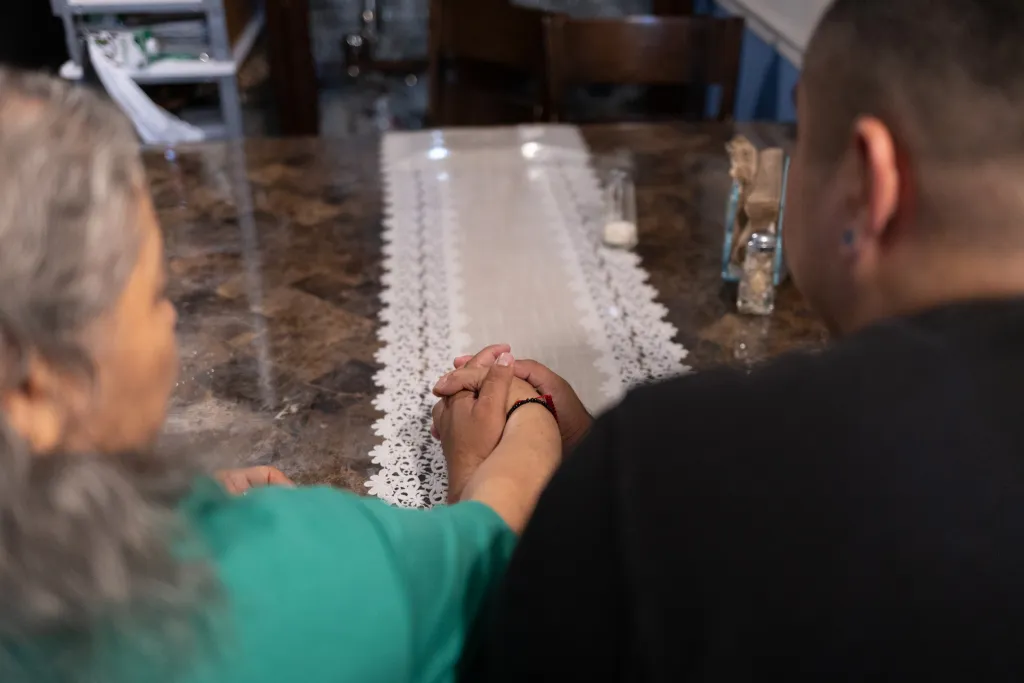
His parents, contending with the relentless, stagnant grief of watching their child disappear inside a stranger, rearranged their lives so that Steven would never be left alone. Gloria quit her job as a home health attendant so she could go with him to his psychiatry and therapy appointments.
But after the arrest, Steven stopped wanting to leave the apartment at all. News footage played over and over in his mind of people being killed by police. He was scared when the doorbell rang. It seemed that police cars were slowing down when they drove past. He couldn’t shake the dislocating feeling of not really being a person — at least not in the eyes of the police or the people at the hospital or the arraignment court.
Steven locked himself in his bedroom, “just constantly thinking, ‘Is it really worth the risk, going outside or going to the store?’” he said.
Meanwhile, in the living room, his family circled around what had become an impossible question: What would they do next time Steven ended up in crisis?
They knew they’d never call 911 again, but there seemed to be nowhere else to turn. “We’re searching, searching, searching,” Steven’s father said, but “we’re alone.”
Which is why Gloria was surprised, a few weeks after her sons’ arrest, to get a call with an unsolicited offer of help from an activist named Peggy Herrera.
Unheard
Peggy became an unexpectedly public figure in the world of mental health advocacy in 2019, after she called 911 to ask for an ambulance. Her 21-year-old son, Justin, was having a ferocious panic attack, breaking things and threatening to kill himself.
By the time cops arrived, Peggy was locked out of her apartment and Justin — terrified of being arrested — refused to come outside. Police wanted to break down the door, but Peggy stood in front of it. Body camera footage, which aired on local news at the time, shows what happened next: Three cops push Peggy to her knees and cuff her hands behind her back. When Justin comes outside to help his mom, they take him face-down on the sidewalk before EMTs strap him to a gurney. Peggy’s voice is raw, screaming, “Leave my son alone!”
In 2021, Justin filed a complaint against the city that, over several years, grew into an ongoing class-action lawsuit with the potential to fundamentally change how New York responds to mental health emergencies. Peggy became an activist, working to keep other people with mental health problems away from cops and out of jail. “People have an illness or they have trauma and what we do is criminalize them and put them in handcuffs,” she said. “They deserve to be treated like human beings.”

There was a moment when it seemed like city officials — along with much of the rest of the country — were listening. In September 2020, amid nationwide Black Lives Matter protests, outrage erupted in Rochester, New York, over body camera footage of a Black man named Daniel Prude, who was forcibly hooded and pinned to the ground by police after his family called 911 for help during an episode of psychosis. He asphyxiated and later died.
“I placed a phone call to get my brother help, not to have my brother lynched,” Daniel’s brother Joe Prude told the press.
As activists called to defund the police, dozens of cities sent delegates to study a 30-year-old program called CAHOOTS, in Eugene, Oregon, that trained EMTs and crisis workers — most of whom had experienced mental illness themselves — to respond to emergencies. Until the program lost funding in 2025, CAHOOTS teams handled about 20% of Eugene’s 911 calls, saving the city millions of dollars a year without a serious injury or fatality. After Prude’s death, nearly 100 new alternative crisis response programs cropped up across the country.
New York City rolled out B-HEARD, starting with a pilot program in three police precincts in Harlem. The goal, officials said, was to get people into voluntary, community-based services, avoid police encounters, and stop the revolving door of the emergency room.
It wasn’t long, however, before political momentum swung back towards policing and forced hospitalizations. As shutdowns related to the COVID-19 pandemic lifted, New Yorkers saw a spike in crime and an increase of visibly mentally ill people on the street. In 2022, a 40-year-old woman named Michelle Go was pushed to her death in front of a subway train by a man with a long history of psychiatric hospitalizations.
Then-Mayor Eric Adams instructed police to take more people to ERs against their will. Gov. Hochul followed suit, making it easier for hospitals to forcibly commit patients to psychiatric wards.

Meanwhile the expansion of B-HEARD stalled out. The program currently operates in fewer than 40% of the city’s police precincts, responding during limited hours to a remarkably narrow range of 911 calls. Even if a B-HEARD team had been available in Steven’s neighborhood, he would likely have been found ineligible. Like most cities with similar programs, B-HEARD screens out incidents involving weapons or violence, according to the Mayor’s Office of Community Mental Health. In practice, however, dispatchers rely on an unusually broad definition of violence — including yelling or property damage.
If a person is “banging on a car or they’re destroying items in the house, that would trigger a police response,” Assistant Chief Ebony Washington testified at a 2024 City Council hearing.
To Peggy and other advocates, the failure to expand and invest in B-HEARD is a betrayal. “What’s the point if it doesn’t get to the families who need it?” What people in crisis need, she said, is “trained peers: people who’ve been through it and know how to help you.”
So when Peggy heard about a Spanish-speaking mom whose two sons faced criminal charges after a mental health emergency, she decided to help them fight in court.
‘Don’t take it!’
Early on the morning of his first hearing, Steven and his parents sat in an underground room of the Queens Criminal Court. Dozens of defendants surrounded them, waiting in a swampy atmosphere of tedium and fear to be called before a judge. Public defenders bustled in and out with stacks of folders, each representing a client they had likely never met.
When Steven’s lawyer arrived, she called him into a hallway to explain what was about to happen: He was facing a charge of disorderly conduct, she said, but the prosecutor was willing to offer him an Adjournment in Contemplation of Dismissal.
ACDs are common, in part, because they are efficient for lawyers and judges. If Steven stayed out of trouble for 12 months, the charges would be dropped. ACDs can pose liabilities for defendants, though, since their arrests continue to show up in immigration cases. If they are arrested again, they stand to face two sets of charges.
Steven’s lawyer didn’t explain that he had the option to fight the charge against him.

As Steven and his parents filed back into the courtroom, Gloria texted Peggy, trying to understand what Steven had just agreed to. Peggy — stuck in traffic on the Jackie Robinson Parkway — sent vehement replies:
“Don’t take it!”
“You are going to fight these charges!”
“He did nothing wrong!”
Once Peggy arrived, the attorney acknowledged that Steven could ask for a trial instead of accepting the ACD. He was called to the bench, and the judge set a date for another hearing.
Genaro’s court date was the following day. Peggy coached him ahead of time to tell his public defender that he wanted a trial — not an ACD or any other deal. But he was called to the bench without even a word with his lawyer.
Prosecutor and defender conducted rapid-fire negotiations and, in less than two minutes, Genaro found himself accepting a one-year ACD.
“I didn’t really know what else to do,” he said afterward.
‘A Pain in the Ass’
With Steven’s next court date coming up and the ACD hanging over Genaro’s head, Peggy didn’t have to go far to find them a legal adviser: Her brother was happy to help.
Victor Herrera is small, pointy-featured and argumentative. In the 1980s, he found legal codes and grievance procedures the way some people find religion: inside Attica prison, where he was notorious for filing complaints against guards, he said. People have to listen when you’re “a pain in the ass.”
After he got out, Victor ended up in the New York City homeless shelter system, where the atmosphere seemed as despotic and deliberately humiliating as prison. He started filing complaints about drug use and missing property — being a pain in the ass.
In response, Victor said in a 2016 lawsuit, shelter staff followed what he characterized as a deliberate practice inside city homeless shelters to silence difficult residents: They called 911 to report him as an “emotionally disturbed person.”

Nine times between 2014 and 2016, police and EMTs put Victor in handcuffs and strapped him to a gurney. At least once, officers slammed him against a wall and put him in a chokehold, according to his legal filings. Five times, he was injected with sedatives or antipsychotics against his will. He tried to tell police and doctors that he wasn’t experiencing a mental health crisis, he said, but when someone in a uniform says you’re crazy, nobody else is going to listen to you. “You’re dismissed, you’re dismissed, you’re dismissed,” Victor said.
Within a year, New York City paid Victor a financial settlement on behalf of its homeless services agency, public hospitals, the NYPD and the fire department. Two private shelter operators soon followed. The settlements don’t include admissions of guilt but Victor keeps photocopies of the checks. They’re proof, when he needs it, that he got heard.
The Department of Social Services did not respond to requests for comment.
After the lawsuit, Victor became one of the first clients of a city-funded Intensive Mobile Treatment program, which helped him get an apartment, encouraged him to become an advocate, and provided treatment for his depression and PTSD. A decade later, he still has flashbacks to being strapped down and sedated. “It can happen anywhere,” he said. “I just relive all that.”
When it happens, he goes home and climbs into bed with his cats, Boots and Socks. “I start questioning whether I’m still valid to be living,” he said. “The most traumatic, for me, was going to a hospital and not being heard.”
What gets him out of bed is the knowledge that people are counting on him.
‘We Have to Help Each Other’
By the time Steven had his second court date, in February 2025, the Trump administration had allowed immigration agents into city courthouses. Steven’s father, who isn’t a citizen, stood across the street and waited while Victor accompanied Steven to his hearing.
An hour later, they came out with good news: The charges had been dropped and the case was dismissed. Steven’s dad wiped tears from his eyes and shook Victor’s hand.
Victor offered to help Genaro contest his ACD. When he called the public defenders’ office, he was told that they never collected evidence — not even body camera footage of the arrest. (Steven, The City Reporter and MindSite News filed a freedom of information request for the footage in Jan. 2025. As of publication, the NYPD had not provided it, despite multiple appeals. The department also did not respond to requests for comment for this story.)
For Peggy and Victor, it was an ugly confirmation that not much had changed. After all the news stories and the promises from officials and politicians, “the system is just not set up for people who struggle with mental health,” Peggy said. “We have to help each other.”
Their best hope might lie in the lawsuit that Peggy’s son Justin set in motion five years ago.
The lawsuit now includes 10 named plaintiffs, though Justin is no longer one of them. He was shot and killed in July 2022, at his own 24th birthday party. The grief still feels like a physical obliteration, Peggy said — like a part of her body was ripped off. But the lawsuit, she said, is part of Justin’s legacy: something he left behind to make the world better.

In January, city attorneys filed a letter in court indicating that they’re ready to explore a settlement. If that happens, the terms could include a detailed, enforceable plan with a clear timeline to build a citywide, non-police response for New Yorkers in crisis, said Jenny Marashi, a lead attorney for the plaintiffs.
“Imagine if we could meet people in their most vulnerable moment with compassion instead of force,” Marashi said.
The blueprints exist for a better solution, she continued. “What you need is a number you can call, where people can come right away, with the discernment to know what you need — which is almost never an emergency room. Ideally those people are led by peers with their own experience” of what it’s like to be on the other side of a mental health call.
“Then imagine there are places to go for help, where people actually wanted to be, designed by people who use the services,” she said. “Think about the people that you know. How many of them have had at least some moment where they just couldn’t handle this freaking super hard life?”
If we imagine we’re creating a system for all of us, it could be a “thread we can follow” — not just to manage emergencies, but toward a reality where New Yorkers treat one another better in the most frightening, vulnerable moments of their lives.
“We could actually have a more healing and safe world,” Marashi said. “Let’s dream big.”
Our nonprofit newsroom relies on donations from readers to sustain our local reporting and keep it free for all New Yorkers. Donate to THE CITY today.
The post The Long Battle to Keep the NYPD Out of Mental Health Emergencies appeared first on The City Reporter.
