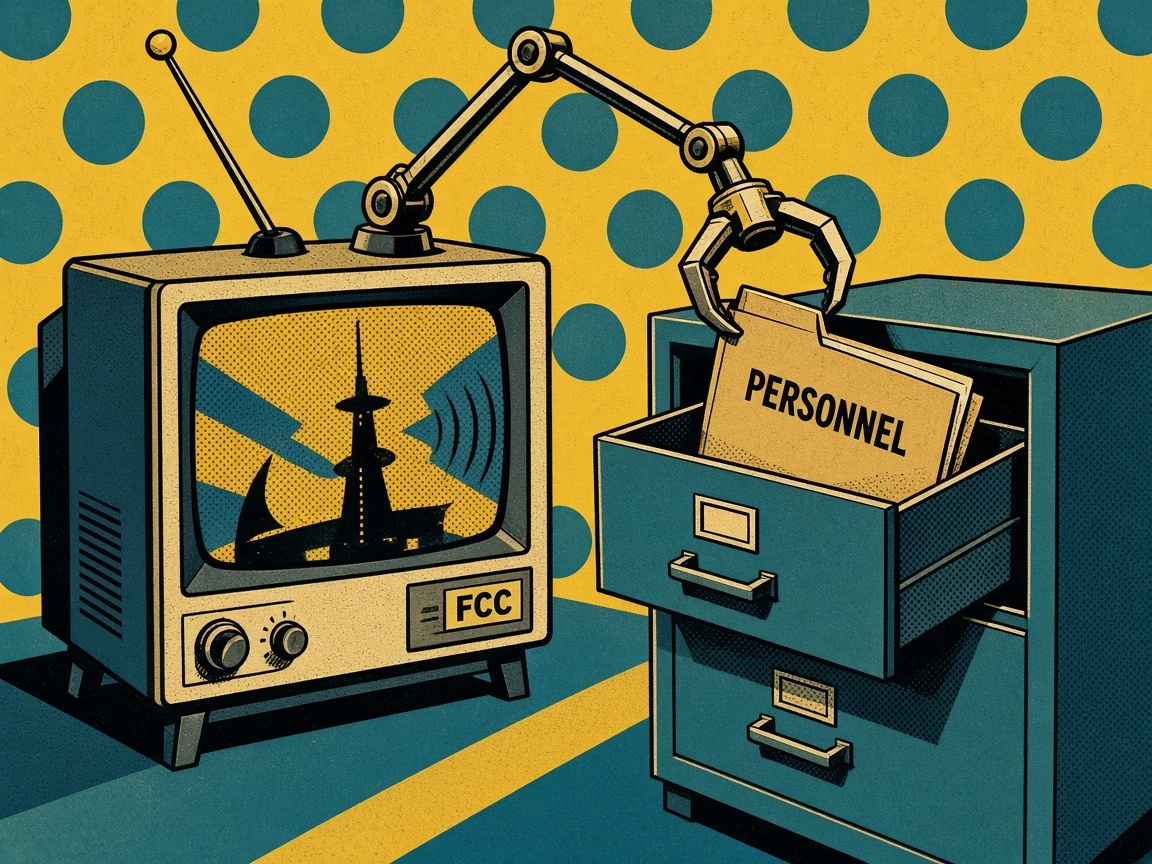
The Federal Communications Commission (FCC) licenses television stations. Does that make it Disney’s human resources department? The agency seems to think so, invoking a “public interest” mandate to investigate the company’s diversity policies—a mandate whose meaning seems to change with whoever holds power.
Under the Communications Act of 1934, as amended, the FCC has initiated early license-renewal proceedings against eight television stations that American Broadcasting Cos. Inc. (ABC), a subsidiary of The Walt Disney Co., owns and operates. ABC sued to challenge those proceedings on First Amendment grounds in American Broadcasting Companies, Inc. v. Federal Communications Commission, now before the U.S. District Court for the District of Columbia.
The case also raises a foundational question of administrative law. Can an agency turn a broadly worded statute into a roving mandate to enforce rules beyond its jurisdiction?
The stated rationale for cutting short ABC’s standard eight-year license terms is an ongoing inquiry by the FCC’s Enforcement Bureau into Disney’s corporate diversity, equity, and inclusion (DEI) policies. The FCC contends that compliance with equal employment standards is an essential part of a licensee’s obligation to operate in the “public convenience, interest, or necessity.”
But a close reading of the agency’s motion to dismiss reveals its reliance on a public-interest standard for broadcast licensees that stretches beyond the statute’s text and seems unjustifiable in today’s media marketplace.
The ‘Public Interest’ Depends on Who’s in Charge
The Communications Act conditions both initial grants of spectrum—the airwaves used to transmit signals—and periodic license renewals on an FCC finding that they will serve the “public interest, convenience, and necessity.” Rooted in the Radio Act of 1927, this standard originally addressed technical spectrum scarcity and harmful interference. Over the decades, the FCC has repeatedly used this elastic phrase to assert authority over matters peripheral to spectrum allocation.
In its brief, the FCC relies primarily on two statutory and judicial pillars to justify its jurisdiction over Disney’s corporate hiring practices:
- Title I’s anti-discrimination declaration. 47 U.S.C. § 151 states a congressional purpose to make radio and wire communication available “without discrimination on the basis of race, color, religion, national origin, or sex.”
- D.C. Circuit precedent. Decisions such as Beaumont Branch of the NAACP v. FCC and Bilingual Bicultural Coalition on Mass Media, Inc. v. FCC have held that a licensee’s intentional employment discrimination reflects adversely on its character qualifications—its fitness to hold a broadcast license—under the public-interest standard.
A close reading of the statutory text casts doubt on this interpretation. Section 151 states the agency’s organizational purpose, directing it to ensure universal access to communications services without discriminatory barriers. It does not expressly grant regulatory authority over internal corporate employment practices. After Loper Bright Enterprises v. Raimondo, the FCC can no longer expect Chevron deference—the judicial practice of deferring to reasonable agency interpretations of ambiguous statutes—for such expansive readings of its authority.
Congress also established a comprehensive federal system for identifying and remedying workplace discrimination through Title VII of the Civil Rights Act of 1964 and the Equal Employment Opportunity Commission (EEOC). When Congress intends an independent regulatory agency to exercise overlapping employment oversight, it enacts targeted statutory language rather than relying on a generalized “public interest” standard.
The FCC’s current enforcement approach extends far beyond Beaumont Branch and arguably beyond what its holding contemplated. That line of cases tied character disqualification for license-renewal purposes to adjudicated, systemic, intentional exclusion that violated established civil rights statutes. Here, the FCC alleges “intentional discrimination” encompassing common corporate DEI benchmarks, fellowship programs, affinity groups, and creative diversity initiatives.
Ironically, cases like Bilingual Bicultural Coalition involved the FCC requiring the types of “affirmative action” programs it now labels “intentional discrimination.”
The current license-renewal proceedings illustrate the problem. By asserting that corporate diversity policies call a licensee’s character qualifications into question, the FCC turns the public-interest standard into a vehicle for shifting executive policy directives. A standard that can both mandate and forbid affirmative action programs based on who holds power is no standard at all.
This creates at least two problems. First, it disconnects what should be neutral, technical administration of telecommunications from the technical realities of telecommunications. Second, it subjects licensees to politically driven obligations that change from administration to administration, creating uncertainty for investment, deployment, and normal business operations.
Just a Routine Retaliation
In March 2025, the FCC opened an investigation into ABC’s employment practices. Its statutory hook was the Communications Act’s requirement for an affirmative public-interest finding when renewing a license. In the FCC’s telling, it is conducting an ordinary pre-renewal investigation—a routine exercise of statutory responsibility.
But that’s the problem. A broad, ambiguous “public interest” standard invites expansive uses of agency power and claims that those uses are political. ABC argues that the renewal investigation provides a pretext for retaliation.
Under D.C. Circuit precedent, a retaliation claim has three elements. The plaintiff must show that it engaged in activity the First Amendment protects, that the government took retaliatory action “sufficient to deter a person of ordinary firmness” from speaking again, and that a causal link connects the protected activity to the adverse action.
Based on the timing of the early license-renewal announcement, ABC appears to have made a prima facie case—an initial showing sufficient to proceed—that the FCC retaliated against the network for carrying speech the Trump administration didn’t like.
The FCC resists this conclusion by relying on Red Lion Broadcasting Co. v. FCC and subsequent cases. It reiterates that broadcasters hold a unique “public trust” and that “aspects of broadcaster speech have long been subject to regulation.” In effect, the FCC challenges the first element by citing cases that afford broadcasters less First Amendment protection. From that premise, it argues that ABC has no clear protection against an investigation into whether it is operating in the public interest.
The FCC also disputes a causal link between its actions and ABC’s speech. It notes that its original investigation into ABC’s DEI practices predates the most recent comments against the network by President Donald Trump and FCC Chairman Brendan Carr by about a year.
The district court will have to decide whether that chronology supports the FCC’s explanation or whether the early renewal proceedings escalate a retaliatory investigation against a longstanding perceived enemy. Which way the court will go remains unclear.
Your Rights May Depend on Your Antenna
Whatever the court decides about retaliation, the FCC ultimately relies on its broad public-interest mandate over broadcast licensees to justify this investigation. But as I’ve written previously, the “bizarre notion that radio and television broadcasters deserve fewer First Amendment protections than newspapers, websites, or cable networks is a vestige of mid-20th-century technological reasoning that has long overstayed its constitutional welcome.”
The relevant distinction is that consumers can receive over-the-air broadcasts through an antenna. Yet much of today’s digital media also travels over radio waves, from a show streamed over a home Wi-Fi network to a TikTok video delivered over a 5G cellular network. Those services don’t face the FCC’s broad public-interest mandate. Taken far enough, the FCC’s reasoning could extend Red Lion’s reduced First Amendment protection to all kinds of speech simply because it travels over a radio signal.
The Supreme Court has yet to overrule Red Lion and related precedents, which held that spectrum scarcity permits content regulation “in the public interest” that could not apply to other media.
That justification doesn’t withstand scrutiny today, if it ever did. As I wrote previously:
The fact that there can be interference if frequencies aren’t allocated doesn’t mean a government agency needs to be in charge of allocating them according to whatever they define as “the public interest” at that given time. Whether through recognizing homesteading or auctioning licenses, the government could have found ways to allocate the frequencies such that they did not interfere with one another without imposing content-based restrictions on speech.
Whatever sense the FCC’s authority over broadcast content once made, it makes very little today. Broadcasters no longer have the market power they enjoyed when viewers’ choices largely consisted of ABC, the National Broadcasting Company (NBC), the Columbia Broadcasting System (CBS), and the Public Broadcasting Service (PBS). Fox, the United Paramount Network (UPN), the Warner Bros. network (the WB), and the CW later expanded those choices.
Today, cable, satellite, and internet-video services offer stiff competition for network television. Viewers commonly access even broadcast-network programming through those services, and relatively few rely on over-the-air antennas.
The media landscape has changed dramatically since the Supreme Court considered broadcasters’ First Amendment rights in Red Lion and FCC v. Pacifica Foundation in the 1960s and 1970s. There’s no reason to keep treating broadcasters differently when they compete—and are largely losing ground—against other video services. Giving ABC fewer speech protections than the Cable News Network (CNN) because viewers can receive it through rabbit ears makes very little sense.
Censorship Is a Bipartisan Opportunity
Without its broad public-interest mandate, the FCC would look much more like the government official in National Rifle Association of America v. Vullo. There, New York’s Department of Financial Services (DFS) argued that it was merely investigating insurance brokers and underwriters it regulated for alleged violations involving products offered to the National Rifle Association (NRA) and other gun-rights groups.
The Supreme Court explained that then-DFS Superintendent Maria Vullo was free to criticize the NRA and investigate possible violations of New York insurance law. But she “could not wield her power, however, to threaten enforcement actions against DFS-regulated entities in order to punish or suppress the NRA’s gun-promotion advocacy.”
Without its broad public-interest authority over broadcasters, the FCC would likely struggle to sustain the underlying investigation it used to justify the early license-renewal proceedings. With that authority, it can engage in considerable jawboning—informal pressure backed by regulatory threats—and backdoor censorship while disclaiming any such intent. The threat of an investigation or license-renewal proceeding may be enough to get broadcasters to do its bidding.
This power invites pressure from activists on both the left and right. During the Biden administration, for instance, left-wing activists at the Media and Democracy Project challenged a Fox affiliate’s broadcast-license renewal over “election misinformation.” Broad discretion over broadcast licenses creates an opening for censorship, whoever controls the FCC. The First Amendment demands more than a commission majority’s judgment about what serves the public interest.
ABC v. FCC illustrates the risks of administrative standards without clear limits. By turning “public interest, convenience, and necessity” from a mandate to allocate spectrum into sweeping authority over corporate employment practices, the FCC claims powers far beyond the Communications Act’s text. Policymakers and courts should reconsider whether this broad authority over broadcasters can coexist with the First Amendment.
Free speech shouldn’t come up for renewal.