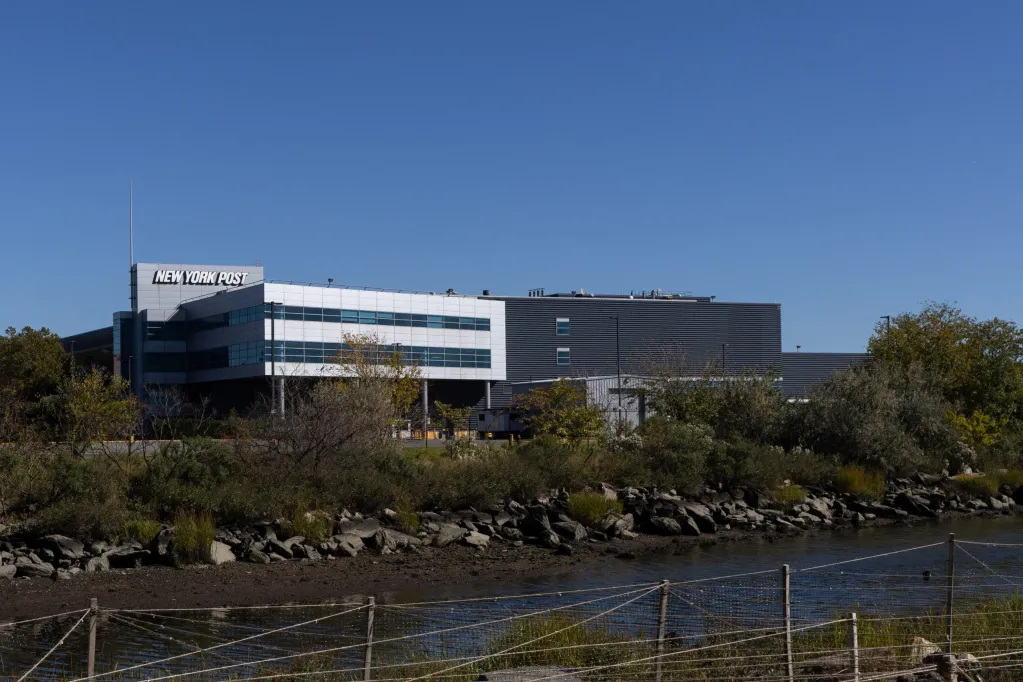
One of the largest industrial warehouse managers in the country is eyeing a massive, once-public vacant building steps from the South Bronx waterfront — raising concerns with locals who say the area is already overrun with similar businesses.
The nearly 400,000-square-foot facility at 900 E. 132nd St. served as the New York Post’s printing plant until 2021 and has sat unused since the newspaper moved its operations to Queens. For years, the company Prologis — a logistics real estate giant whose tenants include Amazon, FedEx and Home Depot — has been interested in the site, according to lobbying records, reports and locals who have spoken with the company.
In the southern-most mile of the South Bronx, surrounded by highways and expressways and filled with industrial depots, a community group rallied on Thursday against the would-be warehouse, located in Mott Haven and Port Morris — known as “asthma alley” for having some of the highest childhood asthma rates in the country.
“It’s not okay that we’re the place to bring facilities that contribute to our poor air quality,” Mychal Johnson, co-founder of South Bronx Unite, a community activist group, said at a press conference held at the site as noisy trucks passing by interrupted his speech.

Prologis through a spokesperson says there is no “final project plan” for the site, and it is only “evaluating.” But a local community group who met with the company earlier this month says it left that talk with the impression that Prologis was planning to move forward with building a warehouse site there.
That follows a 2022 report by The Real Deal that said the company was in “late-stage talks” to acquire the property at the time. The group has also spent thousands on lobbying local elected officials about the site since 2021, including as recently as this summer.
South Bronx Unite held a meeting in August with local residents and Massachusetts Institute of Technology researchers to discuss what the site could become — possibly a clean energy hub, public community center or solar energy space. The plans were preliminary but widely shared in the neighborhood, said Zoe Voss Lee, an urban planner working as a consultant with the group, so it came as a surprise when Prologis tapped them for a conversation about the warehouse earlier this month, she told The City Reporter.
Lee said that during the Oct. 9 conversation with Prologis, South Bronx Unite and the Waterfront Alliance, an environmental advocacy group, the company “essentially confirmed their plan to move forward with building a warehouse site,” and suggested it may be a part of a city program, Blue Highways, intended to reduce truck traffic.
Prologis denied that they’ve acquired the building in a statement on Monday.
Prologis spokesperson Mattie Sorrentino said the group’s claims are “inaccurate and outdated,” adding that there’s no “customer or final project plan at this time.”
“We are evaluating the site, as we do other potential projects in the region,” Sorrentino said.
Political Spending
City and state records indicate that Prologis started lobbying local elected officials about 900 E. 132nd St. in 2021 and have continued to do so through this summer, spending at least $15,000 on lobbying contracts related to those efforts in the past year alone.
In addition, last year Prologis spent over $100,000 lobbying city agencies and elected officials on last-mile special permits, a proposed zoning change that would put extra scrutiny on some new warehouses, and legislation including a bill that would regulate air-pollution from last-mile warehouses.
“A company that wanted to be a good neighbor here would not be lobbying on the rules that regulate pollution and give this neighborhood a say,” Lee said at the press conference.
“Prologis engages with policymakers on issues that affect our ability to serve customers and invest in New York,” Sorrentino said. “We believe policymakers should understand the practical effects of proposed policies on businesses and the movement of goods.”
Sorrentino added that the site hadn’t been selected for the Blue Highways program — a joint city Economic Development Corporation and city Department of Transportation initiative to move freight shipping from highways to waterways.
A Warehouse Boom
While the East 132nd Street site is partially owned by the state transportation department, a private real estate developer, Galesi Group, has controlled it through a 99-year lease since 1991, originally intended for the group to expand freight rail in New York City, according to an archived report from the State Comptroller’s office shared with The City Reporter and public property records. The rest of the site is owned outright by a Galesi-controlled company.
The site became the subject of controversy in the late 1990s when the New York State Comptroller accused the state transportation agency of mismanaging the land and leasing it to a private developer for little public benefit, according to the former Comptroller’s report.
“We question whether certain lease terms were in the best interest of the State,” the Office of the State Comptroller wrote at the time. The state DOT wrote back at the time that utilizing the space was a “major goal.”
A nearby freight rail, Oak Point Link, was built a year later, and the site has since been leased to the New York Post and FedEx in the past, but the lease is still currently held by Galesi Group, according to property records.
The site at 900 E. 132nd St., if it becomes an industrial or logistics site, would be just one of many last-mile warehouses popping up across New York City, often to locals’ dismay. Since the pandemic and its super-heated online shopping boom, companies such as Amazon and FedEx have expanded their operations in the city from the South Bronx to Red Hook, where Prologis is reportedly eyeing property, too.

The increased exhaust from diesel trucks shipping freight to and from the warehouses is a public health threat, advocates say, and a contributor to childhood asthma.
“Their industry is really critical, but how we do it, especially with residents that live around the area, is important,” Furhana Husani, a vice president at the Waterfront Alliance, a nonprofit focused on expanding waterfront access in communities like the South Bronx, told The City Reporter. “What we were a little bit concerned about was that there was no interaction with any of the residents until it seemed like a plan was already in place.”
“We recognize local concerns about potential impacts on traffic, air quality and waterfront access. We have been part of the regional business community for years, investing in the local economy,” Sorrentino said. “We have and will continue to grow relationships here and be a long-term partner.”
Our nonprofit newsroom relies on donations from readers to sustain our local reporting and keep it free for all New Yorkers. Donate to THE CITY today.
The post South Bronxites Fear Another Massive Warehouse as Logistics Giant Eyes Huge Lot appeared first on The City Reporter.