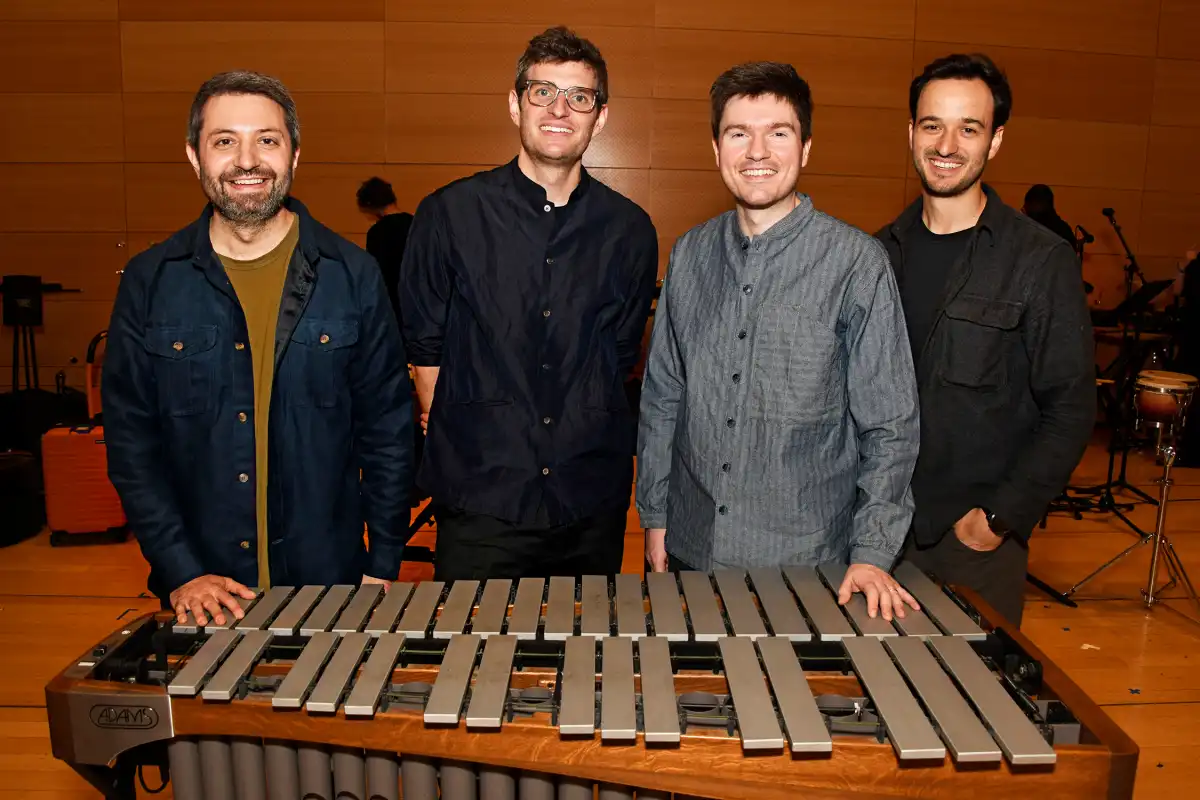
If the name Sandbox Percussion conjures up the image of a bunch of people banging on things for fun, well, you’re partly right.
The quartet, consisting of Ian Rosenbaum, Terry Sweeney, Jonny Allen and Victor Caccese, has been having serious fun with percussion music for their 15 years of existence, after having met while in graduate school at Yale. For the past 11 years, they have conducted a week-long seminar at The New School in Greenwich Village, which culminated this year in a recital in the Tishman Auditorium that included the Sandbox members with 35 students who took on the challenge of learning Steve Reich’s “Drumming,” along with nine other works.
Those pieces — by composers Molly Joyce, Julius Eastman, Joan Tower, Viet Cuong, David Crowell, Gabriella Smith, Michael Torke, and two more by Reich — involved a gamut of instruments that included vibraphones, marimbas, bongos, pieces of wood, tambourine, soda bottles, sandpaper, maracas, triangles, drums, and a few things that we’ve never seen before.
Certain works, such as Eastman’s “Joy Boy” and Smith’s “Five,” were open-ended in such a way that allowed the students to choose their own instrumentation (which explains the soda bottles).
“‘Joy Boy’ is a unique one,” explained Rosenbaum. “The score is essentially a lead sheet, with chords and some descriptions of possible sounds. No dynamics or rhythms. Every performance is completely different – those students spent the week creating an arrangement that is specific to their performance.”
As for “Five,” Rosenbaum noted that “the score is more detailed, but also requires a lot of creativity. In that one, the students chose their instruments and orchestrated the piece. All the notes and rhythms were written, but not who does what, or for how long.”


While it seems daunting to learn so much music in a week, Sweeney admits that it certainly is.
“The biggest challenge is the pace,” he says. “The students arrive and are placed into groups, then learn and prepare the music in just six or seven days. Some of these works are technically demanding, but they also require thoughtful musical decisions and a shared interpretation. It’s remarkable to watch the students build that level of ensemble trust and understanding in such a short amount of time.”
Student Bailey Yerdon concurs: “The hardest part about learning these pieces for me was the unique techniques that were used throughout the compositions. In Reich’s ‘Drumming,’ a technique called phasing is used to move between sections of the work. Additionally, in Cuong’s ‘Sandbox,’ the use of sandpaper, wood slats, and a diving board mallet technique all needed to be mastered in order to perform the work successfully. These skills were hard to perfect in a week’s time, but I think we were very successful in our final performances.”
“Drumming,” the longest piece in the recital, was taught to the participants in the way that Reich originally taught it to his players.
“There is a score that is written down,” Rosenbaum explains, “but the way that we were taught this piece and the way that we’ve heard Steve talk about how he taught it to his ensemble, there’s an oral tradition around this piece. So we’ve been teaching it to the students by rote. Every day we showed them a little bit more of the piece, and by the end of the week, we’re all going to play it and none of the students will have ever looked at the hour-long score.”
“Even though it’s a complex piece,” Sweeney notes, “that process encourages deep listening, collaboration, and a real sense of community. It’s a reminder that music is ultimately about people connecting with one another.”


Reich’s music was chosen as the focal point this year for some very specific reasons.
“Steve Reich, of course, is such a towering and instrumental figure in the percussion world because he was one of the first composers to write chamber music that featured percussion in a really meaningful way, not as a sound effect or in the back of the orchestra or something like that,” Rosenbaum says. “For Sandbox, it was key to the formation of our group. Some of the very first pieces that we played were by Steve Reich. So he’s turning 90 in the fall and we’re using that occasion as an excuse to celebrate him, as well as look at a whole bunch of composers who have come after him, whose own work is directly inspired by him.”
While Sweeney agrees that “the program grew out of our desire to celebrate Steve Reich and the enormous influence his music has had on percussion repertoire over the last several decades,” he adds that “Sandbox selected the rest of the program by balancing artistic goals with the experience level of the performers attending the seminar. We want the music to be challenging and inspiring, while also giving students the opportunity to succeed and grow over the course of the week.”
The composer made himself available for a teleconference with the students during the week, which they found inspiring.
“Reich talked a lot about valuing what is important to you and never losing your voice,” participant Paulina Petras mentions. “It’s not something I didn’t know before, but it’s something that I think classical musicians we often forget about. We’re taught to follow certain aesthetics and standards to a point that sometimes we forget that the thing that draws people to music is the fact that it’s shaped by human experiences and emotions.”
Although the concert was long, it never lagged and was wonderful from start to finish. The program was full of variety and the playing was never less than exemplary.
“I was entranced by this,” said Lawrence de Martin, who has made a living in recording and sound design. “I’ve recorded a lot of percussion ensembles and it was hard to tell the difference between these students and the pros.”
Sweeney couldn’t be happier with the concert.
“The performance was wonderful,” he said. “The students rose to the occasion and delivered a program they should be proud of. Closing concert day is always demanding – there are many pieces to rehearse and soundcheck, and a lot happening behind the scenes, but navigating that pressure is also an important part of the experience. The students remained focused, professional, and supportive of one another, and the result was a joyful and compelling performance.”
Another audience member, Louise Spence, put it quite simply when she proclaimed, “The whole afternoon was wonderful.”
Info about the Sandbox Percussion can be found at sandboxpercussion.com and on Instagram at @sandbox_percussion.
