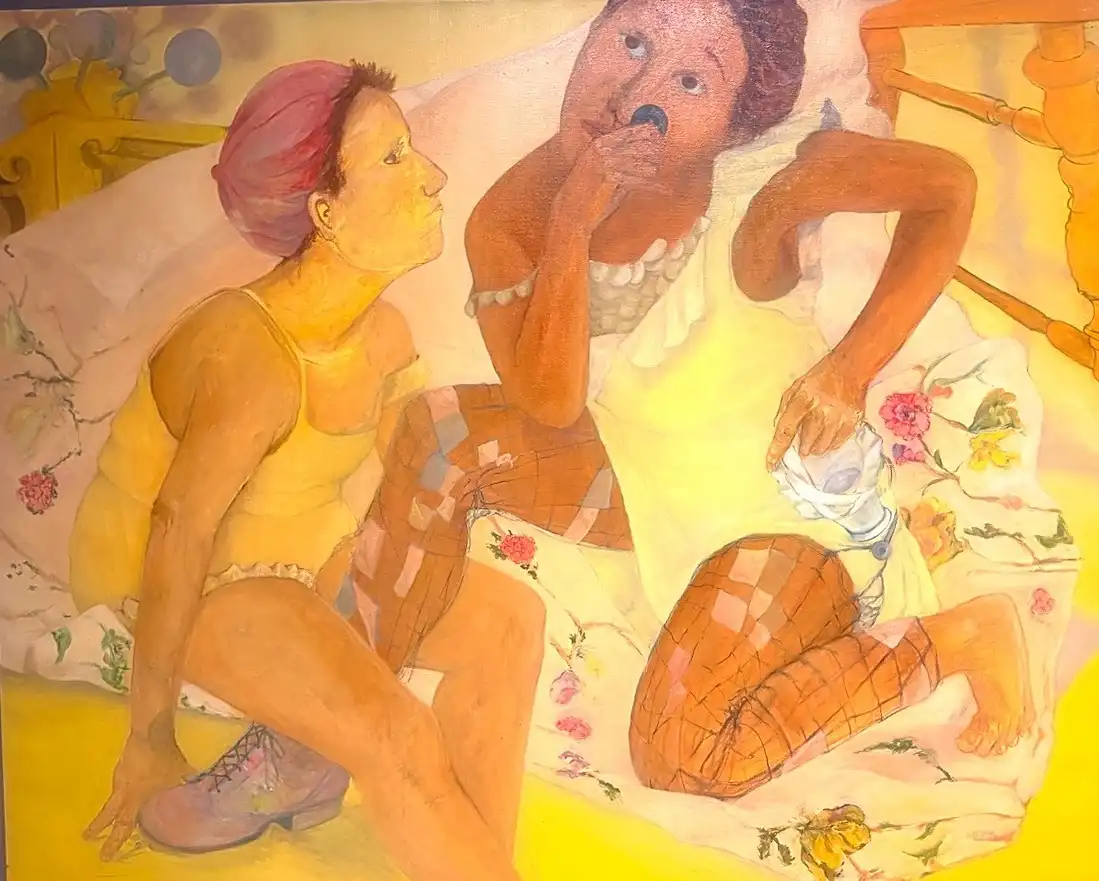
An American child arrives in the middle of a history she has to learn by feel. In the very rooms she is learning to trust, racism can make itself known in who is permitted to use force, whose hurt commands attention, and what it can cost to tell the truth about someone she loves. All the while there is the astonishing pleasure of finding out what her own body can do and how much of a world she can make with a doll. What moves me in Philemona Williamson’s paintings is the perseverance of that curiosity in children who have already had reason to be vigilant.
In Suspicious Touch (2024), the pink and blue have the persuasive softness of colors chosen for a nursery. Then I come to the ghostlike white hand laid across the mouth of the figure I read as a mother, and realize how readily I granted the gesture the benefit of its surroundings. Williamson has spoken of the painting in connection with a baby’s first skin-to-skin contact with its mother and the final touch of someone we love. I keep looking at how much intimacy the hand has at its disposal for an act of force that scarcely needs more room than a caress.
In Branching Eyes (2023), a figure in an impudent pink tips headfirst through a blue-green wood where there are eyes in the branches and the trees show through some of the children. The floating figures and the use of color as an arsenal of emotion bring Chagall to mind. In Birthday (1915), he twists in the air to kiss Bella above a floor as red as the feeling that has lifted him. In Williamson, I feel the dream change while the figure is still in the air.

Williamson paints directly onto the canvas, revising figures and compositions as she goes and photographing what she has done at the end of the day. She called the adolescent body “an intense crucible of passion and mystery” in the statement for her 2024 exhibition Recent Paintings at June Kelly Gallery. A partially painted-out figure can still be seen beside the one that took its place, so the scene has already lived through several versions of itself by the time I arrive wanting to know what happened.
At Bennington, which Williamson entered in 1969, Color Field painting held considerable sway, and she pursued the figure there with an independence I find rather bracing. An encouraging studio visit from Romare Bearden in 1988 preceded her solo exhibition at the Queens Museum of Art. Bearden had helped form Spiral in 1963 as Black artists considered how they might contribute to the civil rights movement. In his six-panel Harlem collage The Block (1971), the lives glimpsed through windows have as much claim on the eye as anything happening on the street.
Some six million Black Americans left the South during the Great Migration between 1910 and 1970, and in Williamson’s family that history has a particular address on Sutton Place. Her father, James, came from North Carolina and cooked and drove for the Greek-American Ladas family. Her mother, Mamie, came from South Carolina and kept house and cared for the children. They lived with their employers, and the older daughters asked young Philemona about their love lives and what to wear. There is a particular education in being taken into the confidence of the people whose household your parents are paid to look after.

Against the flush of pink in her self-portrait Here I Hold Becoming (2020), Williamson clutches a doll in a maid’s uniform and carries another figure across her back. My eye stays with the shoulder under that weight. A child can be deeply wanted in a room and already be learning how much of herself people expect her to put at their disposal.
In Red Buckled Shoe (2014), a girl lies across a field of blue holding a topsy-turvy doll, with a Black child at one end and a white child at the other. I think of the separate dolls Mamie and Kenneth Clark used to ask Black children which looked like them and which they thought were nice or bad. The Clarks’ research helped bring the psychological effects of school segregation before the Supreme Court in Brown v. Board of Education (1954). Williamson gives the girl time to hold the doll and keep her own counsel.
Two children cling to each other near the center of Faith Ringgold’s American People Series #20: Die (1967), with blood on the good clothes of the adults around them. Ringgold drew on the composition of Picasso’s Guernica, which she studied at MoMA, to give the racial violence of American streets the scale of a history painting. The children’s embrace is the gesture I understand most quickly. There is a hope in it that someone might hold you long enough for the danger to pass.
In the letter that prompted A Patient Spirit (2022), a family friend recalled a boyhood fishing trip with Williamson’s father, who told him to hold still when hornets swarmed. I think of James beside that frightened child when I return to the pale hand at the mother’s mouth. To be held and to be held in place can look devastatingly similar. There is still all that pink and blue, and I want the woman to be able to move the hand away and decide, in her own time, how much of the story she wants to tell.
For more information, visit junekellygallery.com.