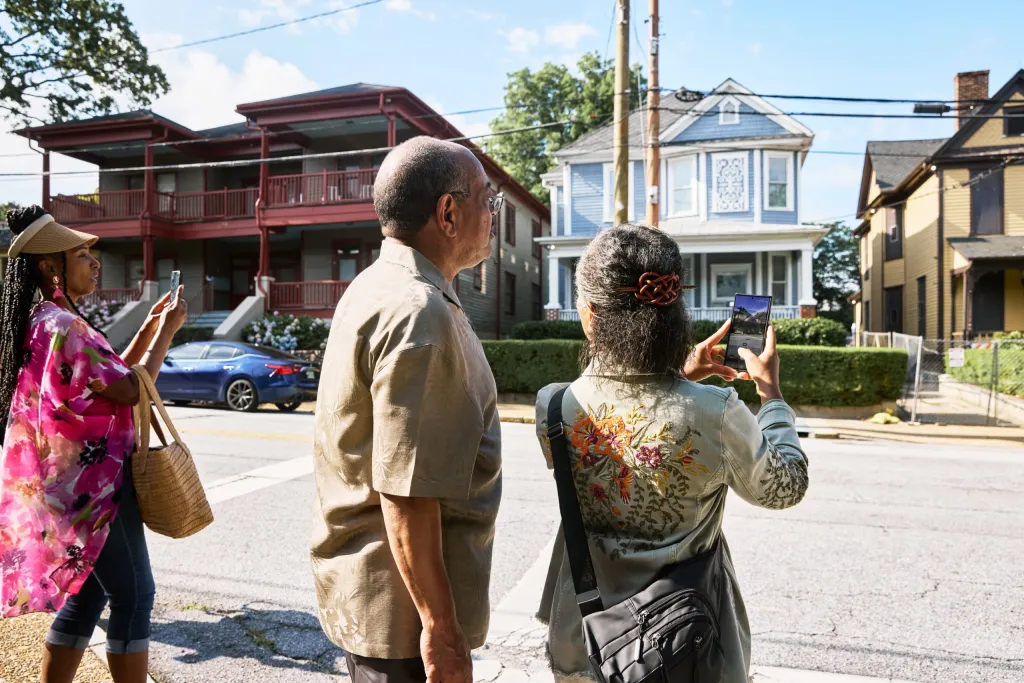
As an English trainer in 2016, I spent a summer time within the archives of the Brooklyn Historic Society studying about abolition and ladies’s suffrage efforts. I held authentic payments of sale of younger Black women from the 1840s in my arms, and I left impressed to show highschool juniors in regards to the legacy of enslavement.
One other summer time, I checked out 160-year-old whip indentations on the perimeters of dwell oak timber in Savannah, Georgia, as I discovered how the Gullah/Geechee individuals have protected their African linguistic, culinary and religious traditions for the reason that time of enslavement, on account of their relative isolation within the Sea Islands off the coasts of Georgia and South Carolina. NEH summer time trainer institutes helped me discover how Black individuals have fought to carve a future for themselves.
I had these alternatives due to the Nationwide Endowment for the Humanities (NEH), which helps universities and museums throughout america in creating programs for Ok-12 academics wherein they study historic ideas they’ll take again to their school rooms.
The institutes gave me hands-on experiences and much more context for books on the American literature checklist, like “Narrative of the Lifetime of Frederick Douglass.” I worry different academics won’t obtain such alternatives, as these transformative applications are actually at risk.
Associated: Lots goes on in school rooms from kindergarten to highschool. Sustain with our free weekly publication on Ok-12 schooling.
Alongside a collection of drastic cuts, the NEH has introduced funding for a brand new spherical of grants linked to extra conservative pondering, and NEH’s web site not too long ago introduced that it’s only enthusiastic about “U.S. historical past extra typically.” It famous that NEH-funded applications can’t promote a selected ideological standpoint or “choice some teams on the expense of others.”
Gone are widespread race-based trainer teaching programs similar to “Crusing to Freedom: New Bedford and the Underground Railroad” and “The Immigrant Expertise in California Via Literature and Historical past.”
The Division of Authorities Effectivity (DOGE) has slashed NEH’s $210 million finances and redirected that cash for the federal authorities’s proposed Backyard of Heroes, the place future guests will stroll by way of lush lawns to see up at 250 life-size sculptures.
The irony? One of many Individuals slated to be featured within the Backyard of Heroes is Araminta Ross, mostly often called Harriet Tubman. Even when her likeness is created with a hammer and chisel, the U.S. authorities has been quietly undermining the historical past she represents by eradicating funding for individuals to find out about a number of the very individuals it hopes to carve into monuments. Honoring her with a statue means little if we concurrently erase her from school rooms and public reminiscence.
Associated: How will we train Black historical past in polarized occasions? Right here’s what it seems like in 3 cities
Some state legislatures and native college boards all through the U.S. are taking cues from the federal authorities by curbing discussions of race and Black historical past in school rooms, beneath the guise of avoiding “divisive subjects” or defending the consolation of white kids. Academics in these districts will not have entry to federally or state-funded skilled studying about extra expansive histories, although academics like me can attest to how the federally funded NEH summer time institutes helped us deepen our college students’ understanding of historic occasions.
These cuts and modifications are misguided and harmful. They erase the varied and complicated historical past of america, undermine democracy by way of silencing marginalized voices and misinforming the general public, and hurt Black and Latine college students by way of a scarcity of illustration of their curriculums. Additionally they doom future generations to repeat errors of the previous, as a result of if we don’t study in regards to the harms of anti-Black constructions like Jim Crow, redlining and mass incarceration, we danger reincarnating these legacies beneath completely different names.
Within the absence of NEH assist, we should discover our personal methods to complement college students’ understanding. Academics — significantly Black academics — have lengthy discovered methods to indicate their college students the worth of comprehending complicated histories in order that we will shift from a public that earnings from Black struggling to 1 that invests in Black life.
As a analysis scholar, I examine how Black academics who train social justice typically discover themselves instructing fugitively, using subversive methods of speaking about histories which are ignored or erased in mainstream instructing. Professor Jarvis Givens framed this idea in “Fugitive Pedagogy.” He opens the e book with the story of historical past trainer Tessie McGee, who in 1933 was instructed by Louisiana’s all-white Division of Schooling to show from the mandated curriculum, which was required to be brazenly displayed on her desk. As a substitute, McGee typically taught passages from a e book hidden in her lap. That e book was by Carter G. Woodson, the daddy of Black historical past.
Because the federal authorities continues eradicating funding, we search for hope and resistance. Final summer time, a number of of the reduce NEH trainer summer time institutes both rallied for personal funding or taught their seminars just about, refusing to let the federal authorities erase these histories. As we speak, educational teams, together with the American Historic Affiliation, are preventing the NEH finances cuts within the courts.
Constructing monuments isn’t an alternative to accountability. A statue can’t train or encourage progress, however schooling, particularly the story of Black resistance practices, can do each.
Historic figures like Harriet Tubman don’t simply want monuments; they want individuals to grasp why they’re monumental.
Jessica Lee Stovall is an assistant professor of African American Research on the College of Wisconsin, Madison, and the director of The SoulFolk Collective.
Contact the opinion editor at opinion@hechingerreport.org.
This story about instructing Black historical past was produced by The Hechinger Report, a nonprofit, impartial information group centered on inequality and innovation in schooling. Join Hechinger’s weekly publication.
The put up OPINION: Academics are being disadvantaged of possibilities to study Black historical past and convey classes again to the classroom appeared first on The Hechinger Report.
