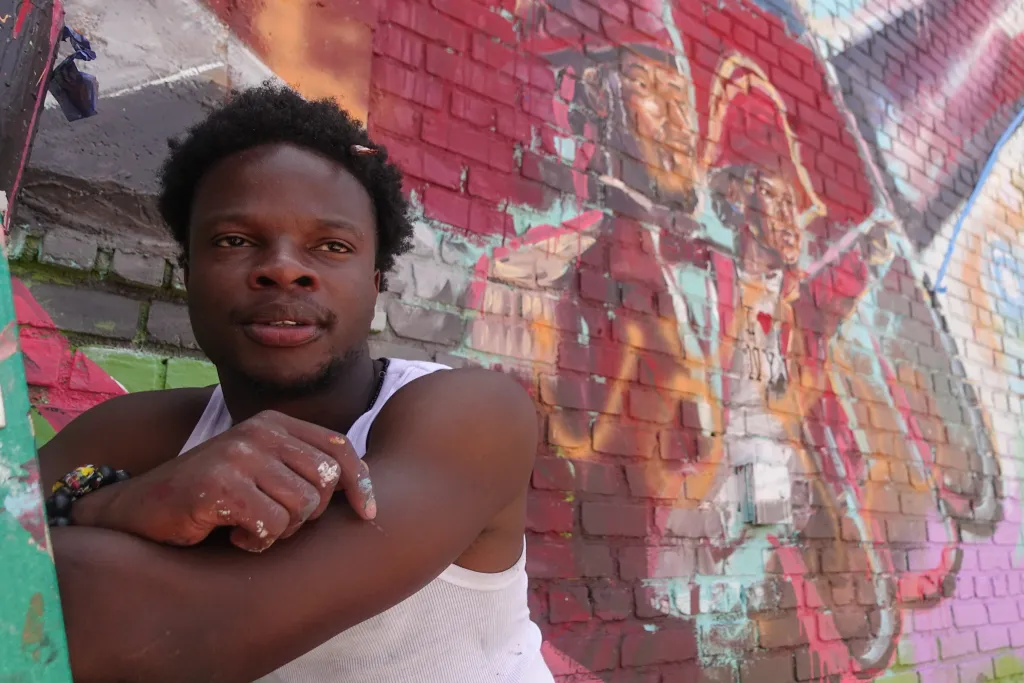
As the U.S. Supreme Court ruling came down ending Temporary Protected Status for Haitian and Syrian immigrants Thursday morning, Doudgy Charmant was painting a mural honoring Haitian heritage at the corner of Newkirk and Nostrand avenues in Flatbush, Brooklyn.
The 27-year-old told The City Reporter he had immigrated to the United States as a child with TPS — a humanitarian immigration status that allows holders to stay and work in the country. He now has a green card, but many of his family members still rely on TPS to avoid deportation. The court’s ruling would upend their lives, he feared.
“They are lost. They’re wondering, ‘What is next?’” he said. “We are hurting.”
“We came here for a better opportunity. Living is all that we seek,” he said.
The Supreme Court’s ruling allowed the Trump administration to end TPS for an estimated 330,000 Haitians across the country. In the coming days, they will no longer have legal status to remain in the county or authorization to work here, and could face potential deportation. TPS for Haitians first went into effect in 2010, in the aftermath of a devastating earthquake that killed an estimated 220,000 people and wounded and displaced many more. It’s been extended continuously by presidential administrations ever since.
The court’s decision also ended protections for around 6,800 Syrian immigrants living in the United States.
New York State is home to an estimated 40,000 Haitian TPS holders, and the ruling swiftly sent shockwaves across New York’s Haitian community, the heart of which lies in Flatbush’s Little Haiti along Nostrand Avenue, renamed Toussaint L’Ouverture Boulevard in 2018 after the Haitian revolutionary.
Haitians who rely on TPS could potentially find other legal routes to remain in the country, like trying to adjust their status through a U.S. citizen relative or applying for asylum. But these avenues have also become increasingly perilous under the Trump administration’s immigration crackdown, with ICE agents targeting immigrants for arrest inside immigration courts as well as those attending appointments with USCIS.
“I’ve got to figure out now that the shoe has actually dropped,” said Pascal Antoine, the station director of Dodor Vibe, a Haitian community radio station on Nostrand Avenue that doubles as a community center offering tax prep, translation, real estate services and English classes.

For weeks Antoine said he’d been fielding questions from residents about what to do if TPS ended, and he’d just been telling them to be patient. As the news came down, Antoine said he was at a loss as to what to say.
“I got to do a little research myself and I got to figure out exactly what to tell people because they’re going to start coming in,” he said. “They’re gonna start asking questions.”
Herold Dasque, a community liaison for Haitian-Americans United For Progress, Inc., a local nonprofit, said he had a more dire warning.
“Prepare themselves to leave the country because there’s not a fight. There’s nothing else to tell them,” Dasque said.
“Don’t let yourself be deported or put yourself in a situation where you’re going to be placed in prison or kept indefinitely,” he added. “You have no work permit. You are illegal. They can arrest you, put you in jail, and you don’t know when you will be released.”
The Supreme Court decision split 6-3 along ideological lines, and is the first ruling from the top court on the Trump administration’s efforts to end TPS for many countries who had the designation. Now, TPS could end for immigrants from around a dozen countries that still have the protection.
The court had previously sided with the administration’s effort to end TPS for Venezuelans on the so-called shadow docket, without a full explanation of the ruling. Around 605,000 Venezuelans will lose TPS later this fall, even as two earthquakes in quick succession this week created further instability in a nation that’s suffered from years of economic and political turmoil.
President Donald Trump’s Department of Homeland Security, which has been attempting to end TPS for immigrants from Haiti and other countries since shortly after Trump took office last year, championed the Supreme Court’s ruling.
“NOT TIRED OF WINNING,” the Department wrote on X. “Temporary Protected Status is meant to be TEMPORARY.”
Last fall, then-DHS Secretary Kristi Noem “determined that Haiti no longer met the conditions” required for the TPS designation and allowed the protection to expire this past February instead of extending it. DHS has broad authority to issue TPS protections to immigrants from countries experiencing the fallout from armed conflicts or natural disasters.
Despite Noem’s finding, the U.S. Department of State still warns against any visits to Haiti, deeming it Level 4, the highest possible threat level for U.S. travelers, due to “kidnapping, crime, terrorist activity, civil unrest, and limited health care.”
Jessica Bansal, an attorney with the National TPS Alliance, said the ruling will take effect in the coming days, though the exact timeline is still unclear.
On Thursday afternoon, the healthcare union 1199 SEIU convened an impromptu press conference to condemn the ruling with immigration advocates, Attorney General James, Mayor Zohran Mamdani and Gov. Kathy Hochul.

Hochul said the Trump administration’s immigration crackdown would “cripple” the state’s healthcare system with many TPS holders working as home health aides and as nursing staff in hospitals, though the union could not say how many of its members have TPS status or come from either country impacted by Thursday’s executive order.
About 25,000 TPS holders are in the state’s work force, adding an estimated $800 million in annual economic contributions and $280 million in federal, state and local taxes, often as caregivers, nursing assistants, mechanics, security guards, and hotel cleaning staff, according to estimates by the policy group FWD.us.
Mamdani said the city is working to understand the implications of the ruling and urged New Yorkers who need legal assistance to reach out to the Mayor’s Office of Immigrant Affairs legal hotline.
1199 SEIU member Sandra Britto, a patient care technician at NewYork-Presbyterian Lower Manhattan Hospital, condemned the high court’s “inhumane decision.”
“This ruling is going to create terrible suffering to my Haitian people, who are only here striving to do better,” she said, as she emotionally invoked the image of earthquake survivors with no home to return to.
“We are not criminals,” she said. “We are law-abiding human beings.”
Back on Nostrand Avenue, clothing vendor Melissa Denaud, 41, said the Supreme Court ruling had broken her heart. She just had a client pass by who had told her she was getting let go from her job because her work authorization was tied to her TPS status. Denaud had immigrated from Haiti over a decade ago and had legal status, though she felt for friends and family with TPS.
“Even if you have papers, you have family, you have friends. It’s the same blood, you know,” she said. “I can’t help them, you know. We can’t do anything about that.”
Our nonprofit newsroom relies on donations from readers to sustain our local reporting and keep it free for all New Yorkers. Donate to THE CITY today.
The post NYC’s Haitian Community Reels in Wake of Supreme Court TPS Ruling appeared first on The City Reporter.