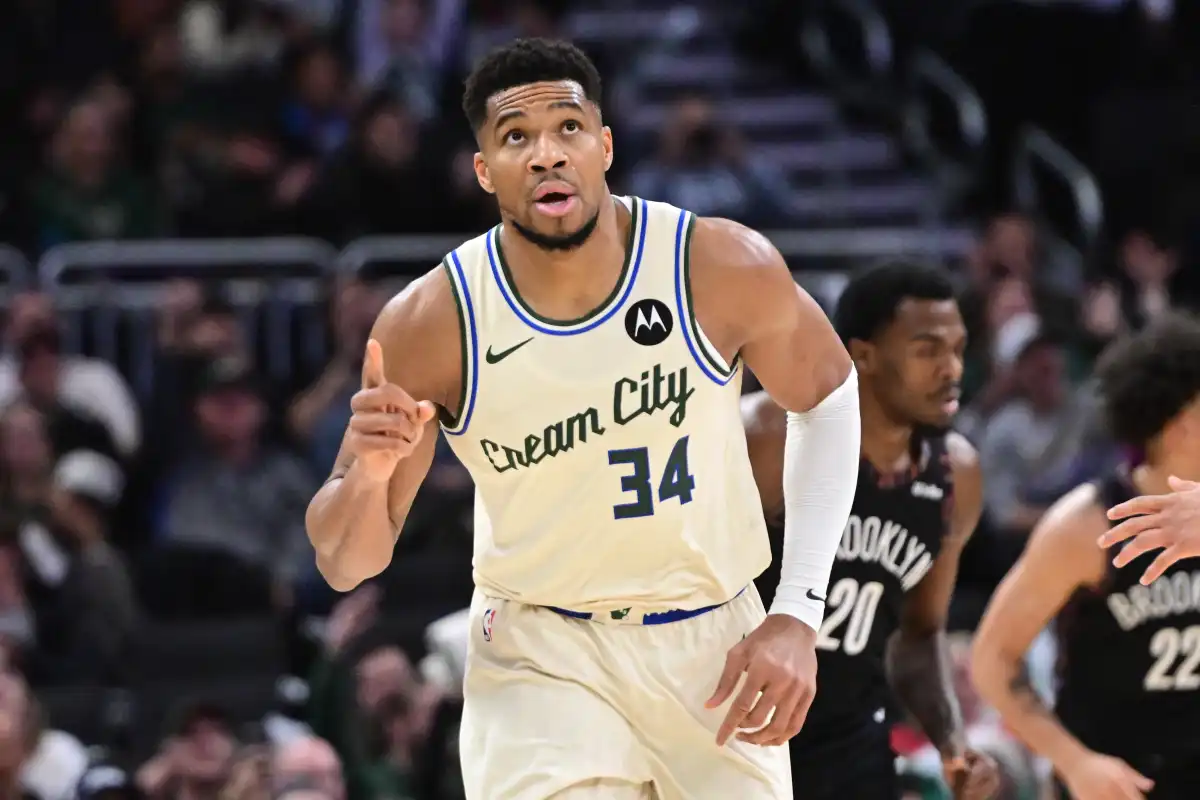
Who would’ve thought the New York Knicks would completely change the landscape of the NBA? After winning the 2026 NBA Finals, the Knicks obviously won’t be making any franchise-altering moves. Simply, it can go down as a true “what if?” because, if the Knicks hadn’t won the NBA Finals, they would have likely pushed the chips into the center of the table to go “all-in” for Giannis Antetokounmpo.
Instead, Antetokounmpo is headed to Miami to join the Heat after a blockbuster late Monday night.
Over the last two seasons, the Knicks had been the rumored destination for Antetokounmpo, who’d grown tired with the Bucks and quietly wanted out, no matter what he claimed to the media. New York was a preferred destination for Giannis, and Leon Rose was rumored to be in contact with Milwaukee in February at the trade deadline. The package likely would’ve been centered around Karl Anthony-Towns, along with several other players and potential picks. However, the Knicks decided they didn’t want to completely destroy their team chemistry by keeping their rotation the same, which led to their first championship in 53 years.
Owner James Dolan already hinted last week that the Knicks likely won’t be pushing over the second apron — meaning decisions will have to be made.
For the Knicks, here is a blueprint for restructuring their roster to remain championship contenders.
What is the “second apron,” and how does it affect the Knicks?
The second apron is the most punitive luxury tax spending threshold in the NBA’s Collective Bargaining Agreement (CBA). The apron is designed to prevent high-spending teams from hoarding talent, imposing strict roster-building penalties rather than just a financial fine. For the upcoming 2026–27 season, the second apron is projected to sit at $222 million. If a team’s total salary exceeds this line, they lose almost all flexibility to improve their roster, along with penalties such as:
- No aggregating salaries
- Frozen draft picks
- No free agent exceptions
- No cash or trade exceptions
The Knicks are projected to sit roughly $13 million below the second apron. Because keeping the entire championship roster together would push them well over the line, the team will likely have to part ways with key rotation players like Mitchell Robinson and Landry Shamet, meaning significant changes to the Knicks’ depth.
However, for the Knicks, there is good news. The entire starting five is already locked into contracts for at least two more seasons. Dolan’s statement that the team won’t go above the second apron signals that the core will remain fully intact, meaning they must get creative to improve their depth.
How to utilize their draft picks in 2026
Even after trading five first-round picks in the summer of 2024 for Mikal Bridges, the Knicks still hold draft capital in 2026. They hold the rights to the No. 24, No. 31, and No. 55 picks. With one of the most loaded draft classes in recent memory, here’s how the Knicks can completely reshape their bench depth.
No. 24: Meleek Thomas — Arkansas
Meleek Thomas is the perfect fit for the Knicks at No. 24, due to the need for cost-controlled shooting to space the floor when Jalen Brunson sits. Thomas is one of the most lethal movement shooters in the 2026 class, averaging 15.6 PPG while shooting 41% from beyond the arc. Selecting Thomas also gives the front office a locked-in, inexpensive four-year rookie contract. He provides immediate “microwave scoring” and secondary creation off the bench at a fraction of the cost of a free agent.
No. 31: Zuby Ejiofor — St. John’s
Re-signing Mitchell Robinson is highly unlikely due to a scarcity of centers driving up his market price. This makes drafting Zuby Ejiofor a strategic and necessary alternative for the Knicks. Though some critics consider Ejiofor undersized, his physical strength and relentless defensive motor speak for themselves. He averaged 7.3 rebounds per game during his 2025–26 collegiate campaign, proving he has the tools to absorb heavy contact and clear out space on the glass. Selecting Ejiofor at No. 31 carries unique financial value under the CBA. Unlike first-round scales, second-round picks can be signed using the Second-Round Pick Exception. This allows the front office to secure Ejiofor on a highly team-friendly, multi-year deal without touching their limited mid-level exceptions, preserving precious room under the punitive $222 million second apron.
No. 54: Dillon Mitchell — St. John’s:
Losing Mitchell Robinson puts a gaping hole in the Knicks frontcourt, something they already experienced this season anyway. Adding Dillon Mitchell, along with Ejiofor, who both shared the same court in college at St. John’s, gives the Knicks excellent depth. Ejiofor acts as the direct, pro-ready rim protector, while Mitchell serves as a high-upside developmental piece who can absorb rotational frontcourt minutes. Mitchell is a hyper-athletic, versatile forward with elite lateral quickness, allowing him to play consistent defense across the entire court. Drafting both players allows the front office to replace Robinson’s production for a fraction of the price.
The future of the following Knicks
Several players will be extension-eligible ahead of next season:
- Tyler Kolek (as of Jul. 6)
- Deuce McBride (as of Jul. 6)
- Karl-Anthony Towns (as of Jul. 6)
- Jose Alvarado (as of Aug. 6, if player option is exercised)
- Josh Hart (as of Aug. 10)
Expected free agents:
- Mitchell Robinson (full Bird)
- Landry Shamet (Early Bird)
- Mohamed Diawara (restricted; non-Bird)
- Jose Alvarado (player option; full Bird)
- Jordan Clarkson (non-Bird)
Karl-Anthony Towns (2027-28 player option) and Deuce McBride stand out as the most pressing cases, set to hit free agency in 2027, while also being top-seven members of the Knicks rotation. Josh Hart can also enter free agency next summer, but New York holds a team option for him in 2027-28. McBride has earned himself four additional years and at least $90 million, a figure the Knicks should aim to reach to have a valuable bench option behind OG Anunoby and Mikal Bridges. For KAT, his extension would be towards the league’s max: a four-year $273 million deal if he were to decline his 2027-28 player option.
If anything, his eligibility for extension is the most urgent. Towns is currently on the books for $57.1 million in 2027-28. If he declines his option and the Knicks give in for the full four-year deal, which takes him through his age-35 campaign, he may be willing to lower his annual average in exchange for the extension.
As for the Knicks’ free-agent options, it may be nearly impossible to bring back Mitchell Robinson and Landry Shamet, both of whom are playing themselves into better future situations. Robinson stands among the top centers on the market, a potential starter for a team like the Lakers. As for Jose Alvarado, the Knicks will have about $17.5 million in room under the second apron, but that only includes eight players under guaranteed contracts, plus their No. 24 pick. Out of all their free agents, it would be most likely that they bring back Mohamed Diawara and Alvarado, both of whom would make an impact off the bench.
What the 2026-27 Knicks could look like
Starting rotation:
- Jalen Brunson
- OG Anunoby
- Mikal Bridges
- Josh Hart
- Karl Anthony-Towns
Bench:
- Miles McBride (extend)
- Jose Alvarado (re-sign)
- Meleek Thomas (select no. 24)
- Mohamed Diawara (re-sign)
- Zuby Ejiofor (select no. 31)
- Dillon Mitchell (select no. 54)
- Pacome Dadiet
- Tyler Kolek
- Taurean Prince (Vet min)
It should be known that the Knicks won’t be making any big-time moves. There’s zero point to do so; they’ve proven under Mike Brown that this roster can not only compete, but it can do so at a dominant level. On their championship run alone, New York totaled the best point differential in playoff history in +283, holding a 16-3 record (third team to win a championship this way), and completing all four closeout wins on the road(fourth team to do so) The most impressive part came during the Finals, when the team completed the biggest comeback in NBA Finals history, along with the third-biggest and fifth-biggest, all in the same series.
Jalen Brunson has silenced all the haters, OG Anunoby has shown he can be a legit option, Mikal Bridges has been efficient as ever, and KAT can play defense. As for the Knicks’ bench, the world isn’t over if Mitchell Robinson and Landry Shamet walk in free agency for better opportunities; the Knicks hold the draft capital to rebuild their roster.
For more on the Knicks, visit AMNY.com